
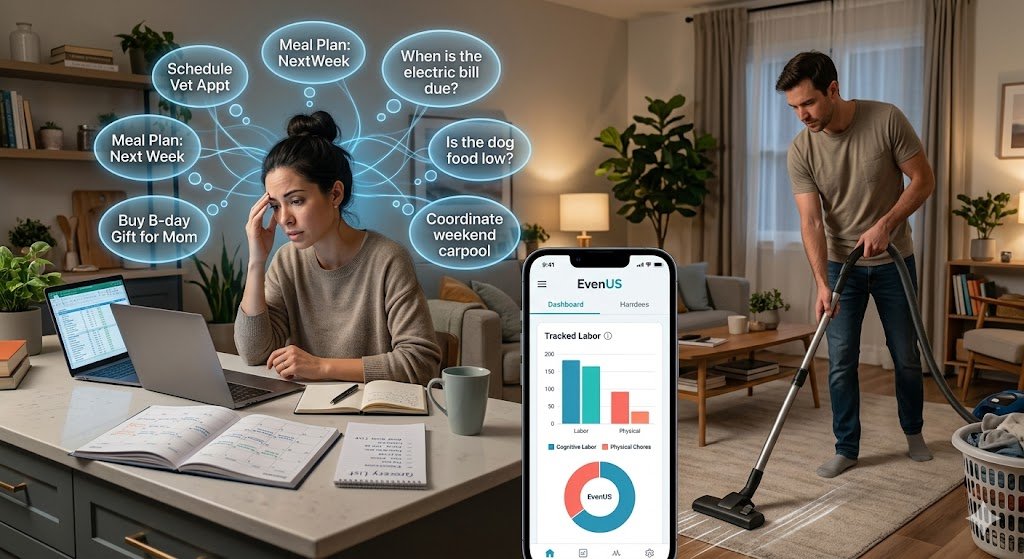
Cognitive Labor vs. Physical Chores – It is a familiar scene in households everywhere: A couple is arguing on a Saturday afternoon. Partner A throws their hands up and says, “I don’t understand why you are so stressed! I cooked dinner, I took out the trash, and I vacuumed the living room. I did my half of the work!”
Partner B is sitting at the kitchen island, staring at a calendar, a stack of mail, and a half-written grocery list, feeling completely unseen and exhausted.
Partner A isn’t lying—they did complete those physical tasks. So why does the 50/50 split feel so painfully unbalanced? The math doesn’t add up because couples are usually only measuring half of the equation. They are keeping score of the physical output while completely ignoring the mental input.
To achieve a truly balanced partnership and stop the endless cycle of chore-related resentment, you have to understand the fundamental difference between cognitive labor and physical chores. More importantly, you need a system that tracks both.
Defining the Terms: Execution vs. Management (Cognitive Labor vs. Physical Chores )
If you want to fix an imbalance in your relationship, you need the right vocabulary to talk about it. Household work is strictly divided into two categories: execution and management.
Physical Chores (The Execution) Physical chores are the tangible, visible actions that take place in the physical world. This is the execution phase. It includes sweeping the floor, scrubbing the toilet, folding the laundry, and driving the kids to school. Physical chores are easy to see, easy to measure, and easy to check off a list.
Cognitive Labor (The Management) Cognitive labor—often referred to as the mental load or invisible labor—is the behind-the-scenes management required to make the physical execution possible. It is the anticipating, planning, organizing, and decision-making.
Cognitive labor is noticing that the dog’s food is running low, researching the best price, and adding it to the grocery list. It is the complex gymnastics of managing a family’s social and educational calendar—like figuring out how to politely request that your twins be placed in different class sections next year, or remembering to sign a six-year-old’s daily reading log before the bus arrives. It is the silent, rolling math of household budgeting and tracking which partner paid for the last three grocery runs.
Physical labor is doing the work. Cognitive labor is knowing what work needs to be done.
The Danger of Only Tracking Physical Chores
For decades, the standard advice for couples arguing about housework has been to “make a chore chart.” Today, that usually translates to downloading a basic shared to-do list app.
These traditional methods are fundamentally flawed because they only track physical execution. When you rely on a system that only measures physical chores, you inadvertently create a dynamic that rewards the “executor” and punishes the “manager.”
We call this the “Gold Star Syndrome.” When a partner gets to check a satisfying box for “taking out the trash,” they receive a psychological gold star. They feel productive. But the other partner gets zero credit for the three hours they spent auditing the family finances, planning a week of nutritious meals, and scheduling dental appointments, because those tasks don’t fit neatly onto a whiteboard.
When the cognitive labor isn’t tracked, it ceases to exist in the eyes of the executing partner. This creates a massive empathy gap. According to research from the Pew Research Center, the uneven distribution of these invisible management tasks is a primary driver of dissatisfaction in modern marriages, disproportionately affecting women, though the dynamic can happen in any partnership where one person becomes the default manager.
If you only track the physical chores, the partner carrying the mental load will always look like they are “doing less” on paper, while simultaneously drowning in reality.
Why Tracking Cognitive Labor Changes Everything
You cannot manage what you do not measure. Bringing cognitive labor out of the shadows and tracking it alongside physical chores completely transforms how a household operates. Here is why it is the secret to true relationship equity:
1. Ultimate Validation For the partner carrying the mental load, simply seeing their invisible work quantified is incredibly validating. It provides concrete, objective proof that they aren’t “crazy,” overly anxious, or just complaining. They are genuinely managing a massive, complex workload, and acknowledging it is the first step toward relief.
2. Forced Accountability When cognitive labor is invisible, the under-contributing partner can easily hide behind the excuse of, “I didn’t know what needed to be done.” Once the mental load is mapped out and tracked, the invisible web of household management is laid bare. Ignorance is no longer a valid defense.
3. Shifting from “Tasks” to “True Ownership” Tracking the cognitive labor forces a couple to change how they divide responsibilities. Instead of asking your partner to complete a physical task (“Can you cook the pasta?”), you transition to handing over an entire zone (“You own the dinner zone this week”). True ownership means that partner is now responsible for the conception, planning, and execution of that zone.
How to Start Tracking the Invisible
Making the shift from tracking chores to tracking total household management requires a deliberate change in your systems.
The Household Audit First, you have to perform an audit. Sit down with your partner and literally write out the “thought tasks” that happen in the background. List everything from “monitoring the toilet paper inventory” to “managing the in-law text threads” to “researching contractors for the leaky roof.”
The Digital Shift Once you see the sheer volume of cognitive labor, you will realize that human memory is a terrible place to store it. Relying on one partner’s brain to hold the household together is a recipe for burnout. You must shift this data into a shared, automated digital space.
Leveraging technology is key. Setting up automations—like using Zapier to centralize calendar reminders, push recurring utility bills to a shared dashboard, or trigger reminders for pet medications—strips the burden of memory away from both of you. Let the system do the remembering.
Track the Whole Picture with EvenUS
If your current chore app is leaving you feeling exhausted and underappreciated, it is because you are using a tool built for a single variable in a multi-variable equation.
EvenUS was built specifically to solve the execution vs. management gap. It is uniquely designed for modern couples who want to stop arguing over who does more. EvenUS is the only platform that quantifies cognitive labor right alongside physical chores, while also balancing shared, proportional finances.
It takes the invisible, background tabs running in your brain and turns them into measurable, shareable data. It eliminates the “Gold Star Syndrome” by ensuring both partners get credit for the planning and the doing.
Don’t settle for a system that only tracks half the work. See your household’s true fairness score by tracking mental load, finances, and chores in one place. Try the free EvenUS demo today.