
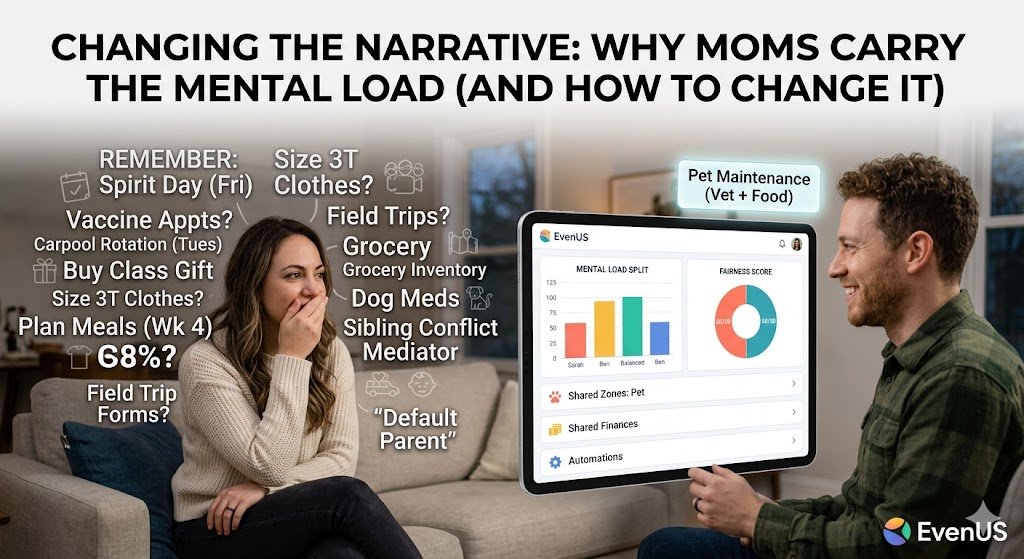
Why Moms Carry Most of the Mental Load- It is a quiet Tuesday night. The kids are finally asleep, the house is relatively still, and you are sitting on the couch with your partner. To an outsider, you are both “off the clock.” But inside your brain, a high-speed processor is running at maximum capacity.
You are wondering if the toddler’s cough is getting worse and if you should book a pediatrician appointment before the morning rush. You are mentally checking if there’s enough milk for breakfast, remembering that Friday is “Spirit Day” at school, and calculating if the shared checking account can handle the upcoming registration fees for spring soccer.
Your partner, sitting right next to you, is truly relaxed. They aren’t being malicious; they simply aren’t running the program.
If you feel like the CEO, project manager, and head of HR for your family, you aren’t imagining it. Research consistently shows that in heterosexual, dual-income households, mothers carry approximately 80% of the daily logistical mental load. This imbalance isn’t a personal failure of your marriage—it is a structural phenomenon. To change the narrative, we must first understand the “why” behind the numbers and then actively install a new operating system for the home.
The Statistics: Quantifying the Invisible
For decades, the “mental load” was a vague feeling of exhaustion that women couldn’t quite name. Today, we have the data to prove it exists.
According to the United Nations ‘World’s Women’ report, women worldwide spend nearly three times as much time on unpaid domestic and care work as men. In the United States, the Bright Horizons Modern Family Index found that 86% of working mothers say they handle all family schedules, and 76% say they are the ones who keep track of the family’s finances and household responsibilities.
These statistics cut across income brackets. Even when both partners work full-time and earn equal salaries, the “Default Parent” status almost always lands on the mother. This 80/20 split is the primary driver of female career stagnation and the “maternal wall” at work—not because women are less capable, but because they are carrying a second, invisible full-time job in their heads.
Read the full study on SAGE Journals
Why Moms? Deconstructing the Four Barriers (Why Moms Carry Most of the Mental Load)
How did we get here? It isn’t because women have a “natural” affinity for remembering shoe sizes or dental records. It is a result of four powerful societal and psychological barriers.
1. The Ghost of the 1950s Household
We are living in a 21st-century economy with a mid-20th-century household model. Decades ago, the division of labor was clear: one partner earned the income, and the other managed the home. While women entered the workforce in droves, the expectation of having a “dedicated household manager” was never officially retired. We simply added “Professional” to the existing list of “Manager,” resulting in the “Double Burden.”
2. The “Intensive Motherhood” Script
Sociology identifies a phenomenon called Intensive Motherhood. This is the cultural standard that a “good” mother must be hyper-vigilant. She isn’t just supposed to feed her children; she is expected to research the best organic ingredients, manage their emotional development with surgical precision, and curate their social lives flawlessly. This script conditions women to be “always on,” while society often views fatherhood as a “supporting role.”
3. Matrescence and the Biological Conflation
Matrescence is the physical, emotional, and neurological transition into motherhood. While hormones and neuroplasticity facilitate bonding, society often uses this biological connection as an excuse for logistical inequality. We conflate “biological bond” with “inherent ability to manage a calendar.” This is a logical fallacy: being able to soothe a crying baby does not mean you were born with the login to the insurance portal.
4. Maternal Gatekeeping
We must also address the internal barrier. Because the stakes of “Intensive Motherhood” are so high, many moms struggle with Maternal Gatekeeping—the tendency to pull back control because they fear their partner won’t do it “right” (or to their specific standard). When we redo a task our partner just finished, we inadvertently condition them to be “reactive helpers” who wait for instructions, rather than proactive owners.
Changing the Narrative: 3 Critical Shifts
You cannot fix an 80/20 split by asking your partner to “help out” more. Helping is for guests; partnering is for owners. You have to force a system reboot.
Shift 1: Declare Logistical Bankruptcy
You need a “State of the Union” conversation with your partner. Explain that the current system is unsustainable and is leading to burnout. Use the “Project Manager vs. Employee” metaphor. Explain that when they ask “What can I do?”, they are still leaving the hardest part of the job—the thinking—to you. Declare that you are resigning as the sole manager.
Shift 2: Move from “Tasks” to “Total Ownership (Zones)”
Stop delegating micro-chores like “Can you take the trash out?” This requires you to notice the trash is full. Instead, delegate an entire Zone, such as the “Morning Routine Zone” or the “Pet Maintenance Zone.” Total ownership means the partner owns all four stages of cognitive labor:
- Anticipating: Noticing the dog is out of food.
- Identifying: Finding the best brand/price.
- Deciding: Ordering the food.
- Monitoring: Ensuring it arrives and tracking the next refill.
Once a zone is handed over, it must completely leave the mother’s brain.
Shift 3: Offload Logistical Memory to Technology
Human memory is a high-cost storage system. Every “remember to…” takes up “RAM” in your brain, leaving less room for creativity, joy, and rest. You must move the family operating system out of your head and into a digital, shared space.
When you use automation—like setting up recurring digital triggers for school dress-up days or syncing financial ledgers—you remove the need for one person to be the “Master Rememberer.”
Offload Your Brain and Share the Load with EvenUS
The 80% mental load is a heavy, invisible weight, but it isn’t permanent. You cannot fix a systemic imbalance with a paper to-do list that only you look at. You need a neutral, objective tool that forces visibility.
EvenUS was built to be the antidote to the “Default Parent” syndrome. It is a dedicated operating system for modern families that:
- Visualizes the Load: It maps out the mental load, showing exactly who is doing the “remembering” versus the “doing.”
- Facilitates Zone Ownership: It allows couples to hand over entire categories of life, ensuring true ownership and zero nagging.
- Synchronizes Finances: It eliminates the stress of being the sole “accountant” by tracking proportional family expenses in real-time.
Stop carrying the family ecosystem in your head. Offload the logistical memory and rewrite the narrative of your home from “Manager and Helper” to “Co-Owners.”
Change your family’s Fairness Score and reclaim your mental space. Try the free EvenUS demo today.