
How to Offload Your Mental To Do List for the Week -It is Sunday night, 8:30 PM. The house is finally quiet, the kids are asleep, and you are sitting on the couch. Physically, you are resting. Mentally, you are running a marathon.
Your brain is a chaotic browser with fifty tabs open: Did I pack the library books for tomorrow? When is the registration deadline for summer camp? Do we have enough eggs for breakfast? Who is picking up the kids from soccer on Wednesday? Did I respond to that email from the teacher about the field trip?
This is the “Sunday Scaries” for parents. It isn’t just a dread of the coming work week; it is the crushing weight of the logistical mental load. Most families enter Monday morning in “reactive mode,” responding to fires as they happen and constantly asking each other, “Wait, who was supposed to do that?”
To stop the cycle of mid-week chaos and resentment, you need more than a cleaning routine. You need a Sunday Reset Protocol. This isn’t about scrubbing baseboards; it is a strategic session designed to move the entire family operating system out of your head and into a shared, digital space. Here is how to achieve a total cognitive offload before the Monday morning alarm goes off.
Why a “Mental” Reset is Better Than a “Physical” One
If you search for #SundayReset on social media, you will see thousands of videos of people meal prepping in aesthetic glass containers and restock-videos of laundry pods. While these physical tasks are helpful, they are often a “band-aid” for a deeper problem.
You can have a refrigerator full of prepped meals, but if you haven’t decided who is responsible for cooking them on a night when both parents are working late, you haven’t actually reduced your stress. You have just organized the ingredients for a future argument.
The goal of a true Sunday Reset is Cognitive Offloading. This is the psychological process of reducing the “working memory” your brain uses to track pending tasks. Research published in the journal Scientific Reports suggests that our brains are biologically wired to obsess over uncompleted tasks—a phenomenon known as the Zeigarnik Effect. By externalizing your to-do list and assigning specific ownership to each item, you signal to your brain that it can “let go” of that information, leading to significantly lower cortisol levels and better sleep.
(Read more: Cognitive Labor vs. Physical Chores: Why Both Need to Be Tracked)
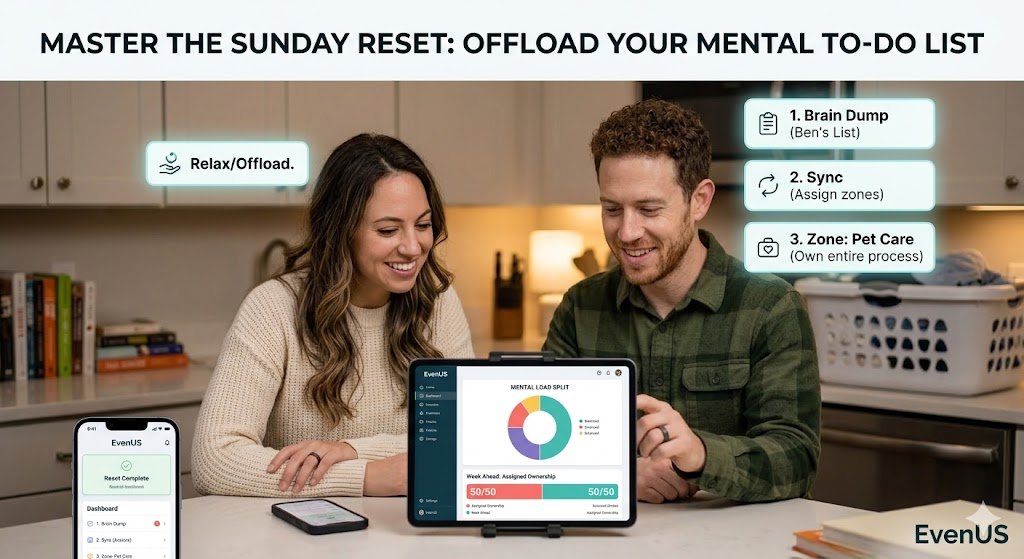
The 3-Step Sunday Reset Protocol (How to Offload Your Mental To Do List for the Week )
To be effective, a Sunday Reset must be a shared ritual, not a solo mission. If one partner performs the reset alone, they are simply reinforcing their role as the “Household Manager.” To move toward true equity, follow this 15-minute protocol together.
Step 1: The Individual “Brain Dump” (5 Minutes)
Before you sit down together, each partner should take five minutes to do an individual brain dump. Don’t worry about organization; just list everything “running” in your head.
- Sarah’s list: Field trip forms, kid’s cough, grocery inventory, vet appointment, cousin’s birthday gift.
- Ben’s list: Car oil change, utility bill, soccer practice logistics, broken dishwasher handle.
Step 2: The 15-Minute Sync (The “Board Meeting”)
Sit down together with your laptops or phones. This is not the time to do the work; it is the time to assign the work. Review the combined brain dump and look for the “logistical friction points” of the coming week. If Thursday is a late night for both of you, who is the “Lead Parent” for the evening? Who is the “Executive Chef” for the week?
Step 3: The “Zone Audit”
Instead of dividing a list of 50 micro-tasks, review your high-level Zones. A Zone is a broad category of household life (e.g., “The Morning Routine,” “Pet Care,” or “School Communications”). The Sunday Reset is the time to trade Zones if one partner is heading into a particularly heavy week at their job. This ensures that the mental load remains balanced even as life fluctuates.
Read the research on Nature.com
4 Questions Every Couple Should Ask on Sunday
To ensure your reset is comprehensive, use these four guiding questions to uncover the invisible labor that usually causes mid-week meltdowns.
1. “What is the one logistical ‘fire’ we need to prevent this week?” Identify the most complex day of the week and pre-solve the problem. If Tuesday has overlapping doctor appointments and soccer practice, decide the transportation plan now instead of at 3:00 PM on Tuesday.
2. “Do we both have total visibility into the family ledger for upcoming bills?” Financial stress is a major contributor to parental burnout. Ensure both partners know exactly what is coming out of the shared account this week so there are no “financial surprises.”
3. “Who is the ‘Lead Parent’ for school/external communications this week?” Assign one person to be the point of contact for the school, the coach, and the family group chats. This prevents the “I thought you were doing it” confusion that leads to missed emails and late forms.
4. “When is our scheduled 30-minute ‘Us Time’?” A relationship cannot survive solely on logistics. Proactively schedule a window where you agree not to talk about the kids, the chores, or the budget.
The Science of Ownership: Why We Need a Neutral System
A common complaint during Sunday Resets is that it feels like “nagging” or “micro-managing.” This happens because, on paper or in a simple to-do app, the information is still tied to the person who wrote it down.
True proactive partnering requires an objective system of record. When household data is stored in a neutral, third-party platform, it shifts the dynamic. You are no longer “telling your partner what to do”; the system is showing both of you what needs to be done to keep the family ecosystem healthy.
Research into cognitive offloading shows that the more reliable the external system is, the more the brain actually relaxes. If you don’t trust the system to remind you, your brain will keep a “backup copy” of the task, defeating the purpose of the reset.
Make Your Reset Permanent with EvenUS
A Sunday Reset on a paper calendar taped to the fridge is a good start, but it’s fragile. If one partner forgets to check the fridge, or if the paper gets lost, the system breaks.
EvenUS was built to be the digital engine for your Sunday Reset. It centralizes your brain dump, visualizes your zone ownership, and tracks your shared finances in real-time.
- Visualize the Week Ahead: See exactly how the mental load is split for the coming seven days.
- Proactive Notifications: EvenUS triggers reminders so you can stop being the “Human Alarm Clock” for your partner.
- Proportional Equity: Ensure that as your week changes, your contribution to the household—both financial and logistical—remains fair.
Don’t start your week in the dark. Offload the family operating system from your memory, sync with your partner, and reclaim your Sunday nights.
Rebuild your partnership and start your week with total household clarity. Try the EvenUS Sunday Reset Demo here.