
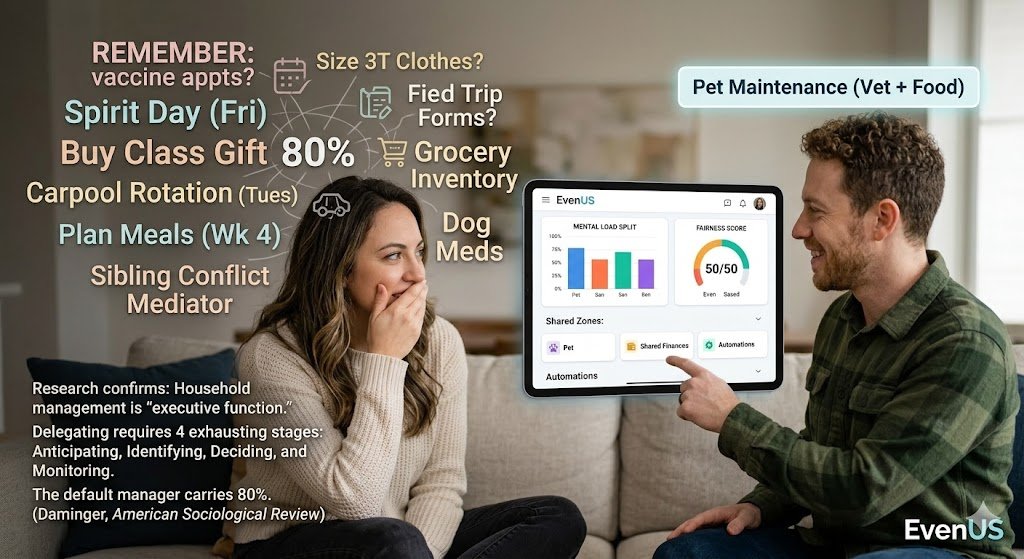
Majority of the Mental Load– It’s 10:00 PM. You and your partner are finally sitting on the couch after a long day of work and parenting. On the surface, you’ve both “done the chores”—the dishwasher is humming, and the toys are put away. Yet, while your partner is truly decompressing, your brain is still a high-speed processor with fifty tabs open.
You are wondering if the toddler’s cough is getting worse, remembering that tomorrow is “crazy sock day” at school, and mentally calculating if you have enough chicken for tomorrow’s dinner.
If you feel like you are the only one “holding the shape” of your family’s life, you aren’t imagining it. You are carrying the Mental Load—the invisible, relentless project management of the home. Because this labor is internal, it often goes unrecorded and unthanked. Here are the seven undeniable signs that you are the default manager of your household, and why identifying them is the first step toward reclaiming your peace.
1. You Hear “Just Tell Me What to Do” Constantly
To your partner, this feels like a supportive offer. To you, it feels like a heavy weight. When a partner waits for instructions, they are effectively resigning from the “Thinking” part of the job and only volunteering for the “Doing.”
As sociologist Allison Daminger points out in her research on cognitive labor, household management involves four stages: Anticipating, Identifying, Deciding, and Monitoring. When you have to “tell them what to do,” you have already performed the first three stages. You are the boss, and they are the employee. That power dynamic is the opposite of a romantic partnership.
2. You Are the “Master Rememberer”
From the date of the next dental cleaning to the specific brand of oat milk the kids prefer, you are the family’s walking database. If your partner has to ask you where the spare lightbulbs are or what time soccer practice starts, it means they haven’t “downloaded” the household operating system. Being the sole keeper of family data leads to a state of hyper-vigilance where you can never truly “clock out” because you are always on call for information.
3. The “Delegation Tax” Feels Too High
Do you often find yourself thinking, “It’s just easier if I do it myself”? This is a classic sign of an imbalanced load. Explaining a task, providing the context, and checking that it was done correctly (the “Monitoring” stage) often takes more mental energy than just performing the physical chore. When the “cost” of delegating is higher than the task itself, the manager ends up doing everything, leading to a cycle of martyrdom and burnout.
4. You Can’t Enjoy “Off” Time
Even when you are physically resting—on a date, at the gym, or in bed—your brain is scanning for future needs. You are mentally checking the pantry or worrying about a registration deadline. This is the Zeigarnik Effect in action.
The human brain is biologically wired to “loop” on unfinished tasks. Because the mental load is never truly “finished,” your brain stays in a low-level state of stress, preventing your nervous system from entering deep rest.
5. You Suffer from Chronic “Decision Fatigue”
By 6:00 PM, the simple question “What do you want for dinner?” makes you want to snap. This isn’t because you’re “moody”; it’s because you have reached your cognitive limit. Making hundreds of micro-decisions all day—about sunscreen, school forms, and budget allocations—depletes the brain’s executive function. When one partner makes 80% of the decisions, they reach a state of “decision fatigue” that makes even small choices feel insurmountable.
6. You Are the Default Point of Contact
The school calls you first. The vet emails you. The family group chats route through your phone. Being the “Default Parent” or “Default Manager” means you are the filter for all external information entering the home. This forces you to constantly “triage” data, deciding what is important and what can wait, which is a massive, unacknowledged cognitive burden.
7. You Feel Like a “Nag”
No one likes being a nag, yet the manager often feels forced into the role. Because you are the only one Monitoring the household ecosystem, you are the only one who notices when a task is left half-finished. Following up on a chore isn’t “bossy”—it’s the final stage of labor. If your partner doesn’t own the “Monitoring” stage, you are forced to be the human alarm clock, which breeds resentment on both sides.
Why This Imbalance Destroys Relationships (Majority of the Mental Load)
Carrying 80% of the mental load isn’t just “tiring”—it’s a relationship killer. Research shows that mothers, in particular, carry a disproportionate amount of this labor regardless of their employment status. This leads to a “Leisure Gap,” where one partner has true free time while the other is always “working” in their head. Over time, this creates a divide where the manager feels like a servant and the helper feels like a guest in their own home.
How to Restore the Balance
You cannot “help” your way out of a mental load imbalance. You have to change the system.
- Make the Invisible Visible: Use a tool to write down the “Thinking” tasks, not just the “Doing” tasks.
- Assign Total Ownership (Zones): Give your partner entire categories of life (e.g., “The Morning Routine” or “Pet Maintenance”). They must own all four stages: Anticipating, Identifying, Deciding, and Monitoring.
- Externalize the Data: Move the household data out of your brain and into a shared digital space.
Restore Fairness with EvenUS
The 21st-century household is too complex to be stored in one person’s head. You need a Household Operating System. EvenUS was designed to solve the mental load crisis by visualizing the invisible. It tracks who is doing the “remembering” and “deciding,” giving both partners a clear, data-driven picture of the household split.
By externalizing the “remembers”—the birthdays, the bills, the school forms—EvenUS closes the “open loops” in your brain and allows both partners to operate as true co-owners.
Is your mental load out of balance? Take the EvenUS Fairness Quiz and reclaim your mental space today.
The Research Reference
This article is grounded in the sociological research of Allison Daminger at Harvard University. Her work is the gold standard for understanding how cognitive labor is divided in modern homes.
- Paper Title: “The Cognitive Dimension of Household Labor”
- Journal: American Sociological Review (2019)
- Key Finding: Daminger’s study identifies that women do significantly more “anticipating” and “monitoring” than men, even in high-earning, egalitarian-leaning households.
- Direct Link: Read the full research paper here