
Emotional Labor in Marriage: Imagine a couple driving home from a family holiday gathering. On the surface, the event was a success. However, as they pull into the driveway, one partner is energized and humming along to the radio, while the other is staring out the window, completely depleted.
The exhausted partner didn’t do any heavy lifting. They didn’t cook the meal or drive the car. But for four hours, they were performing high-intensity Emotional Labor. They were the ones smoothing over a tense political comment from an uncle, monitoring the toddler’s mounting irritability to prevent a meltdown, ensuring their partner felt included in conversations, and maintaining a “pleasant” exterior despite their own growing headache.
This is the “invisible” work of marriage. While the Mental Load refers to the logistics of the home (the “what” and “when”), Emotional Labor refers to the management of the family’s feelings (the “how” and “why”). Because it is internal and often dismissed as “intuition” or “personality,” it is one of the most undervalued and inequitable aspects of modern relationships.
What Exactly is Emotional Labor? (Emotional Labor in Marriage )
The term “emotional labor” was originally coined by sociologist Arlie Hochschild in her 1983 book The Managed Heart.She defined it as the effort required to induce or suppress feelings in order to sustain the outward countenance that produces the proper state of mind in others.
In a marriage, this manifests in three distinct layers:
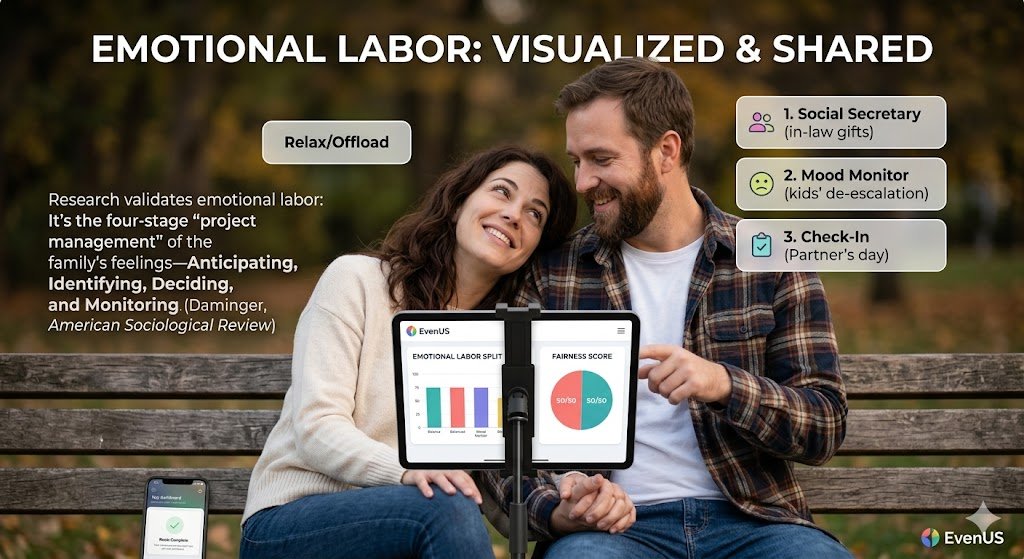
1. The “Social Secretary” (External Management)
This involves maintaining the family’s social fabric. It is the work of remembering birthdays, choosing thoughtful gifts, writing thank-you notes, and ensuring the couple stays connected to friends and extended family. It is the labor of “caring” on behalf of the unit.
2. The “Peacemaker” (Internal Dynamics)
This is the active regulation of the household atmosphere. It’s de-escalating a sibling argument, helping a child process a disappointment at school, or “softening” a request to a partner to avoid a defensive reaction. It is the constant monitoring of the “vibes” in the home.
3. “The Buffer” (Partner Management)
This is perhaps the most taxing layer. It involves anticipating a partner’s emotional triggers and adjusting your own behavior to accommodate them. It’s the partner who “walks on eggshells” to keep the peace or who provides 100% of the emotional validation and listening in the relationship without receiving the same in return.
Why Emotional Labor is a Relationship Killer
When emotional labor is lopsided—which research shows it often is, falling disproportionately on women—it creates a “Resentment Gap.” The partner carrying the load feels like an unpaid therapist or a social cruise director, while the other partner remains blissfully unaware of the effort required to keep the relationship “easy.”
The “Masking” Fatigue
Constant emotional labor requires “surface acting”—pretending to be okay or happy for the sake of the family. This creates a state of chronic internal stress. Over time, this “masking” leads to emotional numbness and a loss of intimacy. You cannot feel truly connected to a partner if you are constantly “managing” them.
The Zeigarnik Effect and “Open Loops”
The brain treats an unresolved emotional tension as an “unfinished task.”
If you are worried about your child’s social isolation or your partner’s brewing work stress, your brain stays in a high-alert state. This is the Zeigarnik Effect. These “open loops” prevent the brain from entering a restful state, leading to the “tired but wired” feeling many parents describe.
The Research: Validating the Invisible
The work of Allison Daminger (Harvard University) and Arlie Hochschild (UC Berkeley) has been instrumental in bringing this to light. Daminger’s research specifically highlights that even in couples who claim to be egalitarian, the “anticipatory” and “monitoring” stages of emotional work remain gendered.
For example, both partners might agree that “the kids’ happiness” is a priority. However, usually only one partner is Anticipating the emotional fallout of a cancelled playdate, Identifying a way to soothe the child, and Monitoring their mood for the rest of the evening. The other partner simply “helps” once the plan is in place.
3 Signs Your Marriage has an Emotional Labor Imbalance
- You are the “Tone Setter”: If you are in a bad mood, the whole house feels it; if you are in a good mood, you are responsible for “lifting” everyone else up.
- The “Mind-Reading” Expectation: You are expected to know why your partner is upset, but your partner is “surprised” when you express exhaustion or hurt.
- Social Isolation: If you stopped managing the social calendar, your family would likely stop seeing friends or extended family entirely.
How to Share the Emotional Load
Transitioning to an equitable emotional partnership requires moving from “Intuition” to “Intention.”
1. Use the “Naming” Technique
Stop calling it “being thoughtful.” Start calling it “Social Labor.” When you buy a gift for your in-laws, tell your partner: “I spent 30 minutes researching and buying this gift; that is part of my labor for our family today.” Making the work visible is the only way it can be valued.
2. Practice Emotional Autonomy
Stop being your partner’s “Emotional Buffer.” If they are in a bad mood, let them be in a bad mood. You are responsible for your reactions, but you are not responsible for “fixing” their internal state. This breaks the parent-child dynamic.
3. Assign Social “Zones”
Just like physical chores, social labor can be categorized. Give one partner total ownership over “Extended Family Relations” or “School Socializing.” This means they own the communication, the gift-buying, and the scheduling for that entire category.
Rebalance the “Heart” of Your Home with EvenUS
You cannot solve a systemic emotional imbalance with a single conversation. You need a platform that treats emotional and mental labor with the same weight as financial contributions.
EvenUS was built to be the “Check Engine Light” for your relationship’s emotional health.
- Visualize the Split: Our dashboard doesn’t just show who did the laundry; it visualizes the “Mental and Social Zones,” showing exactly who is carrying the weight of the family’s external and internal relationships.
- Proactive Partnering: EvenUS triggers reminders for the “Social Zone” owner, so the other partner can stop being the “nag” or the “Master Rememberer.”
- Fairness Score: By integrating your shared finances with your cognitive and emotional labor, EvenUS provides a holistic “Fairness Score” that validates the work of the heart.
Stop managing the vibes and start building a partnership of equals. Reclaim your emotional energy.
Research Reference
This article is grounded in the foundational work of Arlie Hochschild and the contemporary research of Allison Daminger.
- Paper Title: “The Cognitive Dimension of Household Labor”
- Journal: American Sociological Review (2019)
- Key Finding: Cognitive and emotional labor (specifically anticipation and monitoring) are the “final frontier” of gender inequality in the home.
- Direct Link: Read the full research paper here