
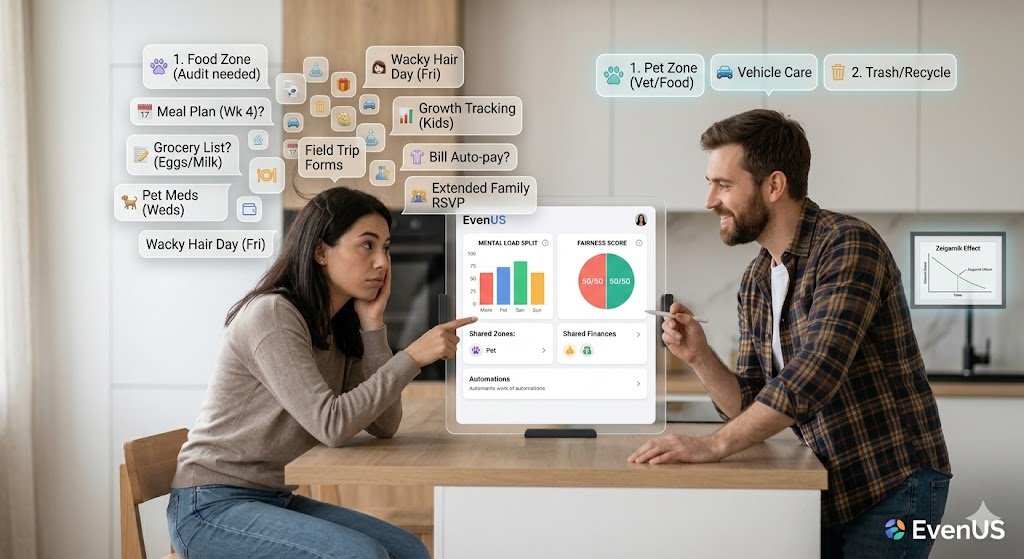
If you feel chronically exhausted despite “splitting the chores” 50/50, you are likely a victim of the Fairness Paradox. Most couples fail to achieve balance because they focus on the execution of tasks (the “doing”) while ignoring the conception and planning (the “thinking”).
To build a sustainable partnership, you must move beyond the chore chart. You must perform a “Household Audit” to identify the invisible threads that hold your life together. This checklist is designed to help you name the work, claim the ownership, and reclaim your mental “RAM.”
The Ultimate Mental Load Checklist
1. The Food & Kitchen Zone: More Than Just Cooking
Food management is the most frequent source of daily mental load. It isn’t just about who stands at the stove; it is about the “Executive Function” required to ensure a meal exists.
- Inventory Tracking: Knowing we are out of eggs or that the milk expires tomorrow before the morning rush starts.
- Meal Planning: Deciding what seven dinners look like based on the family’s fluctuating evening schedules (soccer practice, late work meetings).
- Grocery Logistics: Managing the digital cart, applying coupons, and ensuring someone is home for the delivery window.
- Kitchen Maintenance: Noticing the dishwasher filter needs cleaning or that the sponge has crossed the line from “used” to “biohazard.”
- Waste Management: Remembering “heavy trash day” or ensuring the compost doesn’t become a fruit fly breeding ground.
2. The Children & School Zone: The “Default Parent” Trap
In many long-term relationships, one partner becomes the “Primary Interface” for the children. This creates a massive cognitive imbalance that often leads to parental burnout.
- Growth Tracking: Noticing that last year’s summer clothes are now midriffs or that a child needs the next size up in soccer cleats.
- School Communication: The “Email Avalanche.” Reading the weekly newsletter, logging “Spirit Days,” and ensuring field trip forms are signed and returned.
- Health Logistics: Being the one who knows when the last dentist appointment was, tracking vaccination schedules, and noticing a lingering cough that requires a nebulizer.
- Social Logistics: Managing the complex web of playdates, RSVPs for birthday parties, and the “Mental Gift Registry” (knowing what a 6-year-old actually wants).
- Educational Support: Tracking spelling bees, project deadlines, and noticing when a child is struggling with a specific math concept before the teacher even calls.
3. The House & Finance Zone: The Infrastructure of Life
This zone is often invisible until something breaks. True fairness means one person doesn’t have to be the “nag” to get a lightbulb changed.
- Bill Management: Knowing which accounts are on autopay and which require a manual check. Monitoring for “subscription creep.”
- Household Consumables: The “Invisible Restock.” Tracking toilet paper, dish soap, laundry detergent, and lightbulbs so the house never actually “runs out.”
- Home Maintenance: Noticing the HVAC filter is gray, the gutters are overflowing, or a small leak is starting under the sink.
- Vehicle Care: The “Fleet Manager” role. Tracking oil changes, registration renewals, tire pressure, and ensuring there is enough gas for the morning commute.
- Financial Strategy: Monitoring the household “Fairness Score” and ensuring the budget reflects the family’s current priorities.
4. The Social & Family Zone: The “Social Secretary” Burden
Emotional labor often manifests as “Social Labor.” This is the work of maintaining the family’s place in their community.
- Extended Family: Remembering birthdays, anniversaries, and illness milestones for both sides of the family.
- Holiday Magic: This is high-intensity labor. Planning the decor, the cards, the specific traditions, and the multi-layered gift-giving.
- Vacation Logistics: Researching flights, comparing Airbnbs, creating packing lists for four different people, and booking pet boarding.
- Friendship Maintenance: The “Glue.” Reaching out to friends to ensure the couple stays connected and isn’t socially isolated by the demands of parenting.
Why You Can’t “Just Remember It All”
Attempting to hold this entire checklist in your biological memory leads to the Zeigarnik Effect. This psychological principle states that our brains are hardwired to “loop” on unfinished tasks. For the partner carrying the mental load, these loops never close, leading to a state of chronic hyper-vigilance.
The 3-Step Plan for Redistribution
Step 1: The Solo Audit
Go through this checklist separately. Mark a “1” if you own the “thinking” (Anticipating, Identifying, Deciding) for that task, and a “0” if you wait for your partner to mention it.
Step 2: Set the “Minimum Standard of Care” (MSC)
Compare your lists. Most “Helpers” are shocked to see the length of the “Manager’s” list. Pick a zone to transfer, but first, agree on the MSC. If you agree that “clean kitchen” means counters are wiped but not the floor, the non-owner is strictly forbidden from “monitoring” the floor. This trust is the only way to truly offload the load.
Step 3: Offload to EvenUS
Our brains were designed for having ideas, not holding them. Take the zones you’ve identified and input them into the EvenUS Fairness Tracker.
- Visualise the Split: See your cognitive labor balance in real-time.
- Neutral Nudges: Let the app handle the “reminders.” No more nagging.
- Integrated Finances: See how your mental labor aligns with your financial contributions for a total “Fairness Score.”
Reclaim Your Mental Space with EvenUS
You don’t need to be a martyr to be a good partner. You just need a better operating system. EvenUS is the only app built to take this checklist and turn it into a shared, transparent success story.
Stop being the “Manager” and start being a partner. Get the EvenUS Digital Checklist and App today.
The Research Reference
This article and checklist are grounded in the sociological research of Allison Daminger (Harvard University) regarding the four stages of cognitive labor.
- Key Paper: “The Cognitive Dimension of Household Labor”
- Published in: American Sociological Review (2019)
- Direct Link: Read the full research paper here