
When it comes to merging finances, the traditional advice has always been simple: get married, open a joint checking account, and dump all your money into one giant pot. For decades, this was seen as the ultimate proof of commitment.
But for modern couples—who often enter serious relationships later in life, with established careers, distinct spending habits, and individual financial goals—the “giant pot” method is frequently a recipe for disaster. It breeds financial policing, guilt over personal purchases, and a profound loss of identity.
If you want to build a shared life without losing your financial independence, you need a system designed for modern equity. Enter the “Yours, Mine, and Ours” strategy.
Here is exactly how this three-account architecture works, why it prevents relationship-ending resentment, and how to set it up.
The “Ours” Account: The Engine of Your Shared Life (Yours mine and ours bank accounts)
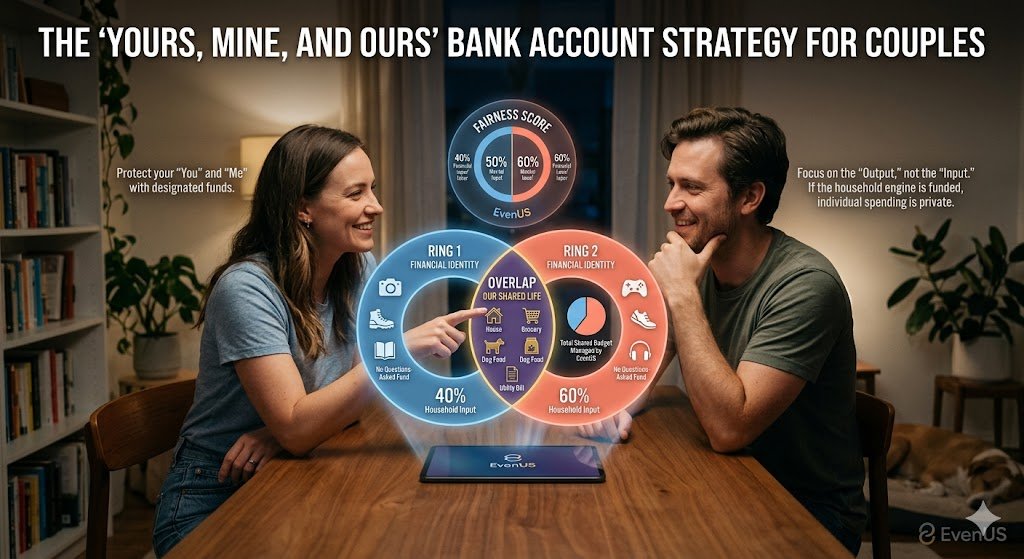
If your relationship is a Venn diagram, the “Ours” account is the overlapping center. It is a single, joint checking account with both of your names on it, and it acts as the financial engine that keeps your household running.
Transitioning from a single life to a shared life means taking on shared liabilities. This account ensures those liabilities are covered systematically, transparently, and fairly, without requiring you to merge your entire identities.
The Purpose & Parameters
This account exists strictly to fund the operational budget of your relationship. It is the pool of money dedicated to the roof over your head, the food on your table, and the future you are building together.
- What It Pays For: Rent or mortgage payments, utility bills, streaming subscriptions you both watch, weekly groceries, couples’ vacations, shared pet care (vet bills and food), and shared insurance policies. It should also include a buffer for joint emergencies, like a broken washing machine or a sudden plumbing leak.
- The Golden Boundary Rule: If an expense does not serve the “Us,” it does not come out of this account. You do not use the “Ours” debit card to buy your morning coffee on the way to the office, a new pair of shoes for yourself, or a round of drinks with your individual friends. Treating this account with strict respect is what builds deep financial trust. When you both know the money in this pot is solely for the household, financial anxiety disappears.
How to Fund the “Ours” Account (The Proportional Method)
The fastest way to ruin the “Ours” account is to fund it incorrectly. You do not put 100% of your paychecks into this account, and unless you make the exact same salary, you do not split the funding 50/50.
Instead, you calculate your total monthly household expenses and fund the account proportionally based on your income ratio. This ensures both partners feel the exact same financial “pinch.”
The Math in Action: Let’s say you sit down and calculate that your shared life—rent, bills, groceries, and a small buffer—costs exactly $4,000 a month to run.
- Step 1: Find the Ratio. You look at your combined gross income. Partner A brings in 60% of the total household income, while Partner B brings in 40%.
- Step 2: Apply the Split. * Partner A contributes 60% of the monthly budget: $2,400.
- Partner B contributes 40% of the monthly budget: $1,600.
The Psychological Win: By funding the account this way, the “Lifestyle Floor” is balanced. The lower earner isn’t bankrupted trying to cover an arbitrary 50% split, and the higher earner isn’t frustrated by having to subsidize the other’s personal life.
Once those respective deposits hit the “Ours” account on the 1st of the month, both partners have equitably fulfilled their duty to the household engine. The rent is paid, the lights are on, and whatever money remains in their personal paychecks is theirs to keep without an ounce of guilt.
The “Yours” and “Mine” Accounts: The Identity Protectors
If the joint account is the engine of your shared life, your individual accounts are the armor protecting your personal identity.
While older generations often viewed keeping separate accounts as a sign of a “lack of trust” or “planning for divorce,” modern relationship psychology tells a completely different story. Maintaining your own financial space is one of the most effective ways to prevent long-term marital resentment.
These are your individual, legally separate checking accounts. Your name is the only one on your account, and your partner’s name is the only one on theirs.
The Purpose & Parameters
This account is your financial safe haven. It is the designated landing pad for your remaining discretionary income afteryou have contributed your proportional share to the “Ours” account. Because your obligations to the household are already fully met, the money that lands here comes with zero strings attached.
- What It Pays For: Absolutely anything you want.
- Daily Indulgences: Your morning coffee, new clothes, video games, or expensive skincare routines.
- Personal Socializing: Dinners out with your individual friends, fantasy football buy-ins, or solo travel.
- Pre-Existing Baggage: This is crucial—if you came into the relationship with $30,000 in personal student loans or pre-existing credit card debt, those payments come out of your account, protecting your partner from taking on liability for your past.
- True Gifting: If you want to surprise your partner with a birthday weekend getaway or a nice piece of jewelry, paying for it out of a joint account ruins the magic (they see the charge, and mathematically, they paid for half of their own gift). Personal accounts preserve the romance and intention of truly treating each other.
The Golden Boundary Rule: Absolute Diplomatic Immunity
For this system to work, you must establish the rule of Absolute Diplomatic Immunity.
Because the shared household is fully funded and thriving, what you do with the money in your personal account is entirely your business. Your partner is strictly forbidden from monitoring, criticizing, or guilt-tripping you over these purchases.
The Psychological Win: This boundary completely eliminates “Financial Policing.” When all your money is in one giant pot, every time an Amazon box shows up at the door, the other partner subconsciously wonders, “Did we really have the budget for that?” This leads to nagging, defensiveness, and treating your partner like a child with an allowance.
By separating personal spending, you completely remove the friction. You are no longer managing your partner’s impulses; you are only managing the shared goals. If your partner wants to spend their entire “Mine” account on vintage comic books or designer shoes, you don’t have to roll your eyes or feel anxious—because it doesn’t impact your shared rent or your shared future one bit.
Why the 3-Account Strategy Saves Relationships
The brilliance of the “Yours, Mine, and Ours” method isn’t just in the math; it’s in the psychological safety it provides. When couples transition to this model, the immediate reduction in daily household tension is palpable. Here is exactly why this architecture protects your partnership:
It Adapts to Income Disparity Without “Punishing” Success
In a traditional 50/50 split, if one partner gets a massive promotion, nothing changes—they just have way more leftover cash while the other partner still struggles. In a fully merged “Giant Pot,” the higher earner might feel like their hard-earned raise was immediately swallowed by collective expenses, leaving them feeling unrewarded.
The 3-Account strategy perfectly balances this. If you get a raise, your proportional contribution to the “Ours” account scales up slightly (lifting the whole household’s standard of living), but the bulk of your new wealth flows directly into your “Mine” account. You are rewarded for your hard work, while your partner isn’t left behind.
It Balances the Power Dynamic
Financial abuse or control often starts subtly, usually when one partner has to constantly ask the other for money or permission to buy things. By guaranteeing that both partners retain their own private checking accounts, you ensure that neither person ever feels trapped or entirely dependent. It maintains the mutual respect of two autonomous adults choosing to build a life together.
It Prevents the “Roommate” Trap
Keeping everything completely separate forces couples to Venmo each other for every grocery run and utility bill. That transactional “tit-for-tat” behavior is exhausting and makes you feel like roommates instead of life partners. The “Ours” account eliminates the Venmo requests. The shared life is fully funded, allowing you to focus on the relationship itself.
4. How to Set It Up: The Automation Secret
The biggest mistake couples make when attempting this strategy is relying on willpower and memory. If you have to remember to log in on the 1st of every month, calculate the math, and manually transfer your $1,600 share to the joint account, you have just created a brand new chore.
In a household, administrative chores equal Mental Load. To make this system truly save your relationship, it must be invisible. You have to automate the input.
The Step-by-Step Automation Guide:
- The Core Calculation: Sit down together once and calculate your total monthly household budget and your proportional split percentages.
- Open the Joint Account: Go to a bank you both like (ideally one with zero monthly fees) and open the “Ours” checking account together. Get two debit cards.
- Update Your HR Direct Deposit: This is the magic step. Do not wait for the money to hit your personal account first. Log into your company’s payroll portal or speak to HR. Set up a split direct deposit.
- Route the Split: Program the system to route your exact proportional contribution (e.g., $1,600) directly into the joint “Ours” account every payday. Route the remaining balance of your paycheck into your pre-existing personal account.
- Autopay the Bills: Set the rent, electricity, and internet to auto-draft directly from the “Ours” account.
By automating the split at the payroll level, the bills are practically paid before you even wake up on payday. You never have to ask your partner for money, and you never have to justify what you spend from your personal account.
Manage the “Ours” with EvenUS
The “Yours, Mine, and Ours” strategy solves the bank account problem, but tracking who actually physically went to the store to buy the shared groceries or who spent two hours on the phone with the internet company can still cause resentment. True equity is about more than just the money.
EvenUS is the ultimate operating system designed for modern couples using this exact financial strategy.
- The Proportional Calculator: Not sure what your fair financial split is? Input your incomes, and EvenUS automatically calculates the exact percentages you each owe to the “Ours” account.
- Track the Shared Effort, Not Just the Shared Dollars: EvenUS goes beyond the spreadsheet by integrating your financial contributions with your Cognitive Labor. It tracks the mental load of managing the household zones.
- The Total Fairness Score: If one partner contributes 70% of the cash to the “Ours” pot, EvenUS helps balance the scales by delegating more of the household management to the other partner. It calculates a holistic Fairness Score that proves you are both pulling your weight in the ways that matter most.
Stop keeping score and start building a system. Download EvenUS and find your household balance today.
The Core Research on Bank Account Structures and Relationship Friction
Title: Common Cents: Bank Account Structure and Couples’ Relationship Dynamics Authors: Jenny G. Olson, Scott I. Rick, et al. Published In: Journal of Consumer Research (2023) Why it supports your article: This is one of the most comprehensive recent studies on how couples manage money. While it acknowledges that merging money can build team alignment, it specifically notes that forcing entirely merged accounts on established individuals often causes significant friction and a loss of personal autonomy. It validates the need for a structured system (like the 3-account method) to balance that shared alignment with individual independence.
- Credible Link: https://academic.oup.com/jcr/article/50/3/474/7081077