
In the beginning, the shared spreadsheet feels like a breakthrough. You and your partner sit down, create a Google Sheet, and feel like “financial adults.” You have columns for rent, groceries, and dining out. You promise to log every receipt.
But three months later, the spreadsheet is a graveyard of half-remembered purchases. One partner is nagging the other to “update the sheet,” while the other feels like they are being audited.
Manual spreadsheets don’t fail because you aren’t disciplined; they fail because they are fundamentally mismatched with how modern couples actually live.
The “Mental Load” Tax: Why Spreadsheets are a Part-Time Job (Tracking Shared Expenses )
A spreadsheet is often marketed as a “free” tool, but it carries a massive hidden cost: Cognitive Labor. Unlike an automated system, a spreadsheet is entirely passive. It does nothing unless you feed it, which turns a simple grocery run into a multi-step administrative project.
The Multi-Step Chore of “Logging”
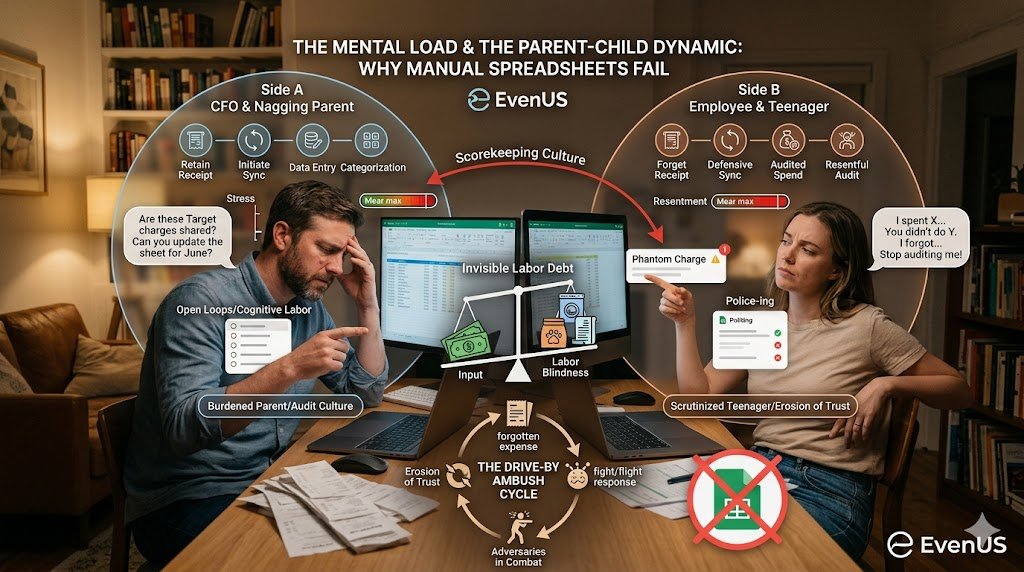
Every time you spend a single dollar on the household, the “spreadsheet tax” requires you to perform four distinct mental tasks:
- Retention: You have to remember to ask for and save the physical or digital receipt.
- Initiation: You have to remember to open the spreadsheet app later that evening.
- Data Entry: You have to manually type in the date, the vendor, and the exact amount.
- Categorization: You have to decide if that Target run was “Groceries,” “Home Decor,” or “Pharmacy.”
This isn’t just “typing numbers”; it is a persistent background process running in your brain. When you multiply this by 30 or 40 transactions a month, it becomes an exhausting administrative burden that follows you throughout your day.
The Accidental CFO and the Resentful “Employee”
In almost every relationship using a manual system, one partner naturally ends up being more “detail-oriented.” This person becomes the De Facto CFO. They are the ones who actually keep the sheet updated, reconcile the bank statements, and notice when the math doesn’t add up.
The other partner, by default, becomes the “Employee.” They have to be nagged to “submit their receipts” or reminded to “update the sheet for the week.”
This creates a toxic Parent-Child dynamic.
- The CFO partner feels like a nagging parent, burdened by 90% of the administrative work.
- The Employee partner feels like a scrutinized teenager, resenting the constant “auditing” of their daily life.
This dynamic is a romance killer. It replaces the feeling of being “equal co-pilots” with a hierarchy of oversight and accountability. By the time you sit down for dinner, you aren’t talking about your day; you’re talking about why the $14 salad from Tuesday isn’t on the Google Sheet yet.
The Solution: Closing the “Open Loops”
To protect your relationship, you must close these “open loops” of cognitive labor. You need a system that recognizes a transaction as it happens, categorizes it automatically, and keeps the “Ours” budget updated in real-time.
When you remove the manual tax, you stop being accountants and go back to being partners.
Recency Bias and the “Financial Archaeology” Trap
The biggest flaw in a manual spreadsheet isn’t the math—it’s the memory. Most couples don’t log expenses the second they happen; they wait until “later.” But in a busy life, “later” usually means Sunday afternoon, or worse, the end of the month.
This creates a phenomenon known as Recency Bias. You remember the $150 grocery trip from yesterday perfectly, but you’ve completely forgotten the $22 hardware store run from three weeks ago.
The Interrogation: “What was this $42 charge?”
When you finally sit down to reconcile the spreadsheet against your actual bank statement, you inevitably find “phantom charges”—expenses that don’t have a corresponding entry or receipt.
This forces you into a state of Financial Archaeology. You have to dig through old emails, check your Amazon order history, or scroll through your photo gallery to figure out what happened on the 14th.
Because you can’t remember, the conversation quickly turns into an interrogation:
- “Do you remember what you bought at CVS for $42?”
- “Was that for the house, or was that a personal gift for your brother?”
- “Why is there a recurring $15 charge here that isn’t on the sheet?”
The Erosion of Trust
Even if the purchase was 100% legitimate and for the household, the act of being questioned about it feels like policing. To the partner being asked, it feels like they are being audited. To the partner asking, it feels like they are the only ones responsible for the “Ours” budget.
This “back-and-forth” creates a subtle undercurrent of distrust. You stop being a team moving toward a goal and start being two people defending their past actions.
The Solution: Real-Time Transparency
A manual spreadsheet is a historical document—it tells you what you did wrong three weeks ago. To stop the interrogation, you need a system that provides live transparency.
When a transaction is captured and categorized the moment it happens, “Financial Archaeology” dies. You never have to ask what a charge was for, because the data is already there, validated, and settled. You move from defending the past to planning the future.
They Solve the Math, But Ignore the Equity
A spreadsheet is a calculator, not a relationship counselor. It is exceptionally good at adding up numbers, but it is fundamentally blind to Fairness. When couples rely on a manual sheet, they almost always default to a “50/50 split” because it’s the easiest formula to plug into a cell.
However, in a modern partnership, a 50/50 split of the dollars often results in a 100/0 split of the resentment.
The Income Disparity Trap
If Partner A earns $100k and Partner B earns $50k, a spreadsheet that splits a $3,000 rent payment down the middle ($1,500 each) looks “equal” on paper.
In reality, that $1,500 represents a much larger percentage of Partner B’s take-home pay. Partner B is left with very little “Mine” money for personal joy, while Partner A has a massive surplus. This creates a Power Imbalance. The lower earner often feels like they are drowning just to keep up with a lifestyle they didn’t choose, while the higher earner feels like they are “carrying” the other person.
The “Labor Blindness” of the Spreadsheet
The biggest failure of a manual spreadsheet is that it only tracks Financial Inputs. It has no column for:
- The two hours spent meal-planning and grocery shopping.
- The mental energy of remembering it’s the week to put the trash out.
- The physical labor of cleaning the kitchen after the meal.
If you spent $150 on groceries, the spreadsheet gives you credit for $150. If your partner spent three hours of their life turning those groceries into five nights of healthy meals, the spreadsheet gives them credit for zero.
This creates a “Scorekeeping” culture. One partner feels superior because they “paid more,” while the other feels undervalued because their non-monetary contributions are invisible.
The Solution: Total Contribution Equity
To stop fighting about the spreadsheet, you have to stop looking at the money in isolation. You need a system that calculates a Proportional Split (based on income) and validates Cognitive Labor (based on effort).
True equity happens when both partners feel the same financial “pinch” and both partners feel that their time and mental energy are being seen and rewarded. When the “Total Contribution” is balanced, the need to nitpick the grocery bill disappears.
The “Syncing” Nightmare: Why 80% of Spreadsheets Are Abandoned
The final reason manual tracking fails isn’t about math or even fairness—it’s about friction. A system only works if you actually use it, and Google Sheets or Excel are notoriously “unfriendly” to the rhythm of a modern couple’s life.
Most couples start with high intentions, but by month six, the spreadsheet is a ghost town. This is the “Syncing Nightmare.”
The Mobile-to-Desktop Gap
Have you ever tried to open a complex Google Sheet on your phone while standing at a crowded grocery store checkout or a busy restaurant?
- The columns are too small.
- The cells are hard to click.
- The formulas break if you delete a row by accident.
Because entering data on a mobile device is clunky, most partners tell themselves: “I’ll just do it later when I’m at my computer.”
The “Sunday Afternoon Reconcile”
Because “later” never happens during the week, the chores pile up. You end up with the dreaded Sunday Afternoon Reconcile. Instead of enjoying your day off, you spend two hours hunched over a laptop, cross-referencing bank apps, Venmo histories, and crumpled receipts.
This turns your relationship into a business meeting. You aren’t connecting as partners; you are auditing each other. If one partner forgets a password or can’t remember a specific charge, the “sync” fails, and the frustration grows.
The Data Silo Problem
In a manual system, the data is “siloed.” If Partner A updates the sheet, Partner B doesn’t get a notification. They have no idea the “Ours” budget is running low until they check the sheet—which they rarely do. This lack of real-time feedbackleads to accidental overspending, followed by more “Financial Archaeology” to figure out where the money went.
The Solution: Frictionless, Real-Time Syncing
To save your finances, you need to stop being a data entry clerk. You need a system that:
- Is Mobile-First: Logging an expense should take three seconds, not three minutes.
- Is Proactive: It should send Neutral Nudges (notifications) to both partners, so you’re always on the same page without having to “ask.”
- Is Unified: It should bridge the gap between your bank account and your shared goals automatically.
When you remove the syncing friction, the “system” stops being a chore and starts being a support structure. You stop managing the spreadsheet and start managing your life.
The Solution: Move from “Manual” to “Automated”
To save your relationship from the “Spreadsheet Spiral,” you need to stop being the data entry clerk for your own life. You need a system that handles the “inputs” so you can focus on the “outputs.”
Enter EvenUS: The Anti-Spreadsheet
EvenUS was built to solve the specific failures of manual tracking. We designed it to be the “Neutral Third Party” that manages the friction so you don’t have to.
- Automation, Not Audition: EvenUS syncs with your shared life, removing the need for “The Interrogation.”
- Proportional Fairness: No more manual math to figure out who owes what. EvenUS calculates your Proportional Split based on your actual income, ensuring the financial “pinch” is felt equally by both partners.
- The Household Fairness Score: This is the game-changer. EvenUS is the first platform that tracks Cognitive Labor alongside financial spend. If you handle the mental load of planning the week, EvenUS validates that effort, ensuring your “Total Contribution” is recognized even if your dollar amount is lower.
Stop being an accountant and start being a partner.
Ditch the spreadsheet and discover your Fairness Score with EvenUS today.
The High Cost of Manual Cognitive Labor
Title: Cognitive Household Labor: Gender Disparities and Consequences for Mental Health and Wellbeing Authors:Allison Daminger (Harvard University) Published In: American Sociological Review / Journal of Family Theory & Review Why it supports your article: This study is the gold standard for “Mental Load” research. It proves that the “planning, anticipating, and monitoring” of household tasks (like manual budgeting) is a distinct form of labor. It specifically notes that this labor is “invisible” and “enduring,” leading directly to burnout and relationship stress.
- Credible Link: https://pmc.ncbi.nlm.nih.gov/articles/PMC11761833/