
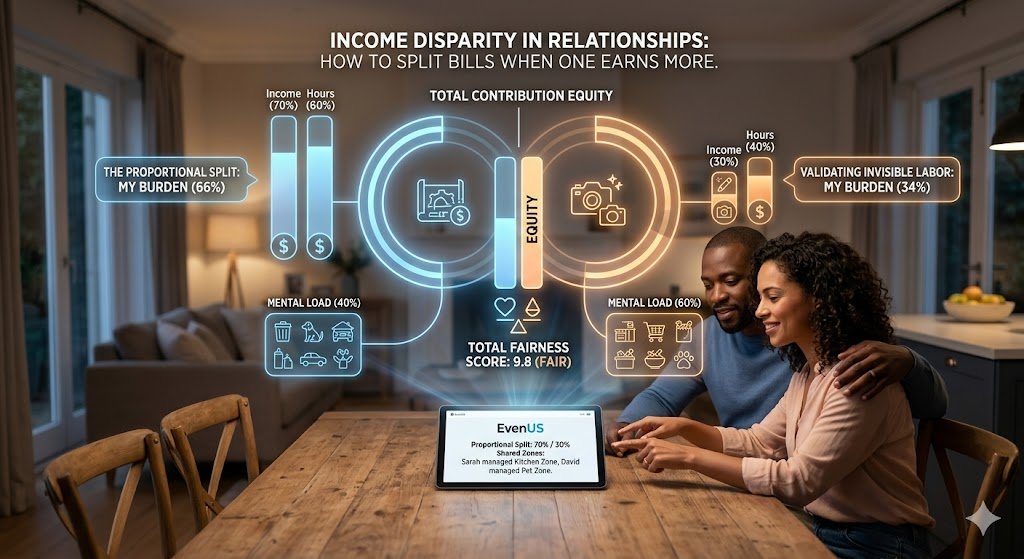
In modern relationships, the idea that both partners will earn the exact same salary is practically nonexistent. One partner almost always earns more—sometimes slightly more, and sometimes significantly more.
Yet, despite this reality, most couples default to the exact same financial strategy they used with their college roommates: The 50/50 Split. When there is an income disparity in a relationship, splitting the bills straight down the middle is one of the fastest ways to breed resentment, guilt, and financial anxiety. If you want to build a sustainable life together, you have to stop striving for “equal” and start striving for “equitable.”
Here is the blueprint for managing unequal incomes without tearing your partnership apart.
The Myth of the 50/50 Split: Why “Equal” Isn’t Always “Fair” (Income Disparity in Relationships)
When couples first merge their lives and move in together, the default financial arrangement is almost always a strict 50/50 split. On the surface, it feels perfectly logical and incredibly fair. You are sharing an apartment, sharing the groceries, and using the same electricity—so you should split the costs right down the middle, just like you would with a roommate.
But a romantic partnership is not a roommate agreement. When there is a significant income disparity, forcing a 50/50 split is the fastest way to build resentment and kill the romance.
The “Equal Dollar” Trap
The fatal flaw of the 50/50 split is that it assumes a dollar carries the exact same weight for both partners. In reality, the emotional and practical weight of a bill changes entirely depending on the size of the paycheck it comes out of.
Let’s look at the math. Imagine your total shared living expenses (rent, utilities, groceries) come to $3,000 a month. Under a strict 50/50 split, you each owe $1,500.
- Partner A (Earns $120,000/year): Their monthly take-home pay is roughly $7,000. Handing over $1,500 for the house is a breeze. It leaves them with $5,500 of discretionary “Mine” money. They can invest, travel, buy expensive hobbies, and live entirely without financial stress.
- Partner B (Earns $50,000/year): Their monthly take-home pay is roughly $3,200. Handing over that same $1,500 consumes nearly half of their total income. They are left with just $1,700 to cover their personal car payment, student loans, phone bill, and savings.
The Emotional Toll on the Lower Earner
When you enforce an equal split under unequal conditions, the lower-earning partner is forced to live in a chronic state of financial scarcity. They are financially suffocated just trying to afford the baseline cost of the relationship.
This leads to the “Keeping Up” Anxiety. Partner B feels like they are drowning just to maintain a lifestyle they might not have chosen if they were living alone. While Partner A is living comfortably and building wealth, Partner B has to say “no” to personal joys, stress over every minor purchase, and sometimes secretly rack up credit card debt just to avoid feeling like a burden.
The Power Dynamic Shift
Eventually, this financial strain creates a toxic shift in the relationship’s power dynamic, turning co-pilots into adversaries.
- The Higher Earner often becomes frustrated and confused: “Why are you always stressed about money? We split everything fairly!” They might even start to view their partner as a financial “drag” who is holding them back from nicer vacations or a better house.
- The Lower Earner becomes deeply resentful: “I am giving you everything I have, and it’s still barely enough, while you have a massive surplus.”
When you prioritize “equal dollars” over “equal burden,” the relationship stops being a partnership. It becomes transactional. If you want to build a sustainable life together, you have to stop protecting your individual surpluses and start protecting the team. That requires permanently retiring the 50/50 myth.
The Solution: The Proportional Split (The “Equal Pinch”)
If a 50/50 split means “equal dollars,” a proportional split means “equal burden.” True financial equity in a relationship dictates that both partners should feel the exact same financial “pinch” when the household bills are paid. To achieve this, you must transition from splitting the bills down the middle to splitting them based on the percentage of the total household income you each bring in.
This is the Proportional Split, and it is the single most effective financial strategy for couples with an income gap.
The Math of True Equity
Let’s use the exact same scenario from the previous section: Partner A earns $120,000 a year, Partner B earns $50,000 a year, and the shared monthly household expenses (rent, utilities, groceries) total $3,000.
Instead of arbitrarily cutting the $3,000 in half, you calculate your contributions based on your capacity. Here is the three-step formula:
Step 1: Calculate the Total Household Income
- Partner A ($120,000) + Partner B ($50,000) = $170,000 Total Income.
Step 2: Find Your Individual Percentages Divide your individual income by the total household income to find your proportional share.
- Partner A: $120,000 ÷ $170,000 = 70%
- Partner B: $50,000 ÷ $170,000 = 30%
Step 3: Apply the Percentages to the Bills Multiply the total monthly expenses ($3,000) by your individual percentages.
- Partner A’s Share: 70% of $3,000 = $2,100
- Partner B’s Share: 30% of $3,000 = $900
The Psychological Win: Ending the Resentment
Look at the difference. Under the old 50/50 split, Partner B was paying $1,500—nearly half their take-home pay—just to survive in their own home. Under the proportional split, Partner B pays $900.
This isn’t a “handout” from the higher earner; this is basic team economics. By adopting the proportional split, you instantly solve the two biggest emotional crises caused by income disparity:
- The Lower Earner Can Breathe: Partner B is no longer financially suffocated. They finally have enough “Mine” money left over to save for their own goals, pay off personal debts, or buy a coffee without feeling intense guilt. The chronic stress of “keeping up” disappears.
- The Higher Earner Gets a Partner Back: Partner A pays more of the actual dollars ($2,100), but because they earn significantly more, the impact on their wallet feels exactly the same as Partner B’s. In return for the higher dollar amount, they get a partner who is relaxed, financially secure, and able to actively participate in the relationship without anxiety.
“Mine” Money is Restored
The greatest benefit of the proportional split is that it protects personal autonomy. When both partners contribute an equal percentage of their income to the “Ours” bucket, it ensures that both partners are left with a fair percentage of “Mine” money.
You no longer have to ask permission to buy a video game, a new pair of shoes, or drinks with friends. The household is fully funded, the burden was shared equally, and you are both free to enjoy the fruits of your own labor without resentment.
The “Lifestyle Creep” Dilemma: When Proportional Splits Aren’t Enough
The proportional split is a massive upgrade from the 50/50 trap, but it is not a magic wand. It works perfectly when a couple’s shared expenses are kept at a reasonable baseline. However, it completely breaks down when the higher-earning partner introduces Lifestyle Creep.
What happens when Partner A (earning $120,000) decides they are tired of the standard $2,000-a-month apartment and wants to upgrade to a luxury $5,000-a-month penthouse? Or what if they want to trade the modest domestic road trip for a $10,000 European vacation?
The Limit of the Percentage
Even if you are using a fair 70/30 proportional split, a massive spike in the total shared budget will still crush the lower earner.
If the rent jumps from $2,000 to $5,000:
- Partner A (70%): Pays $3,500. They might be totally fine with this because their income supports it.
- Partner B (30%): Pays $1,500. Even though it’s “only” 30%, that $1,500 might wipe out their entire discretionary budget or force them into debt just to afford their share of the new luxury lifestyle.
In this scenario, Partner B is right back where they started: financially suffocated and stressed, just to keep up with Partner A’s expensive tastes.
The “Higher Earner Subsidy” Rule
To protect the relationship from the resentment of lifestyle creep, you must implement the Higher Earner Subsidy Rule.
The rule is simple: The household’s shared baseline budget must be anchored to what the lower earner can comfortably afford at their proportional percentage.
If the higher-earning partner insists on a lifestyle upgrade that pushes the lower earner out of their financial comfort zone, the higher earner must independently subsidize the difference. You cannot force your partner into financial anxiety just to fund your taste for luxury.
How to Navigate the Upgrade Conversation
When the urge to upgrade hits, it requires a radically honest conversation. Here is how that looks in practice:
- The Request: Partner A says, “I really want us to move to that new building downtown with the gym and the pool, but the rent is $4,500.”
- The Boundary: Partner B looks at their budget and says, “At our 70/30 split, my share would be $1,350. My absolute maximum comfort zone for rent right now is $1,000. If I pay more than that, I can’t hit my savings goals.”
- The Subsidy: Partner A now has a choice. They can either stay in a cheaper apartment that fits Partner B’s $1,000 limit, OR, if Partner A really wants the luxury building, they agree to pay the $350 difference themselves.
The new split for the luxury apartment becomes: Partner B pays their maximum comfortable limit ($1,000), and Partner A covers the rest ($3,500).
Resentment-Free Upgrades
When you use the Subsidy Rule, nobody loses. The higher earner gets to enjoy the fruits of their hard work and live in the luxury apartment they desire, and the lower earner gets to enjoy the upgrade without the crippling financial anxiety of paying for it. It frames the upgrade as a shared win rather than a forced financial burden.
Time vs. Money: Valuing the Invisible Labor
Here is the secret that traditional financial advice almost always misses: Income is only one currency in a relationship. Time and mental energy are the others.
When couples argue about an income disparity, they are usually staring exclusively at a bank statement. But a bank statement is a terribly flawed ledger because it only measures financial inputs. It is completely blind to the physical and cognitive labor required to keep a shared life running.
If you want to stop fighting about the money gap, you have to start validating the labor gap.
The “Free Time” Imbalance
In many relationships, an income disparity exists for a very practical reason. One partner might have a high-stress, 60-hour-a-week corporate job, while the other partner works 40 hours with more flexibility, or has intentionally taken a step back in their career to manage the household or raise children.
Because the lower-earning partner has more “flexibility,” they naturally absorb the lion’s share of the domestic duties. They do the grocery shopping on Tuesday afternoons, wait for the plumber on Thursday mornings, and spend their weekends deep-cleaning the house.
If Partner A brings in 70% of the income, but Partner B contributes 80% of the household labor, looking only at the money creates a massive, unfair distortion of reality.
Uncovering the “Mental Load”
The imbalance isn’t just about physical chores; it’s about Cognitive Labor—the invisible, exhausting work of managing a household.
The mental load is the burden of being the “Lead Project Manager” for your shared life. It is the mental background process of noticing that the milk is low, researching a new vet for the dog, tracking the school calendar, and remembering to buy a gift for your partner’s mother.
If Partner B earns less money but carries the vast majority of this mental load, they are making a massive, vital contribution to the survival of the relationship. If the higher earner ignores this invisible labor, they risk making their partner feel like an undervalued, unpaid employee in their own home.
Balance the “Total Contribution”
You cannot have a fair conversation about financial equity if you are ignoring labor equity. To fix the resentment caused by unequal incomes, you must shift your perspective from financial inputs to Total Contribution.
Total Contribution = Money + Time + Mental Energy.
If one partner provides more of the financial fuel, the other partner is likely providing more of the domestic management. When you stop looking at the relationship through a purely financial lens, you often realize the scales are already balanced. As long as both partners agree that the trade-off of time versus money is fair, the resentment surrounding the paycheck gap disappears.
Automate the Balance with EvenUS
Calculating proportional splits on a napkin is tedious. Trying to manually track who did the laundry, who scheduled the dentist appointments, and who paid the electric bill is exhausting. If you attempt to balance the scales of time and money using a spreadsheet, you run the risk of turning your romantic relationship into an accounting firm.
You need a system that does the math, tracks the effort, and removes the friction so you can simply go back to being partners.
That is exactly why we built EvenUS—an operating system designed entirely for couples to navigate the complexities of shared lives and unequal incomes.
The “Anti-Spreadsheet” for Modern Couples
EvenUS takes the philosophy of “Total Contribution” and automates it, acting as a neutral third party so you and your partner never have to argue about what is fair again.
- No More Math Arguments: You simply input your respective incomes, and EvenUS automatically calculates your exact Proportional Split for all shared expenses. The app tells you what is equitable, so you don’t have to debate it.
- Make Invisible Labor Visible: EvenUS doesn’t just track your dollars; it tracks your household “Zones.” If you take on the mental load of managing the kitchen, walking the pets, or planning the meals, that effort is tracked, quantified, and validated.
- The Total Fairness Score: This is the game-changer. EvenUS combines your proportional financial contributions with your cognitive and physical labor to generate a holistic Fairness Score. You can finally see—and prove—that both partners are pulling their weight in the ways that matter most.
Stop Keeping Score and Start Teaming Up
When the system is fair and the invisible labor is visible, the resentment caused by income disparity disappears. The lower earner feels valued for their time and effort, and the higher earner feels confident that the financial burden is being shared equitably.
Stop letting a paycheck dictate the power dynamic in your home.
Take the friction out of your finances. Download EvenUS and discover your true Fairness Score today.
The Impact of the Mental Load (Cognitive Labor)
Title: The Cognitive Dimension of Household Labor Author: Allison Daminger (Harvard University) Published In:American Sociological Review Why it supports your article: This is the definitive sociological study proving that the “mental load” (anticipating, planning, and managing household logistics) is a distinct, measurable form of labor that disproportionately falls on one partner. It validates the article’s claim that a “50/50 financial split” is inherently unfair if one person is doing the vast majority of the invisible cognitive work.
- Credible Link: https://journals.sagepub.com/doi/10.1177/0003122419859007