
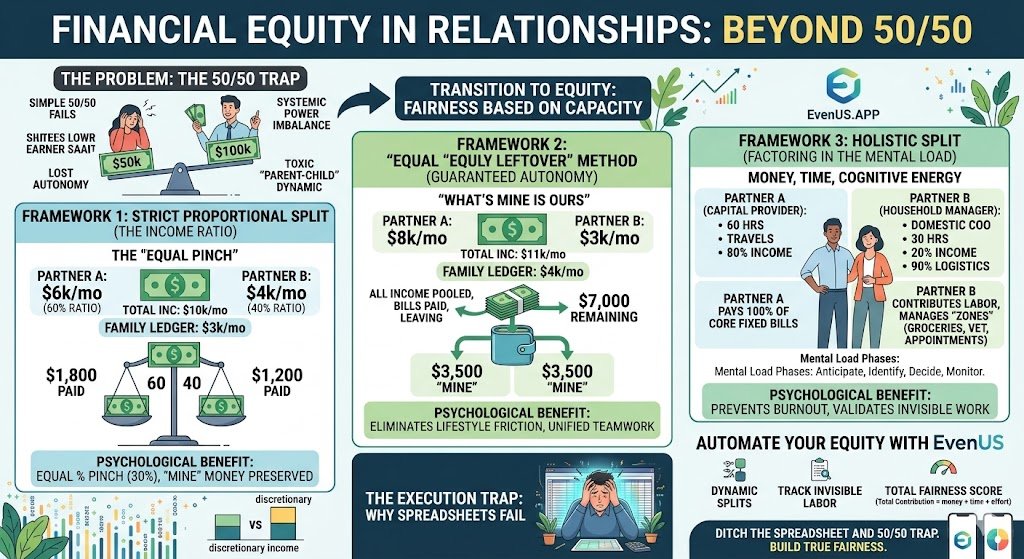
In the landscape of modern relationships, one of the most complex hurdles couples face isn’t a lack of communication or conflicting values—it is the math of their daily lives. When two people decide to merge their households, they rarely arrive with perfectly matching salaries, identical debt loads, or equal capacities for domestic management.
Yet, for decades, the ubiquitous financial advice given to couples has been shockingly simplistic: just split everything 50/50.
While this “roommate model” of finance sounds clean and objective, it routinely fails in the face of significant income disparity. If one partner earns twice as much as the other, forcing an equal-dollar split creates a systemic power imbalance. The lower earner suffocates under the financial pressure, while the higher earner builds wealth with ease. To protect the relationship from silent resentment, couples must transition from a mindset of equality (equal dollars) to a mindset of equity (fairness based on capacity).
But what does true financial equity look like in practice? Depending on a couple’s specific financial psychology and lifestyle, equity can take several forms. Here is a detailed, research-backed deep dive into three proven frameworks for dividing expenses fairly when incomes differ.
The Psychology of the Pay Gap in Relationships (Fair Expense Division for Couples with Unequal Earnings)
Before implementing a mathematical framework, it is crucial to understand the psychological friction that income disparity creates. According to research published in the Journal of Financial Therapy, unequal financial power often leads to a toxic “Parent-Child” dynamic.
When a strict 50/50 split drains the lower earner’s discretionary income, they lose their financial autonomy. If the couple wants to take a vacation or dine at a nice restaurant, the higher earner must step in as the “benefactor” to treat the lower earner. Over time, the lower earner begins to feel like a dependent who must ask for permission to participate in their own shared life, while the higher earner may feel burdened by carrying the lifestyle. This loss of agency is a primary driver of financial infidelity—hiding purchases or lying about prices to reclaim a sense of control.
To dismantle this dynamic, couples must choose an expense-division model that guarantees both shared responsibility and individual autonomy.
Framework 1: The Strict Proportional Split (The Income Ratio)
The Strict Proportional Split is the gold standard for modern couples who want to maintain a strong sense of financial independence while ensuring the household bills are paid equitably. The core philosophy here is the “Equal Pinch.”Instead of contributing the same amount of dollars, both partners contribute the exact same percentage of their income to the shared life.
The Mathematics of the Split
Imagine a scenario where a couple’s shared household expenses (rent/mortgage, utilities, shared groceries, and pet care) total $3,000 a month.
- Partner A (Higher Earner): Takes home $6,000 a month.
- Partner B (Lower Earner): Takes home $4,000 a month.
- Total Household Income: $10,000 a month.
To find the proportional ratio, divide each individual’s income by the household total:
- Partner A’s Ratio: $6,000 / $10,000 = 60%
- Partner B’s Ratio: $4,000 / $10,000 = 40%
Next, apply this ratio to the shared Family Ledger:
- Partner A pays 60% of the $3,000 bills = $1,800
- Partner B pays 40% of the $3,000 bills = $1,200
The Psychological Benefit
Under this framework, both partners are contributing exactly 30% of their respective take-home pay to the household. The financial “pinch” is identical. Most importantly, the money left over in their individual accounts becomes their “Mine” money. Partner A has $4,200 left over, and Partner B has $2,800 left over. They can spend, save, or invest these funds with absolute autonomy, free from guilt or interrogation.
The Limitation
While the percentage is fair, the absolute dollars left over still heavily favor the higher earner. Partner A still has significantly more discretionary income. If Partner A wants to take a luxury vacation that Partner B’s “Mine” money cannot cover, the couple will still have to negotiate how to fund lifestyle upgrades.
Framework 2: The “Equal Leftover” Method (Guaranteed Autonomy)
For some couples, the Proportional Split doesn’t go far enough. If the income gap is massive (e.g., one partner earns $150,000 and the other earns $40,000), a proportional split still leaves the lower earner with vastly fewer absolute dollars for personal enjoyment.
The “Equal Leftover” method solves this lifestyle friction by ensuring both partners receive the exact same dollar amount of personal autonomy every month, regardless of who earned what. It is a radical embrace of the “What’s mine is ours” philosophy.
The Mathematics of the Split
Imagine a scenario with a wider income gap and $4,000 in shared monthly expenses.
- Partner A: Takes home $8,000 a month.
- Partner B: Takes home $3,000 a month.
- Total Household Income: $11,000 a month.
Instead of calculating ratios, the couple pools all income into a joint “Ours” account first:
- $11,000 (Total Income) – $4,000 (Shared Bills) = $7,000 Remaining.
The couple then divides the remaining surplus equally and transfers it back to their individual checking accounts:
- Partner A gets $3,500 in “Mine” money.
- Partner B gets $3,500 in “Mine” money.
The Psychological Benefit
This method completely eliminates lifestyle friction and income-based power dynamics. Neither partner feels “poorer” in their daily personal life. Both have the exact same financial freedom to pursue hobbies, buy gifts, or save for personal goals, fostering a deep sense of unified teamwork. Recent studies in the Journal of Consumer Research indicate that couples who pool resources in this manner report the highest levels of long-term relationship satisfaction.
The Limitation
This requires absolute, unwavering trust. The higher-earning partner must genuinely view the relationship as a single economic unit. If the higher earner feels they are “subsidizing” the other’s personal savings or expensive hobbies, resentment will build rapidly.
Framework 3: The Holistic Split (Factoring in the Mental Load)
The most significant flaw in purely mathematical financial splits is that they only measure dollars. They assume that capital is the only valuable currency in a relationship. In reality, a household runs on money, physical time, and cognitive energy.
In many relationships with unequal earnings, the partner who earns less money actively compensates by taking on the vast majority of the household management. They absorb the Mental Load—the invisible, exhausting labor of anticipating needs, identifying solutions, making decisions, and monitoring outcomes (as identified by sociological research in the American Sociological Review).
If one partner provides the capital, but the other partner acts as the “Household COO,” a truly fair split must validate that invisible labor.
The Dynamics of the Split
- Partner A (The Capital Provider): Works 60 hours a week, travels frequently, and earns 80% of the household income.
- Partner B (The Household Manager): Works 30 hours a week, earns 20% of the income, but manages 90% of the domestic logistics (meal planning, scheduling vet and doctor appointments, managing repairs, and organizing shared schedules).
The Application
Instead of forcing Partner B to drain their smaller paycheck to meet a purely financial ratio, the couple assigns tangible value to Partner B’s time and cognitive effort.
- Partner A covers 100% of the core fixed financial bills (rent/mortgage, utilities, shared insurance).
- Partner B’s contribution is explicitly recognized as the management of the household “Zones.” They may only financially cover smaller, variable costs like their own car payment or weekend groceries.
The Psychological Benefit
This prevents the lower-earning partner from burning out. By validating the invisible work, the relationship achieves a balanced state of total equity. It proves that both partners are contributing maximally to the “Us” entity, just utilizing different currencies.
The Execution Trap: Why Spreadsheets Fail
Understanding these frameworks is empowering; executing them manually is exhausting.
Most couples who attempt a Proportional or Holistic split start with a shared spreadsheet. But life is dynamic. Salaries fluctuate with bonuses or commissions, utility bills spike in the winter, and tracking who actually completed the household chores becomes a source of bickering. The administrative friction of maintaining the math eventually outweighs the benefits, and couples abandon the system.
To make financial equity sustainable, you need an automated, neutral third party.
Automate Your Equity with EvenUS
EvenUS is the first relationship operating system designed specifically to handle the complexities of unequal incomes and the mental load.
- Dynamic Financial Splits: You simply connect your accounts and set your framework. EvenUS automatically calculates your proportional split based on real-time data. If an income changes, the math updates instantly. No spreadsheets required.
- Track the Invisible Labor: EvenUS solves the flaw of the “money-only” mindset. The platform allows you to explicitly track household “Zones,” chore management, and the cognitive labor that keeps your life running.
- The Total Fairness Score: Stop guessing who is pulling their weight. EvenUS combines your financial input with your time and effort to generate a single, objective Fairness Score. For the first time, both the capital provider and the household manager can visually see their holistic contributions keeping the relationship in perfect balance.
Money should be a tool that builds your shared future, not a wedge that drives you apart. By choosing the right equitable framework and automating the math, you can permanently remove financial tension from your relationship.
To validate the “Holistic Split” & Invisible Labor
Source: American Sociological Review Study: The Cognitive Dimension of Household Labor (2019) Author: Allison Daminger (Harvard University) Why it fits your article: This study formally identifies and categorizes the “Mental Load.” It provides the sociological proof that cognitive labor (anticipating, identifying, deciding, and monitoring) is a distinct, exhausting form of work. This is the ultimate proof text for why couples must factor in household management when discussing financial equity.
- Outbound Link: https://journals.sagepub.com/doi/10.1177/0003122419859007