
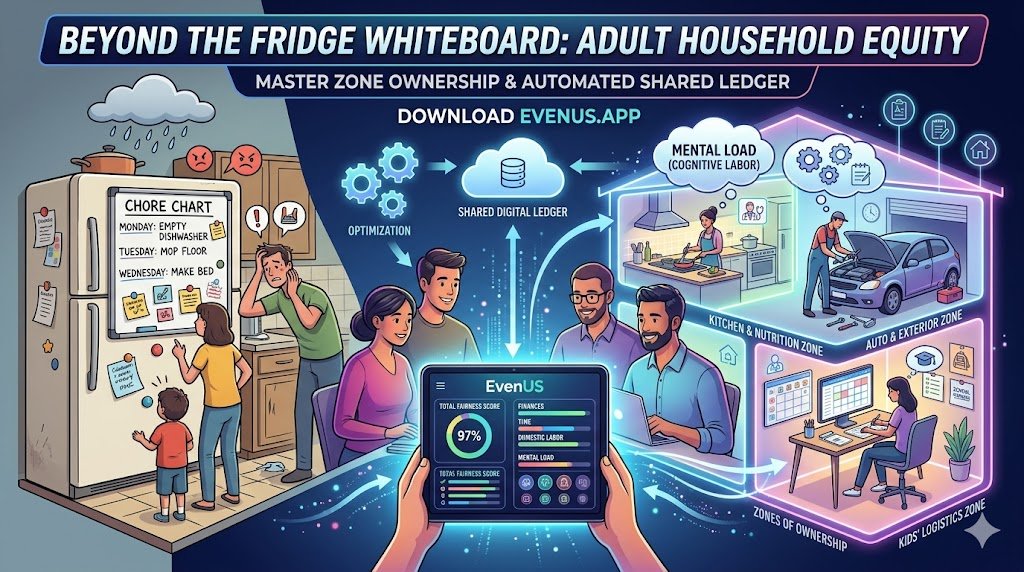
Beyond the Fridge Whiteboard- For decades, the standard advice for couples drowning in household responsibilities has been to “make a chore chart.” The result is usually a brightly colored magnetic whiteboard slapped onto the refrigerator, complete with dry-erase checkmarks and rigid assignments: Partner A takes out the trash on Tuesdays; Partner B loads the dishwasher on Wednesdays.
While this system works perfectly for teaching a child basic responsibility, it is fundamentally flawed for modern, adult partnerships. When you are managing careers, nurturing a romantic connection, and trying to balance the chaotic, overlapping schedules of twins in different class sections alongside a six-year-old, a sticker chart is insulting. It reduces the complex, high-stakes management of a family into a patronizing list of micro-tasks.
Adults do not want to be assigned “chores”; they want to build and manage efficient systems. When a household operates on a child-like task list, it inevitably breeds micromanagement, scorekeeping, and the toxic “Parent-Child” dynamic where one partner acts as the household manager and the other as a reluctant employee.
To protect your peace and your partnership, you must abandon the chore chart and build a comprehensive framework of household equity. Here is the definitive, research-backed guide to organizing domestic life for modern couples.
Beyond the Fridge Whiteboard: How to Build a Chore System That Adults Actually Want to Use
1. The Trap of Task-Splitting and “Availability Bias”
The reason traditional chore charts fail is that they focus exclusively on splitting physical tasks right down the middle (the 50/50 split). If there are forty chores to do in a week, the chart attempts to assign twenty to each person.
This approach creates a massive administrative bottleneck. Suddenly, both partners are spending valuable cognitive energy just tracking who wiped down the counters last. Furthermore, it triggers a psychological phenomenon known as Availability Bias. Because you physically experience the effort of every task you complete, your own labor is highly “available” to your memory. Conversely, you are largely blind to the physical friction your partner experiences when they complete their tasks.
When you split micro-tasks, both partners inevitably feel like they are doing 70% of the work. The chart, intended to create peace, becomes a scoreboard for resentment.
2. The Solution: The “Zone of Ownership” Model
The most effective way to eliminate task-tracking friction is to transition from micro-managing chores to macro-managing “Zones.” In the business world, a CEO does not assign individual emails for their executives to send; they assign entire departments. Your household should run the same way.
Instead of dividing fifty tasks, divide your home and life into functional Zones, and assign complete, end-to-end ownership to one partner.
How Zone Ownership Works: If you own a Zone, you do not just execute the final step; you own the planning, the execution, and the quality control.
- The Kitchen & Nutrition Zone: The owner of this zone doesn’t just “cook dinner.” They own the meal planning, the grocery inventory, the shopping, the food prep, and the cleanup strategy.
- The Auto & Exterior Zone: The owner doesn’t just “mow the lawn.” They own the landscaping schedule, the vehicle maintenance logs, the insurance renewals, and the physical garbage removal.
- The Kids’ Logistics Zone: The owner handles the school communications, tracks the extracurricular sign-ups, manages the pediatrician appointments, and ensures the permission slips are signed.
The Benefit: When you own a Zone completely, you have the autonomy to execute it however you see fit. If the Kitchen Zone owner wants to meal-prep on Sundays so they don’t have to cook on Wednesdays, they can. There is no more nagging, no more “I thought you were going to do it,” and no more micromanagement. The delegation is absolute.
3. Validating the Invisible: Accounting for the Mental Load
The most critical flaw of the traditional fridge chore chart is that it only measures physical movement. It tracks who pushed the vacuum, but it ignores the exhausting, invisible work required to keep the house running.
Sociological research, notably the work of Harvard’s Allison Daminger, categorizes this invisible work as Cognitive Labor, or the “Mental Load.” Daminger identifies four distinct stages of household work:
- Anticipating a need (realizing the six-year-old is outgrowing their winter coat).
- Identifying options (finding a store with a sale on durable coats).
- Deciding on the action (choosing the size and color).
- Monitoring the result (making sure the coat actually fits when it arrives).
The physical task of clicking “Buy” or driving to the store is just a fraction of the total labor. In many relationships, one partner takes on 90% of this cognitive labor. If your household management system does not explicitly recognize and value this “Project Management” as real work, the partner carrying the mental load will burn out.
When defining your Zones of Ownership, ensure that the planning and logistical phases are explicitly discussed and valued just as highly as the physical execution.
4. Automate the Friction: The “Zapier” Mindset for the Home
Manual data entry is the enemy of consistency. If your household management system requires you to sit down every Sunday night and manually rewrite a whiteboard or update a complex spreadsheet, you will abandon it within a month. Adults thrive on automated systems that reduce cognitive friction.
You need to apply a “Zapier” mindset to your home—where an action or need in one area automatically triggers a solution or reminder in another, without requiring human intervention.
Practical Automations for the Household:
- Digital Shared Calendars: Ditch the paper calendar. Use a shared digital calendar where school events, work travel, and social obligations are automatically synced to both partners’ phones.
- Smart Home Integrations: Use voice assistants to build dynamic grocery lists. When you use the last of the milk, a simple voice command adds it to a shared digital list, eliminating the “Mental Load” of trying to remember it later.
- Subscription Services: Automate your baseline necessities. Set up recurring deliveries for dog food, toilet paper, air filters, and cleaning supplies.
The goal is to remove as many low-level, recurring decisions from your brain as possible, freeing up your cognitive energy for your career, your kids, and your partner.
5. The Grace Protocol: Building a System That Bends
A child’s chore chart is fundamentally rigid: if the bed isn’t made, the allowance isn’t paid. Adult lives, however, are wildly unpredictable. Illnesses sweep through the house, major project deadlines hit at work, and sometimes, the laundry is simply going to sit in the basket for four days.
A household system that cannot bend will break under pressure. To make a framework sustainable long-term, you must build in a “Grace Protocol.”
The Weekly “State of the Union” Set aside ten minutes every Sunday afternoon for a forward-looking check-in. The goal is not to look backward and scorekeep, but to look forward and assess capacity.
- Ask the Capacity Question: “What is your energy level looking like for this week?”
- Adjust the Zones: If Partner A has three late-night meetings and is operating at 30% capacity, Partner B temporarily absorbs a portion of their Zone.
This protocol transforms the relationship from a transaction (where a missed chore is a breach of contract) into a true partnership (where a missed chore is a signal that your teammate needs cover).
6. The Ultimate Solution: Digitize and Unify with EvenUS
The evolution of household management naturally leads away from manual tracking and toward sophisticated, purpose-built digital tools. Attempting to manage modern domestic equity through shared notes apps or spreadsheets usually devolves into administrative friction and the exact “Venmo Roommate” arguments you are trying to avoid.
This is the exact problem the EvenUS app was engineered to solve. Built exclusively for couples, it replaces the archaic chore chart with a dynamic, automated ledger of total relationship equity.
- Track the Invisible Labor: EvenUS is designed to capture the full spectrum of household management. It provides a platform to log not just physical tasks and shared financial expenses, but the time and cognitive energy spent managing the home.
- Dynamic Proportional Balancing: The app acts as a neutral third party, synthesizing your financial contributions, time spent, and domestic labor into a single, unified view. It calculates a “Total Fairness Score,” ensuring that the partner who handles the bulk of the mental load is tangibly credited for their effort.
- Eliminate the Scoreboard: By automating the tracking and the math, EvenUS removes the need for one partner to act as the nagging project manager. It shifts the dynamic from “Me vs. You” to “Us vs. The System.”
Upgrading your household management is not just about keeping a cleaner kitchen; it is about protecting your individual identities, preserving your energy, and actively choosing to build a balanced partnership. When you drop the chore chart and adopt a system of shared ownership and automated equity, you stop fighting over the micro-tasks and start enjoying the life you are building together.
Stop managing chores and start managing your equity. If you are ready to ditch the dry-erase board and automate your household’s mental load, it is time to upgrade your system. Transform how you and your partner share life’s responsibilities with dynamic tracking, fair-share math, and comprehensive zone management.
👉 Build your balanced partnership today at EvenUS.app
Division of Household Labor & Relationship Burnout: