
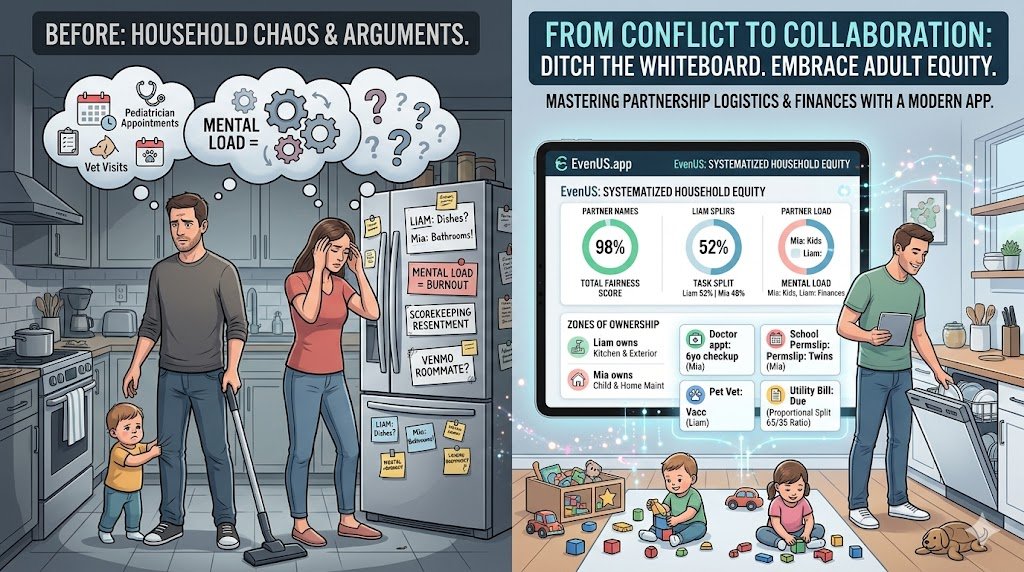
From Conflict to Collaboration– It is a universally recognized domestic trope, played out in millions of households every weekend: The dreaded Saturday morning cleaning frenzy.
It almost always begins the same way. One partner wakes up early, fueled by a potent mix of latent stress and black coffee, and begins aggressively vacuuming the hallway to signal that “playtime is over.” They slam cabinet doors, sigh heavily while loading the dishwasher, and march through the house armed with microfiber cloths and a deep sense of martyrdom. The other partner wakes up to the sound of a vacuum cleaner hitting the baseboards, feeling immediately defensive and deeply resentful that their hard-earned weekend is being hijacked by a spontaneous, high-stress chore bootcamp.
What follows is rarely a collaborative, team-building effort. It is a standoff. It is a morning of passive-aggressive comments, micro-managed task assignments, and simmering tension that ruins the rest of the day.
If your weekly cleaning routine feels more like a battlefield than a shared responsibility, the issue is not that your house is too dirty, and the issue is not that your partner is inherently lazy. The issue is that your operating system is fundamentally broken. Relying on a once-a-week, high-stress purge fueled by resentment is an entirely unsustainable way to run a home.
If you want to protect your peace and your partnership, you have to dismantle the Saturday morning standoff. Here is how modern couples are completely reimagining the domestic cleaning routine, shifting from weekend conflict to systematized, stress-free collaboration.
From Conflict to Collaboration: Reimagining the Weekly Cleaning Routine
1. The Death of the “Weekend Purge”
The traditional model of saving all the household chores for Saturday morning is a relic of a bygone era, usually modeled after a time when one partner managed the home full-time. For modern, dual-income couples, treating the weekend as a catch-all for domestic labor is a recipe for severe burnout.
Consider the logistical reality of a growing family. When your Saturday is already cannibalized by managing a six-year-old’s birthday party circuit, while simultaneously trying to coordinate the entirely separate schedules, needs, and extracurriculars of twin siblings, your weekend bandwidth is already stretched to its absolute limit. Spending your remaining three hours of free time aggressively scrubbing toilets and mopping floors is a surefire way to destroy your mental health and your marital intimacy.
The Shift to Continuous Maintenance: You must stop treating cleaning as a singular, punishing weekend event. The most peaceful households operate on a system of continuous maintenance. By breaking down the house into daily, manageable, 15-minute micro-routines—running a load of laundry on Tuesday night, wiping down the bathrooms on Thursday morning—you completely eliminate the need for the weekend purge. You reclaim your Saturday for actual rest, family connection, and recovery. A collaborative home runs on steady, invisible systems, not emergency purges.
2. Abolishing the “Cleaning General” Dynamic
During a standard weekend cleaning spree, one partner inevitably assumes the role of the “Cleaning General.” Because they initiated the purge, they feel entitled to bark orders and delegate tasks. “Can you do the guest bathroom? Did you take out the recycling? Grab the Windex and do the sliding doors.”
As established in the Co-CEO framework of relationship equity, this dynamic is incredibly toxic. It forces one person to carry the entire cognitive load of project-managing the house, identifying every speck of dust and assigning a worker to clean it. The other partner is immediately demoted to an “intern” who only acts when instructed. It breeds exhausting micromanagement on one side and weaponized incompetence on the other. The General feels like a nagging parent; the intern feels like a scolded teenager.
The Shift to Zone Ownership: To collaborate effectively, you must move from task delegation to Zone Ownership. The General must be permanently fired. Instead of one partner assigning the kitchen cleanup on a Saturday, Partner A simply owns the Kitchen Zone for the entire week (or month). They hold the executive authority over when to clean it, what products to use, and how to execute it. Partner B owns the Living Areas and the Bathrooms. When both partners become autonomous managers of their respective domains, the nagging completely stops.
3. Defining the “Clean Threshold” (The Minimum Viable Standard)
A massive percentage of cleaning arguments stem from mismatched visual thresholds.
Partner A might look at the kitchen and feel it is perfectly “clean” because the plates are in the dishwasher and the food is put away. Partner B might walk in and feel their blood pressure spike because, to them, the kitchen isn’t clean until the sink is scrubbed with Bar Keepers Friend, the counters are sanitized, and the dish towels are swapped out for fresh ones. When Partner A stops at their personal threshold, Partner B feels disrespected and assumes their partner is doing a “half-job” on purpose.
The Shift to Objective Baselines: You cannot hold a partner accountable to a standard that only exists in your head. You must establish a Minimum Viable Standard (MVS) for every room in the house. Sit down together during a calm, neutral time (never during an argument) and explicitly agree on what “done” actually looks like.
If the agreed-upon MVS for the living room includes folding the throw blankets and clearing the coffee table of mail, then the zone is not complete until those specific criteria are met. This simple act removes subjective feelings, personal preferences, and assumptions from the equation. It replaces emotional scorekeeping with an objective, shared standard.
4. Making the Invisible Labor Visible: The “Prep Work” Trap
A hidden source of deep conflict during cleaning routines is that one partner often does the “invisible” organizing work long before the physical cleaning even begins.
You cannot run a vacuum over a floor covered in stray Lego bricks, school permission slips, and dog toys. You cannot wipe down a kitchen counter covered in unopened mail and half-empty water bottles. The act of picking up, sorting, decluttering, and organizing surfaces takes massive cognitive and physical energy.
If Partner A spends forty-five minutes frantically decluttering the living room so that Partner B can spend ten minutes quickly running the vacuum, the labor is not equal—even if both people technically “cleaned the living room.” Partner B gets the satisfaction of completing the final, visible task, while Partner A is exhausted from the invisible prep work.
The Shift to Validating the Load: Organizing and decluttering must be recognized as distinct, heavy-lifting tasks, not just a minor precursor to running a mop. In a collaborative environment, the cognitive load of organizing the chaos is treated with the exact same weight and value as the physical act of scrubbing the surfaces.
5. Systematizing the Routine with EvenUS
You cannot successfully shift from a dynamic of weekend conflict to systematized collaboration if you are still trying to manage your domestic schedules via group texts, passive-aggressive sighs, or a static whiteboard on the refrigerator. Human memory is flawed, and manual scorekeeping always breeds resentment. To make continuous maintenance, Zone Ownership, and the MVS actually work, you need a shared digital brain.
This is exactly where the EvenUS platform completely transforms the architecture of a relationship. Engineered specifically for couples—not roommates, and not corporate teams—EvenUS provides the overarching framework required to permanently end the chore wars.
- Automated Zone Rotations: Instead of arguing over whose turn it is to scrub the bathrooms this weekend, the EvenUS app manages the rotation autonomously. It acts as the neutral, emotionless third party, sending automated nudges and completely eliminating the need for a “Cleaning General.”
- Standardizing the MVS: You can build your agreed-upon Minimum Viable Standards directly into the app’s zone descriptions. When a partner claims a zone is finished, they are visibly confirming to the system that they hit the shared baseline.
- The Total Fairness Score: By explicitly allowing couples to log not just the physical cleaning, but the time spent decluttering, organizing, and managing the invisible household logistics, EvenUS quantifies the holistic effort. It synthesizes your domestic labor, your mental load, and your proportional finances into one unified metric.
When you can open an app and look at a dashboard that proves, objectively, that the labor of the household is balanced and fair, the anxiety vanishes. When you outsource the nagging, the schedule, and the scorekeeping to a dedicated relationship equity tool, you stop fighting over the vacuum cleaner. You get to protect your peace, preserve your energy, and finally get your weekends back to enjoy the life you are building together.
If you are tired of spending your precious weekends locked in a standoff over the vacuum cleaner, it is time to change your operating system. According to relationship experts at the Gottman Institute, how couples navigate the division of household labor is one of the strongest predictors of long-term marital satisfaction. You cannot fix a systemic relationship issue with a passive-aggressive whiteboard. Stop fighting over micro-tasks, validate the invisible prep work, and start automating your shared life.
👉 End the chore wars and systematize your domestic equity today at EvenUS