
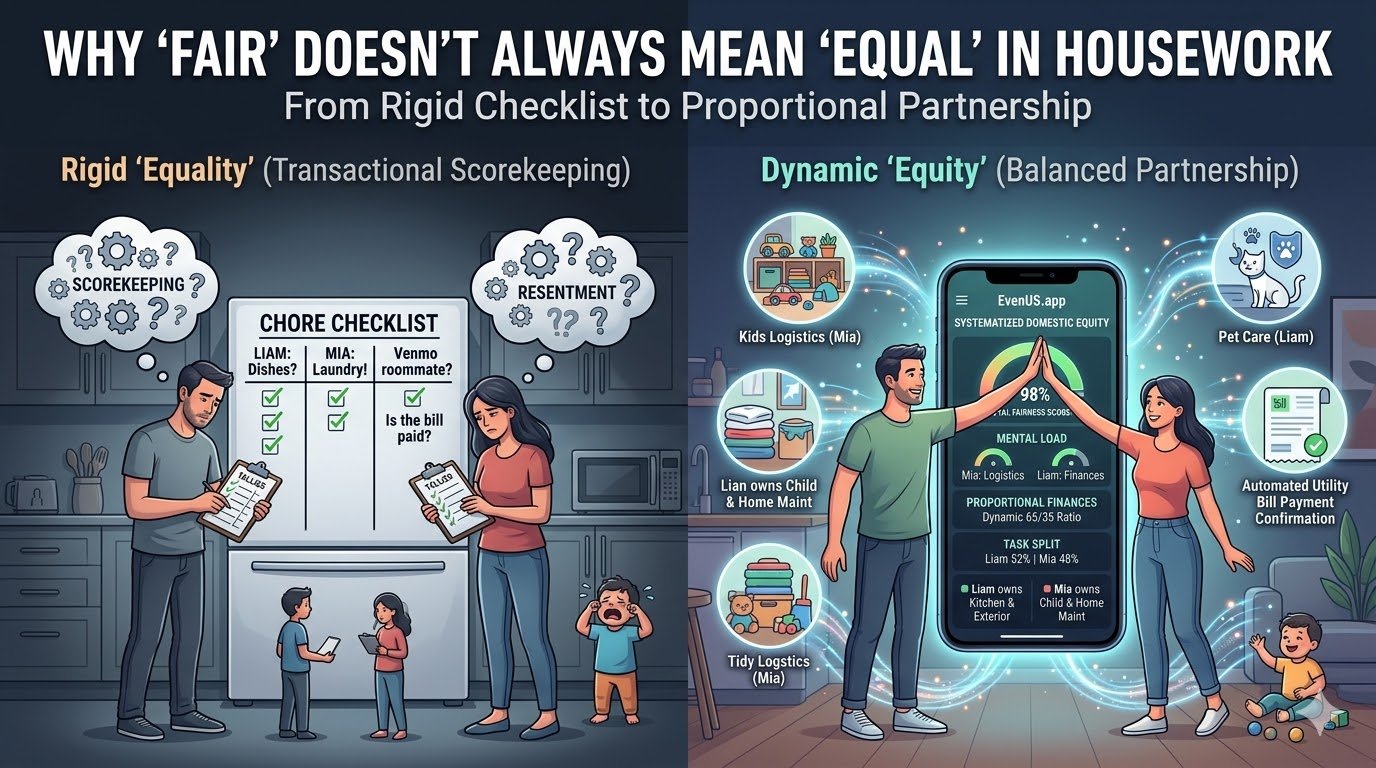
For generations, the holy grail of the modern, progressive relationship has been the “50/50 split.” In theory, it is the ultimate expression of egalitarian love: couples sit down, draw a rigid line down the middle of a piece of paper, and divide the household chores directly in half. You wash the dishes; I dry them. You pay exactly half the rent; I pay the other half. You do the bedtime routine on Tuesdays and Thursdays; I take Mondays and Wednesdays.
Fair Doesn’t Always Mean Equal – On paper, this looks like a mathematical triumph. It sounds like a victory for fairness. But in the messy, high-pressure reality of modern life, the strict 50/50 split is quietly destroying the very relationships it was meant to save.
The reason is simple: striving for a perfectly equal division of labor relies on the flawed assumption that both partners have the exact same income, the exact same working hours, the exact same physical energy levels, and that every chore holds the exact same “weight.” In a world of fluctuating careers, varying emotional capacities, and the invisible burden of the mental load, a 1-to-1 split is not just difficult—it is mathematically and emotionally impossible.
If you want to build a sustainable, resentment-free partnership, you must stop striving for Equality (where everything is divided perfectly in half) and start striving for Equity (where responsibilities are shared based on capacity, proportionality, and the true weight of the labor). Here is an in-depth look at why “fair” and “equal” are not synonyms, and how to redesign your domestic life for true balance.
Why “Fair” Doesn’t Always Mean “Equal” in Housework: Reimagining Domestic Equity
1. The Weight of the “Mental Load”: Why Tasks Aren’t 1-to-1
The primary reason a 50/50 chore list fails is that it treats all household tasks as if they require the same amount of effort and cognitive energy. This is a cognitive bias that ignores the “Mental Load”—the invisible work of anticipating needs, identifying solutions, and making executive decisions.
Consider a common “equal” split: Partner A agrees to take out the trash and mow the lawn, while Partner B agrees to manage the children’s school schedules and handle the weekly meal planning. On a standard checklist, this looks like two chores each. It looks “equal.”
However, taking out the trash is a purely physical task that takes three minutes and requires zero planning. Conversely, managing the logistics of a growing family—such as advocating for twins to be placed in different school sections to foster their individual growth, while simultaneously tracking a six-year-old’s pediatric appointments and extracurriculars—is a massive, ongoing cognitive project. Partner B is essentially working as a high-level project manager, while Partner A is an entry-level technician.
The Equity Shift: You must stop counting chores and start weighing them. True fairness requires acknowledging that the person who thinks about the chore (Phase 1: Anticipating and Phase 2: Deciding) is often doing more work than the person who physically executes the chore. An equitable system grants more “points” to cognitive labor, ensuring the planner is not burned out by the invisible weight of the household.
2. The Trap of Financial “Equality”
The confusion between fair and equal is perhaps most destructive in the realm of household finances. Many modern couples, desiring to maintain their financial autonomy, choose to keep their bank accounts separate and split shared bills exactly 50/50.
If the rent is $2,000, both partners pay $1,000. This is equal. But if Partner A earns $120,000 a year and Partner B earns $60,000 a year, this arrangement is structurally unfair. Partner B is spending a massive, suffocating percentage of their take-home pay just to survive the baseline household expenses, while Partner A is comfortably building discretionary wealth, investing in hobbies, and padding their personal savings.
This creates a “Venmo Roommate” dynamic. It breeds a transactional atmosphere where the lower-earning partner feels like a subordinate, and the higher-earning partner is blind to the financial stress their “equal” partner is carrying.
The Equity Shift: Fair finances are proportional, not equal. A truly equitable partnership operates on dynamic ratios. If one partner contributes 70% of the household income, they should arguably contribute 70% of the household expenses. This ensures that both partners have a similar percentage of “fun money” and the ability to save, preserving individual autonomy while fostering a team-first mindset.
3. The Fluctuation of Human Capacity
A 50/50 chore chart is static and rigid, but human life is fluid and unpredictable. What happens to a perfectly equal chore chart when one partner gets a massive promotion and is suddenly working 60-hour weeks? What happens when one partner is navigating a chronic health flare-up, recovering from a difficult pregnancy, or grieving a loss?
If you enforce a strict “equal” contract, the partner with temporarily diminished capacity will inevitably fail to meet the standard. The other partner will then feel resentful that they are “picking up the slack,” viewing the dynamic as a breach of contract rather than an opportunity for support.
The Equity Shift: A fair relationship recognizes that capacity is not a constant. Some weeks, the split will naturally be 80/20 because one partner is drowning. The goal is macro-equity over the lifespan of the relationship, not micro-equality on a random Tuesday. True partners step in to cover the “gap” without keeping a bitter scorecard, knowing that the balance will shift back when the roles are reversed.
4. Overcoming “Availability Bias” in Scorekeeping
Why do we cling to the 50/50 split? Because equality is incredibly easy to measure. You can look at a whiteboard and instantly see if there are three checkmarks next to your name and three next to your partner’s.
Measuring “equity”—which requires calculating time, mental load, proportional finances, and physical energy—is mathematically complex. Because we cannot easily calculate these variables in our heads, we fall victim to Availability Bias. We are intimately aware of every dish we wash and every stressful email we send, but we are often blind to the labor our partner performs when we aren’t looking. Consequently, both partners often feel like they are doing 70% of the work.
5. Systematizing Equity: The EvenUS Solution
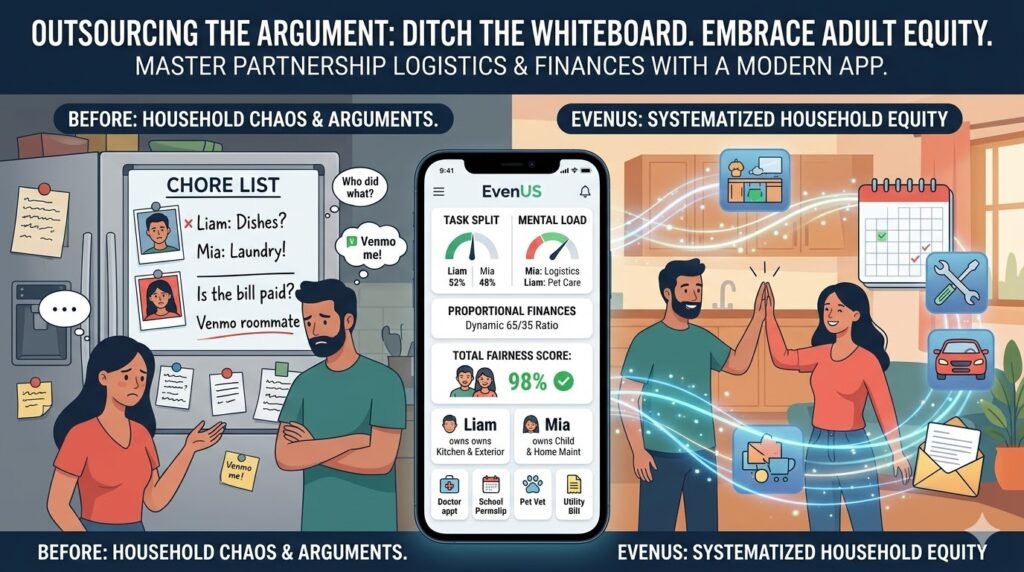
You cannot achieve true equity through verbal agreements or a basic notepad app. The math is too dense, and the human brain is too biased. To build a truly balanced partnership, you have to outsource the complex calculations to a neutral, data-driven system.
This is the foundational architecture of the EvenUS platform. EvenUS was built specifically to solve the “Equality vs. Equity” paradox for modern couples.
- It Weights the Labor: Instead of simple checkboxes, EvenUS allows you to log the mental load. It recognizes that “Planning the Week” is a heavier lift than “Taking out the Trash,” ensuring both partners feel seen for their specific contributions.
- It Automates Proportional Finances: The virtual joint ledger takes the guesswork out of money. It automatically handles income-proportional splits, so the financial burden is shared fairly based on what you actually earn, not an arbitrary 50/50 split.
- The Total Fairness Score: EvenUS synthesizes your time, your money, and your cognitive effort into one unified dashboard. It provides an objective “Total Fairness Score” that acts as a neutral third party. When the data shows the household is balanced at 98% fairness, the scorekeeping arguments simply disappear.
Conclusion: From Transactional to Transformational
When you stop trying to slice your life perfectly down the middle, you remove the transactional, “I-owe-you” nature of the relationship. By embracing true equity, you validate your partner’s unique capacity, respect the invisible weight they carry, and build a household that actually functions as a cohesive team.
Equality is about the tasks; Equity is about the people. It’s time to stop counting chores and start building a life where both partners can thrive.
If you want to understand the psychological toll of strict “equality” vs. “equity,” it is worth exploring the concept of Availability Bias in Relationships. This foundational research explains why both partners consistently feel they are doing more than their fair share, and why manual scorekeeping is a losing game for intimacy.
Once you realize that your brain is hard-wired to miscalculate fairness, you need a system that doesn’t rely on your memory. Stop trying to slice your life perfectly down the middle with a whiteboard. Move your household management into a dashboard that weights the mental load, calculates proportional finances, and tracks true partnership equity.