
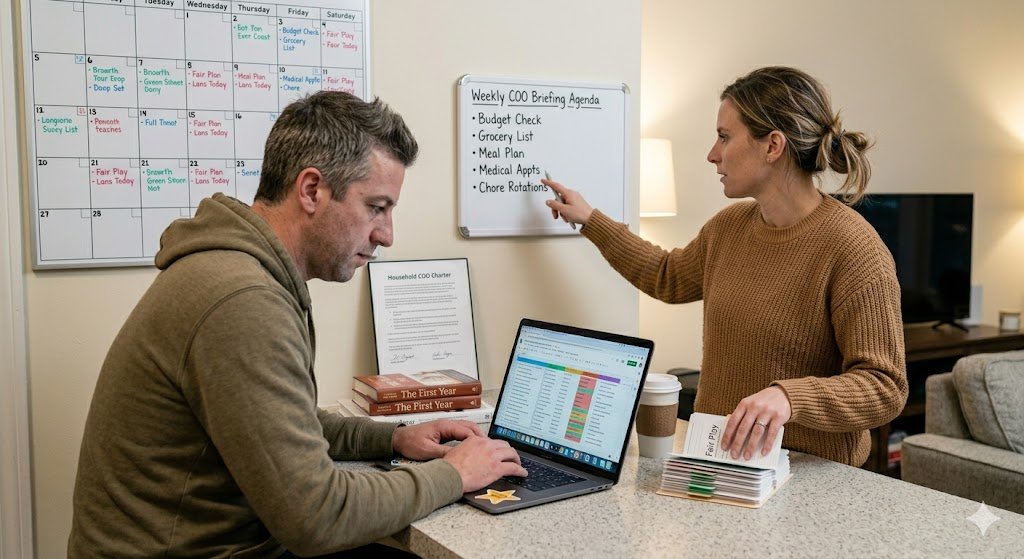
Why Every Modern Couple Needs a Household COO.- It’s 8 p.m. on a Wednesday. Dinner is eaten, the kids (or the dog, or just the two of you) are settled, and one partner collapses on the couch with their phone. The other is still standing at the kitchen island, mentally running through tomorrow’s checklist: “Did I schedule the oil change? Who’s picking up the dry cleaning? When is the credit card due? Oh, and we’re out of coffee again.”
Sound familiar? This silent, endless loop of planning, remembering, and coordinating is the mental load — the invisible third shift that quietly erodes relationships. One partner carries 70–73 % of it, while the other barely notices until the explosion comes.
Enter the solution every modern couple actually needs: a Household COO — a Chief Operating Officer for your home life. Just as every successful company has a CEO who sets vision and a COO who executes the operations, every thriving couple needs someone (or a rotating team) to run the “business” of daily life with clarity, systems, and accountability.
This isn’t about turning your relationship into a corporation. It’s about stopping the quiet resentment, reclaiming hours every week, and protecting the love that brought you together in the first place.
Why Every Modern Couple Needs a “Household COO.”
Why Modern Couples Are Crashing Without One
Today’s households are more complex than ever. Dual-income families, remote work, kids with packed schedules, aging parents, health apps, subscriptions, taxes, travel planning, and the sheer volume of decisions that hit every single day have turned home life into a full-time operational role.
Yet most couples still run it like a 1950s mom-and-pop shop: no org chart, no meetings, no clear roles. The result? One person — statistically the woman — becomes the unpaid, unthanked COO by default.
The data is sobering. A 2024 study published in the Journal of Marriage and Family (analyzing 3,000 U.S. parents) found mothers handle 71 % of household tasks that require cognitive effort — scheduling, planning, remembering, coordinating. A University of Southern California study of 322 mothers put the number at 73 % for cognitive labor and 64 % for physical labor. Taking out the trash was literally the only task where fathers did more planning.
A 2024 Skylight report surveyed over 2,000 parents and discovered the mental load now equals more than 30 hours per week — essentially a full-time job on top of paid work. Sixty-one percent said it directly reduces time spent with their partner.
Swedish population data (14,000+ adults) shows women still perform almost twice as much unpaid domestic work as men, even in 2025–2026. A 2025 meta-analysis and multiple studies link this cognitive burden directly to higher rates of depression, stress, burnout, and — crucially — lower relationship satisfaction and functioning. The partner carrying the load feels invisible; the other feels nagged. Both lose.
Without a deliberate Household COO structure, modern couples aren’t just inefficient — they’re quietly accumulating resentment that no amount of date nights can fix.
The Proven Benefits of Installing a Household COO
Couples who professionalize their home operations report dramatic improvements:
- Less conflict and higher satisfaction When tasks are clearly owned and systems exist, arguments over “who forgot” drop sharply. Research shows equal or clearly divided labor (especially when cognitive load is shared) correlates with stronger relationship quality.
- More time for connection The Skylight data showed couples reclaiming hours once the mental load is systematized. That translates to real evenings together instead of one person mentally multitasking while the other relaxes.
- Better mental health Studies in Archives of Women’s Mental Health (2025) and related journals found that reducing one partner’s disproportionate cognitive labor measurably lowers depression, stress, and burnout symptoms.
- Financial wins A Household COO tracks subscriptions, negotiates bills, spots waste, and keeps budgets realistic — often saving hundreds per month that used to disappear into “I don’t know where the money went.”
- Long-term resilience Life events (new baby, job loss, move, illness) stop feeling like total chaos because the operational backbone already exists.
In short: couples who treat their home like a well-run organization don’t just survive modern life — they thrive in it.
Step-by-Step: How to Appoint and Run Your Household COO
This isn’t complicated. Most couples can set it up in one focused weekend.
1. Have the “We Need a COO” Conversation Sit down device-free. Ask:
- Who currently carries most of the mental planning?
- How much time per week does it feel like we’re losing?
- What would life feel like if this ran smoothly?
Frame it as “us vs. the chaos,” never “you vs. me.” Many couples discover the load is 80/20 without either realizing it.
2. Decide the Model Three options work well:
- Single COO (one partner owns operations for 3–6 months, the other supports). Ideal if one person is naturally organized.
- Rotating COO (switch every quarter). Prevents burnout and builds empathy.
- Co-COO (split domains: one handles finances + scheduling, the other handles household maintenance + family calendar).
Choose based on strengths, schedules, and energy — not gender.
3. Define the COO Role Clearly Write a one-page “job description.” Typical responsibilities include:
- Master calendar & family schedule
- Budget tracking and monthly money meeting
- Grocery & meal planning
- Chore system & delegation
- Subscriptions, bills, insurance, taxes
- Vendor management (cleaners, repair people, childcare)
- Medical & school admin
- Long-term planning (vacations, home projects, retirement)
The COO doesn’t do every task — they own the thinking and ensure it gets done.
4. Build the Systems
- Shared digital brain: Google Calendar + Notion/Trello/Excel dashboard (one source of truth).
- Weekly 20-minute “COO Briefing” every Sunday evening (agenda: wins, next week’s priorities, budget check).
- Chore matrix or app (Fair Play cards, Sweepy, or a simple Google Sheet).
- Monthly metrics review: How many hours did we save? Relationship satisfaction 1–10?
5. Add Accountability & Appreciation The non-COO partner agrees to follow the system without pushback. The COO gets full authority in their domain but must report transparently. End every briefing with genuine appreciation — it’s the cheapest and most effective motivation there is.
Handling the Hard Parts: Resistance, Gender Dynamics & Burnout
Some partners initially resist: “I’m not a secretary.” Others fear losing control. Start small — let the new COO run just the calendar and grocery list for 30 days and review results. Data almost always wins the argument.
For couples where the woman has carried the load for years, the transition can feel emotional. Give space for that. Many men report huge relief once they see the invisible work and step into real ownership.
If one person is clearly better at operations, lean into it — but never let it become permanent without rotation. The goal is equity, not perfection.
Real-Life Routines That Make the COO Role Stick
- Sunday COO Briefing (20 minutes) — agenda on the fridge or shared doc.
- Monthly Money & Operations Date — review budget, cancel unused subscriptions, plan big items.
- Quarterly Role Review — adjust domains, celebrate time saved, tweak systems.
- Daily Handoff — a 2-minute voice note or text: “COO update — dentist appointment booked, groceries ordered.”
- Annual Offsite — one weekend away (or at home) to review the whole system and dream about the next year.
Couples who run this for six months rarely go back. The home simply feels lighter.
The Bottom Line
Your relationship is the most important “company” you’ll ever run. Yet most couples invest more strategy in their Netflix queue than in how they actually operate their shared life.
A Household COO isn’t extra work — it’s the smartest shortcut to less stress, more equity, deeper connection, and a partnership that can handle whatever life throws at you next.
You already chose each other. Now give your home the professional operating system it deserves. One clear role, one shared dashboard, and one weekly briefing can transform the quiet exhaustion into quiet confidence.
The couple who runs their household like a well-oiled machine doesn’t just survive modern life — they get to actually enjoy it.
Backed by Research
- Journal of Marriage and Family (2024): Moms handle 71 % of cognitive household tasks — https://onlinelibrary.wiley.com/doi/10.1111/jomf.13057
Ready to Stop Carrying the Mental Load Alone?
Your relationship deserves better than one partner quietly running the entire “business” of home life while resentment builds. Install a Household COO in under an hour and finally get clarity, fairness, and hours back every week. Grab your free Household COO Starter Kit — complete with the one-page job description, weekly briefing agenda template, shared dashboard setup, chore matrix, and 30-day rollout plan that thousands of couples now use.
Turn chaos into calm and protect the love you actually have time for.