
It’s Sunday evening. The bills are spread across the kitchen table, one partner is silently fuming about the latest credit-card surprise purchase, and the other is mentally tallying who did (or didn’t) unload the dishwasher for the third time this week. Voices rise. Resentment simmers. This isn’t a fight about money or dishes—it’s a fight about values that were never discussed.
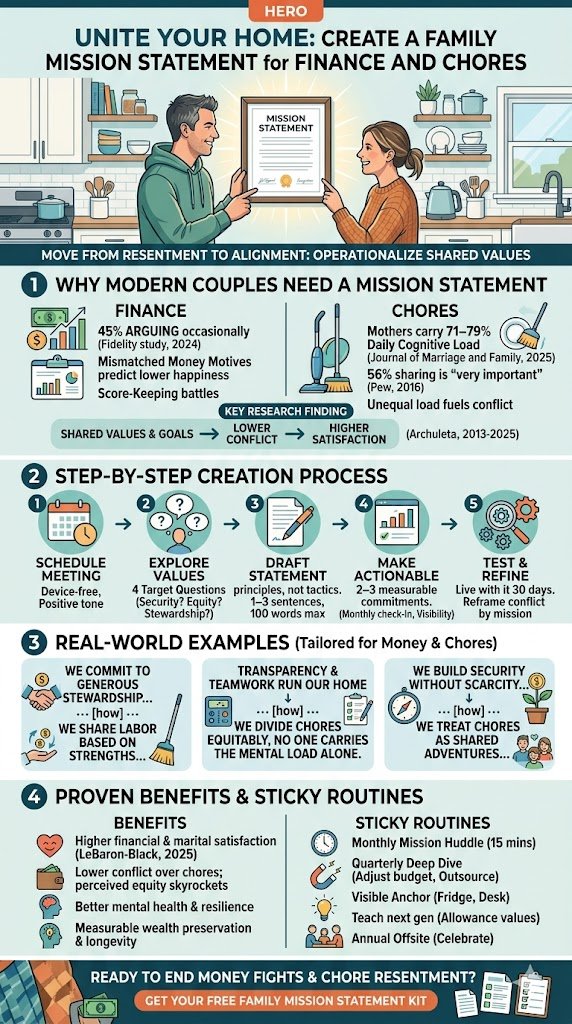
Most couples inherit their financial habits and chore expectations from their parents or culture, then clash when those unspoken rules collide. The result? 45 % of couples argue about money at least occasionally (Fidelity 2024 Couples and Money Study), while 56 % of married adults say sharing household chores is “very important” to a successful marriage (Pew Research Center, 2016). Yet few ever sit down to define what their shared values actually are.
Enter the Family Mission Statement for Finance and Chores—a short, powerful declaration of what your household stands for when it comes to money and daily labor. Think of it as the Constitution for your shared life: one page that turns vague frustrations into clear principles, reduces mental-load battles, and aligns every spending decision and chore rotation with what you both actually believe.
This isn’t fluffy corporate-speak. It’s a research-backed tool, popularized by Stephen R. Covey in The 7 Habits of Highly Effective Families (1997), that operationalizes shared values—the single strongest predictor of both financial satisfaction and relationship quality in modern couples.
Creating a “Family Mission Statement” for Finance and Chores
Why Modern Couples Desperately Need One
Today’s households are complex machines: dual incomes, streaming subscriptions, kids’ activities, aging parents, and the invisible “mental load” of remembering everything. Without explicit alignment, small mismatches compound into major resentment.
A 2025 University of Georgia study found that spouses who view their partner as a “saver” (rather than a spender) report significantly higher marital happiness and financial well-being. Conversely, mismatched money motives predict lower satisfaction. On the chore side, a 2022 University of Utah analysis of national surveys showed that couples who share at least three household tasks (rather than dividing them rigidly) experience dramatically higher relationship quality and sense of equity—more so than the raw percentage split.
The numbers are stark: mothers still shoulder 71–79 % of daily cognitive labor (Journal of Marriage and Family, 2025; Archives of Women’s Mental Health, 2024), and this imbalance directly predicts higher depression, stress, and relationship conflict. Financial stress amplifies everything—yet the same studies show that shared goals and values act as a powerful buffer.
A path-model study by Archuleta, Grable & Britt (2013, updated analyses through 2025) tested 600+ couples and discovered something profound: financial satisfaction does not directly predict relationship satisfaction. Instead, the link is fully mediated by reduced harsh conflict and—most importantly—shared goals and values. When couples explicitly align on money and household roles, the entire dynamic shifts from score-keeping to teamwork.
The Proven Benefits of a Finance-and-Chores Mission Statement
Couples who create and live by a targeted mission statement report:
- Higher financial and marital satisfaction — Kruger, Palmer & Goetz (2023) and LeBaron-Black (2025) both found that shared financial values and responsibilities are stronger predictors of satisfaction than income level or specific budgeting tools.
- Lower conflict over chores — When fairness is anchored in a written family principle (“We divide labor based on strengths and energy, not gender”), perceived equity skyrockets (Carlson, Council on Contemporary Families, 2022).
- Better mental health and resilience — Aligned couples experience less mental-load spillover; financial anxiety is buffered because decisions are framed by shared principles rather than individual impulses (Peetz et al., 2024).
- Long-term legacy — Families with explicit mission statements make more consistent decisions across life stages—retirement planning, outsourcing chores, teaching kids money values—leading to measurable wealth preservation and relationship longevity.
In short, the mission statement turns reactive arguments into proactive alignment. It’s the difference between surviving your household and thriving in it.
Step-by-Step: How to Create Your Finance-and-Chores Mission Statement
Follow Covey’s proven process, adapted specifically for money and labor. Most couples finish in one focused 60–90 minute conversation.
1. Schedule a Device-Free Family Meeting Pick a low-stress time (no kids interrupting if possible). Start with appreciation: “What do we already do well with money or chores?” This sets a positive tone.
2. Explore Your Individual and Shared Values Ask four targeted questions (write answers privately first, then share):
- What does “financial success” mean to each of us? (Security? Freedom? Generosity? Adventure?)
- How do we want to feel about our home labor? (Equitable? Joyful? Efficient?)
- What principles do we want to live by when money is tight or chores pile up?
- What legacy do we want to leave our kids (or future selves) about money and teamwork?
Common value clusters that emerge: stewardship, transparency, balance, abundance mindset, equity.
3. Draft the Statement Keep it short—1–3 sentences, maximum 100 words. Focus on principles, not tactics. Structure: “We commit to [core value] in our finances by [how] and in our chores by [how].”
Real-World Examples (drawn from couples who adapted Covey’s method):
- “We practice generous stewardship: we save responsibly, spend with intention, and give joyfully. We share household labor based on strengths and energy so every member feels valued and rested.”
- “Our home runs on transparency and teamwork. We make financial decisions together with honesty and foresight; we divide chores equitably so no one carries the mental load alone.”
- “We build security without scarcity: we budget for today’s needs and tomorrow’s dreams. We treat chores as shared adventures that strengthen our partnership.”
4. Make It Actionable Turn principles into 2–3 measurable commitments:
- Monthly “mission check-in” (15 minutes).
- Annual deep review.
- One visible reminder (fridge magnet, phone wallpaper, or Notion dashboard).
5. Test and Refine Live with it for 30 days. When a money or chore conflict arises, ask: “What does our mission statement say here?” Adjust wording as needed—mission statements evolve.
Handling Differences: When Values Clash
One partner may come from a “save every penny” home; the other from “enjoy life now.” The mission statement process surfaces these early. Solution: focus on shared language (“We value both security and joy”). Research shows even imperfect alignment beats silent mismatch—perceived similarity in money motives predicts satisfaction regardless of exact numbers (Wiley 2024 study).
If one partner resists “corporate” language, reframe it as “our family promise.” Start small: one sentence about finances, one about chores. The data is clear—once couples experience the reduction in arguments, resistance fades fast.
Real-Life Routines That Make the Mission Statement Stick
- Monthly Mission Huddle (15–20 minutes): Review spending, chore load, and one win.
- Quarterly Deep Dive: Adjust budget categories or outsource a hated chore (Harvard Business School research by Whillans shows outsourcing time-draining tasks measurably boosts relationship satisfaction).
- Visible Anchor: Post the statement where you handle money (desk) and chores (fridge).
- Teach the Next Generation: Read it aloud at family dinners or use it when kids ask for allowance—turning values into lived legacy.
- Annual Offsite: One evening or weekend away to rewrite or celebrate how the mission improved your life.
Couples who review consistently report the statement becomes their “North Star” during job loss, baby arrival, or inflation spikes.
The Bottom Line
A Family Mission Statement for Finance and Chores isn’t extra paperwork—it’s the smartest investment you’ll ever make in your relationship. In an era of constant financial noise and chore resentment, it gives you clarity, equity, and unity.
You already chose each other. Now choose the kind of household you want to run—together. One focused conversation and one page of shared principles can transform silent score-keeping into joyful partnership. Your future bank account, your evenings, and your marriage will thank you.
Start tonight. Grab paper, ask the four questions, and write your first draft. The couples who do this don’t just manage money and chores better—they build a home that actually feels like home.
Backed by Research
- Fidelity Investments 2024 Couples and Money Study: 45 % argue about money; shared decision-making key to harmony — https://newsroom.fidelity.com/pressreleases/love—money–most-couples-give-themselves-high-marks-in-communication–yet-fidelity-study-reveals-h/s/c15df94d-f289-4d2d-bb10-85424c803f8e
Ready to End Money Fights and Chore Resentment for Good?
You don’t have to keep arguing over surprise purchases, unequal chores, or the silent mental load that quietly drains your connection. Create your Family Mission Statement for Finance and Chores in just one focused evening and turn vague frustrations into clear, shared values that guide every decision.
Grab your free Family Mission Statement Kit — packed with ready-to-use templates, 10 real-couple examples tailored for money & chores, step-by-step worksheet, monthly huddle agenda, printable display version, and 30-day implementation checklist that couples are using right now.
Align your home once — and protect your peace, partnership, and bank account for years.