
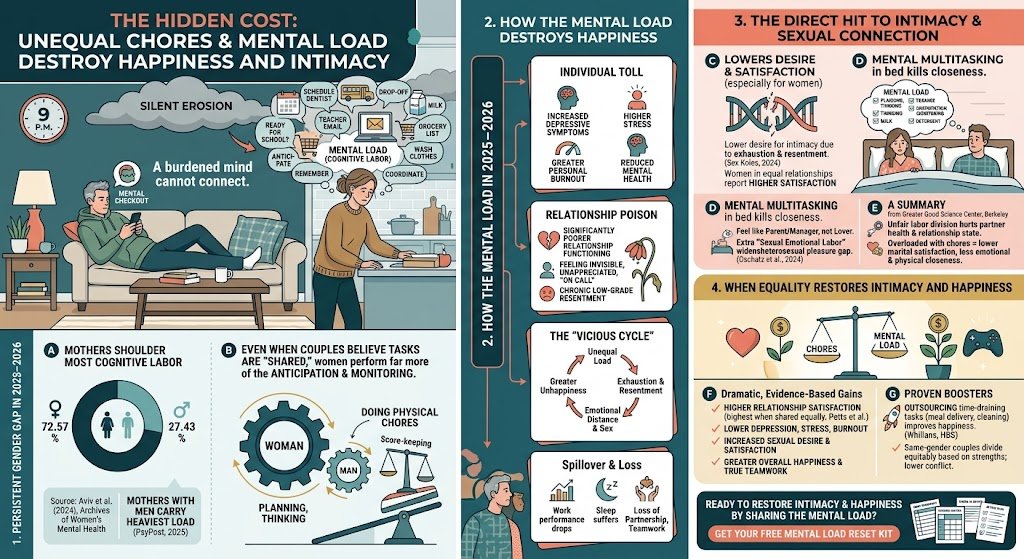
It’s 9 p.m. The kids are finally asleep. One partner collapses on the couch, phone in hand, mentally checking out. The other is still standing at the kitchen counter, running through tomorrow’s mental checklist: “Did I schedule the dentist? Who’s doing school drop-off? We’re low on milk again. And did I reply to that teacher email?” No one said a harsh word, yet the air feels heavy. This isn’t a fight about dishes—it’s the silent erosion caused by unequal chores and the mental load.
The mental load—also called cognitive labor—is the invisible work of planning, anticipating, remembering, and coordinating household life. It’s not just doing the laundry; it’s noticing the laundry needs doing, adding detergent to the shopping list, remembering the kids’ sizes, and worrying about whether the clothes will be ready for school. Decades of research show this burden falls overwhelmingly on women, even in dual-income households. The consequences reach far beyond frustration: they directly damage happiness, mental health, and intimate connection.
How Unequal Chores and Mental Load Affect Intimacy and Happiness
The Persistent Gender Gap in 2025–2026
Despite decades of progress, the numbers remain stark. A 2024 study published in Archives of Women’s Mental Health (Aviv et al.) found that mothers still shoulder 72.57 % of all cognitive household labor compared to 27.43 % for their partners. Broader analyses in the Journal of Marriage and Family (2025) put the figure at 71–79 % for daily cognitive tasks like scheduling, meal planning, and childcare coordination.
Physical chores show a slightly narrower gap, but cognitive labor—the endless “thinking” work—is more unequally divided and more damaging. Mothers partnered with men carry the heaviest load of all family configurations, according to a December 2025 study in PsyPost. Even when couples believe tasks are “shared,” women perform far more of the anticipation and monitoring.
This isn’t just perception. Time-use diaries and large-scale surveys confirm the imbalance persists across income levels, education, and countries. Swedish population data and U.S. studies show women still perform nearly twice the unpaid domestic work overall.
How the Mental Load Destroys Happiness
The toll on individual happiness and mental health is well documented and devastating.
The same 2024 Archives of Women’s Mental Health study linked higher cognitive labor to:
- Increased depressive symptoms
- Higher stress
- Greater personal burnout
- Reduced overall mental health
- Significantly poorer relationship functioning
Physical labor was mainly tied to relationship quality, but cognitive labor predicted depression, anxiety, burnout, and emotional exhaustion across the board. Women carrying the disproportionate load report feeling invisible, unappreciated, and perpetually “on call.”
A 2025 analysis in Social Problems and related research shows this mental burden spills into every domain of life: work performance drops, sleep suffers, and general life satisfaction declines. One partner feels resentful; the other feels nagged. Both lose the sense of partnership that happiness in marriage depends on.
Equity theory explains why: when one person consistently gives more (in invisible ways) without recognition, fairness perceptions collapse. The result is chronic low-grade resentment that quietly poisons daily joy.
The Direct Hit to Intimacy and Sexual Connection
The damage doesn’t stop at happiness—it reaches the bedroom.
Multiple studies show unequal household labor directly lowers sexual desire and satisfaction, especially for women. Research published in Sex Roles (2024) found that women who shoulder most chores and mental load report significantly lower desire for intimacy. The mechanism is straightforward: exhaustion, resentment, and the sense of carrying the household alone kill the emotional safety and energy needed for closeness.
When one partner is mentally rehearsing tomorrow’s to-do list while lying in bed, erotic connection becomes impossible. The Journal of Sex Research and related work confirm that women in more equal relationships report higher sexual satisfaction and frequency. Unequal divisions create a “double burden” that leaves women feeling like a parent or manager rather than a lover.
Emotional labor compounds this. A 2024 study on women’s sexual emotional labor (Oschatz et al.) showed that women often perform extra invisible work during sex—managing their partner’s pleasure, suppressing their own discomfort, or faking enthusiasm. This further widens the heterosexual pleasure gap and reduces genuine intimacy.
The Greater Good Science Center at Berkeley summarizes it clearly: unfair labor division hurts mental health, partner health, and the state of the relationship. Women overloaded with chores and planning experience more depressive symptoms and lower marital satisfaction, which directly translates to less emotional and physical closeness.
The Vicious Cycle: How It Compounds
The effects create a self-reinforcing loop:
- Unequal load → exhaustion and resentment
- Resentment → emotional distance
- Distance → lower intimacy and sex
- Lower intimacy → even greater unhappiness and perceived unfairness
Couples enter a downward spiral where small daily imbalances become major relational threats. Many women describe feeling “touched out” or “not in the mood” not because of their partner personally, but because they never get a mental break from running the household.
Men aren’t unaffected. Partners who recognize the imbalance often feel guilty or defensive, which further strains connection. Both lose the spontaneous affection and teamwork that fuel happiness.
When Equality Restores Intimacy and Happiness
The good news is dramatic and evidence-based.
Couples who achieve more equal divisions of both physical and cognitive labor report:
- Higher relationship satisfaction (highest when cognitive housework is shared equally—Petts et al., Journal of Marriage and Family)
- Lower depression, stress, and burnout for women
- Increased sexual desire and satisfaction
- Greater overall happiness and sense of partnership
Harvard Business School research (Whillans) shows that outsourcing time-draining chores (cleaning, meal delivery) measurably improves relationship happiness by freeing mental bandwidth. Same-gender couples often divide cognitive labor more equitably based on strengths, reporting lower conflict and higher satisfaction.
Feeling appreciated acts as a powerful buffer. One 2022 study found that perceived appreciation can offset some negative effects of unequal labor on relationship satisfaction.
Real-Life Patterns That Emerge
In couples where the mental load is unequal, evenings often look like one partner relaxing while the other mentally multitasks. Weekends become chore marathons instead of connection time. Intimacy becomes scheduled or nonexistent. Over time, many women describe “quiet quitting” the relationship—not leaving, but emotionally withdrawing.
Conversely, couples who deliberately share the load describe deeper conversations, more spontaneous sex, and a sense of true teamwork. They report sleeping better, laughing more, and feeling like partners again.
The Bottom Line
Unequal chores and mental load are not minor annoyances—they are silent relationship killers. They erode happiness through chronic stress, depression, and burnout. They destroy intimacy by replacing desire with resentment and exhaustion. The data from 2024–2026 is unambiguous: the cognitive labor gap predicts poorer mental health, lower relationship quality, and reduced sexual connection.
The solution isn’t perfect 50/50 every day. It’s deliberate, visible, and ongoing equity—shared planning, clear ownership of cognitive tasks, and genuine appreciation. When couples treat the mental load as real work and divide it fairly, happiness and intimacy don’t just return—they deepen.
Your relationship deserves better than silent score-keeping. The invisible load is heavy enough to break even the strongest couples. Make it visible, share it intentionally, and watch your happiness and intimacy come back to life.
Backed by Research
- Aviv et al. (2024). Cognitive household labor: gender disparities and associations with mental health. Archives of Women’s Mental Health. https://pmc.ncbi.nlm.nih.gov/articles/PMC11761833/
Ready to Restore Intimacy and Happiness by Sharing the Mental Load?
The silent resentment from unequal chores and endless cognitive labor doesn’t just exhaust you — it quietly kills connection, desire, and joy in your relationship. You don’t have to keep feeling invisible, touched-out, or emotionally distant. Fix it fast with proven systems that actually work.
Grab your free Mental Load Reset Kit — complete with the cognitive labor audit worksheet, fair division matrix for chores + planning, weekly equity check-in script, intimacy-rebuilding conversation prompts, and 30-day action plan that couples are using right now to reclaim closeness and happiness.
End the invisible burden tonight and bring the spark back.