
The Silent Resentment– It’s 10 p.m. The house is finally quiet. One partner is already asleep. The other lies awake, mentally replaying the day: “Did I confirm the pediatrician appointment? Who’s picking up the dry cleaning tomorrow? Did I remember to thank my partner for taking out the trash… or did I just feel irritated that it was the only thing they did?” No argument happened. No doors were slammed. Yet a heavy, unnamed tension hangs in the air. This is silent resentment — the slow-burning emotional tax of carrying unshared invisible work.
Invisible work (also called cognitive labor, mental load, or emotional labor) is the unseen planning, anticipating, remembering, coordinating, and emotion-managing that keeps a household and relationship running. It’s not the physical act of cooking dinner; it’s noticing the fridge is empty, planning the meals, making the grocery list, checking allergies, and worrying whether everyone ate enough. It’s the constant low-level vigilance that never clocks out.
In 2025–2026, this burden remains dramatically unequal. A landmark USC Dornsife Public Exchange study (2024, with ongoing analysis into 2026) found mothers responsible for 72.57 % of all cognitive labor — the conception, planning, and monitoring of household tasks — compared to their partners. Even high-earning career women shoulder the majority of “thinking work,” according to a 2025 Socius: Sociological Research for a Dynamic World study from the University of Bath and University of Melbourne. The result? Chronic exhaustion, quiet resentment, and a slow erosion of happiness and intimacy that many couples never name until it’s too late.
The Silent Resentment: Healing from Unshared Invisible Work
Why the Resentment Stays Silent
Silent resentment thrives in the gap between what is done and what is noticed. The partner carrying the load feels unseen and taken for granted. The other partner often feels genuinely unaware — or defensive when it’s pointed out. As psychologist and researcher Allison Daminger’s work (updated in 2025 Journal of Marriage and Family) shows, gratitude and resentment in households reveal deep divergences in expectations. Women frequently expect true partnership in both physical and cognitive labor; many men express gratitude for any physical help while assuming their partner will handle the mental orchestration.
This mismatch creates a perfect storm. The overloaded partner experiences what researchers call “cognitive overload” — constant multitasking that depletes emotional reserves. Forbes (2025) described it as role-blurring and invisible burdens that lead to burnout, irritability, and “a deep, quiet resentment — not just toward the demands of work and family, but toward the relationship itself.”
The resentment is silent because it rarely explodes over one chore. It accumulates in micro-moments: the partner who relaxes while the other mentally runs tomorrow’s checklist; the “I’ll do it later” that becomes “I guess I’ll just handle it.” Over time, love starts feeling like unpaid overtime.
The Measurable Damage to Happiness and Intimacy
The data is unequivocal. Higher cognitive labor directly predicts:
- Increased depression, stress, and burnout (Archives of Women’s Mental Health, Aviv et al., 2024; replicated in 2025–2026 analyses)
- Poorer relationship functioning and satisfaction (Journal of Marriage and Family, 2025)
- Lower sexual desire and intimacy — especially for women who feel like household managers rather than partners (multiple studies summarized in Psychology Today and Scientific American, 2025)
A 2025 Scientific American piece on the “invisible family load” found that carrying more than your partner strains the relationship and decreases satisfaction. People (particularly mothers) reported feeling “frustrated,” “angry,” and “resentful” at the chronic imbalance. Emotional labor — managing everyone’s feelings on top of logistics — compounds the damage. When one partner constantly anticipates needs, soothes tensions, and keeps the emotional temperature stable, they eventually run out of capacity for genuine connection. Intimacy fades because desire requires safety, rest, and reciprocity — none of which thrive under chronic invisible overload.
The partner not carrying the load often feels blindsided when resentment finally surfaces. They may think “I do plenty around here,” missing that the real weight was never the dishes — it was the thinking about the dishes.
Left unhealed, silent resentment doesn’t just erode happiness; it quietly rewires the relationship into a parent–assistant dynamic rather than a partnership of equals.
The Path to Healing: Making the Invisible Visible
The good news is that silent resentment is highly treatable once named and addressed. Healing begins with three evidence-based shifts: visibility, ownership, and appreciation.
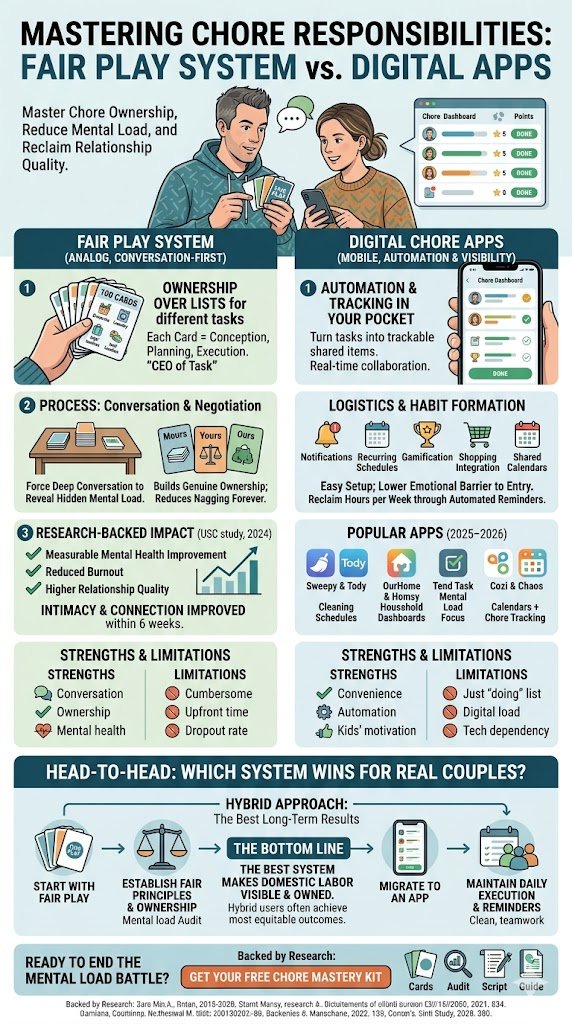
Step 1: Name and Audit the Invisible Work Sit down together (no phones, no distractions) and list every task in three categories: physical (doing), cognitive (planning/remembering), and emotional (managing feelings). Use a simple worksheet or the Fair Play card system as a starting point. The USC study showed that simply making cognitive labor visible was the first breakthrough for most couples. Many report shock when they see the 70/30 or 80/20 split in black and white.
Step 2: Shift from “Helper” to “Owner” The most effective fix isn’t more equal doing — it’s equal owning. Assign full ownership of tasks (conception + planning + execution). The USC Fair Play intervention (2024) proved this approach reduces burnout and improves relationship quality when couples follow through. The person who owns the task becomes CEO of it; the other partner stops micromanaging or waiting for instructions. This single change eliminates the exhausting “mental delegation” loop that fuels resentment.
Step 3: Build Gratitude and Check-In Rituals Daminger’s 2025 longitudinal study found that resentment decreases dramatically when men increase proactive attunement and women practice clear delegation. Create a weekly 15-minute “household temperature check”: What felt heavy this week? What felt lighter? End with specific appreciation: “Thank you for owning the grocery planning — it took a huge weight off me.” Research consistently shows that perceived appreciation buffers the negative effects of imperfect division.
Step 4: Address Emotional Labor Separately Emotional labor (managing moods, remembering birthdays, smoothing conflicts) needs its own conversation. Many couples discover the mental load was only half the story. Healing here often involves therapy or couples coaching to redistribute the “relationship manager” role.
Step 5: Seek External Support When Needed If resentment has deep roots or one partner resists change, professional help accelerates healing. Couples who use structured tools like Fair Play combined with therapy report faster shifts in equity and connection. Outsourcing (cleaning service, meal kits) can also buy breathing room while new habits form — Harvard Business School research confirms this measurably boosts relationship satisfaction.
Real-Life Routines That Sustain Healing
Couples who heal successfully adopt simple, repeatable practices:
- Daily 2-minute hand-off: Quick voice note or text sharing one cognitive update (“Groceries ordered; dentist confirmed”).
- Sunday Reset Ritual: 20 minutes reviewing the week, reassigning ownership as needed, and expressing gratitude.
- Monthly Load Audit: Rate each person’s invisible workload 1–10 and adjust.
- Phone-Free Connection Block: Evenings where the mental load is explicitly off-duty so intimacy can return.
- Annual Offsite Review: A weekend away to celebrate progress and update the system.
Many couples report that after 60–90 days of consistent practice, the resentment doesn’t just fade — it transforms into deeper trust and spontaneous affection. Sex improves. Laughter returns. The relationship feels like a team again instead of two exhausted individuals sharing a house.
When One Partner Resists Change
Resistance is common, especially from the partner who benefited (consciously or not) from the imbalance. Frame the conversation around shared goals: “I love us too much to let resentment grow.” Focus on data and feelings rather than blame. Many reluctant partners become allies once they experience the relief of true ownership and see the positive impact on intimacy. If resistance persists, individual therapy for the overloaded partner can provide clarity and boundaries while the couple works toward equity.
The Bottom Line
Silent resentment from unshared invisible work is one of the most common — and most overlooked — threats to modern relationships. It doesn’t announce itself with dramatic fights; it whispers in exhaustion, emotional distance, and the slow fading of desire. Yet it is also one of the most healable threats. Once named, made visible, and deliberately shared, the same energy that created resentment becomes the foundation for deeper partnership.
You didn’t choose to carry the invisible load alone. But you can choose to stop carrying it silently. The healing isn’t about keeping score or achieving perfect 50/50 every day. It’s about creating a relationship where both people feel seen, valued, and rested enough to actually love each other.
The silent resentment has already cost you enough nights of peace and connection. Start the conversation this week. Make the invisible visible. Reclaim the partnership you thought you had — and build one that’s even stronger.
Ready to Release the Silent Resentment and Reconnect?
Carrying the invisible load alone while resentment quietly builds doesn’t have to be your normal. Start healing today with practical tools that make the unseen work visible and truly shared. Download your free Silent Resentment Healing Kit — featuring the full invisible work audit worksheet, ownership transition templates, weekly check-in scripts, emotional labor conversation guide, and 30-day reconnection plan that hundreds of couples now use.
Take the first step toward feeling seen, valued, and close again.
→ Get Your Free Silent Resentment Healing Kit
Backed by Research
The insights in this article are grounded in recent peer-reviewed research on cognitive labor and its impact on relationships. The USC Dornsife Public Exchange study (2024) found that mothers handle 72.57% of cognitive household labor, directly linked to higher burnout, depression, and lower relationship satisfaction. Studies published in the Journal of Marriage and Family (2025) and Archives of Women’s Mental Health (2024) confirm that unshared invisible work significantly reduces intimacy, sexual desire, and overall happiness. Additional analysis from Scientific American (2025) shows how silent resentment develops and how making the mental load visible and equitably shared leads to measurable healing in connection and well-being.
Key Sources
- USC Dornsife Public Exchange – Cognitive Labor Study (2024): https://dornsife.usc.edu/public-exchange/invisible-load-study-2024
- Journal of Marriage and Family (2025): https://onlinelibrary.wiley.com/doi/10.1111/jomf.13057
- Archives of Women’s Mental Health (2024): https://pmc.ncbi.nlm.nih.gov/articles/PMC11761833/
- Scientific American – “The Invisible Family Load” (2025): https://www.scientificamerican.com/article/the-invisible-family-load