
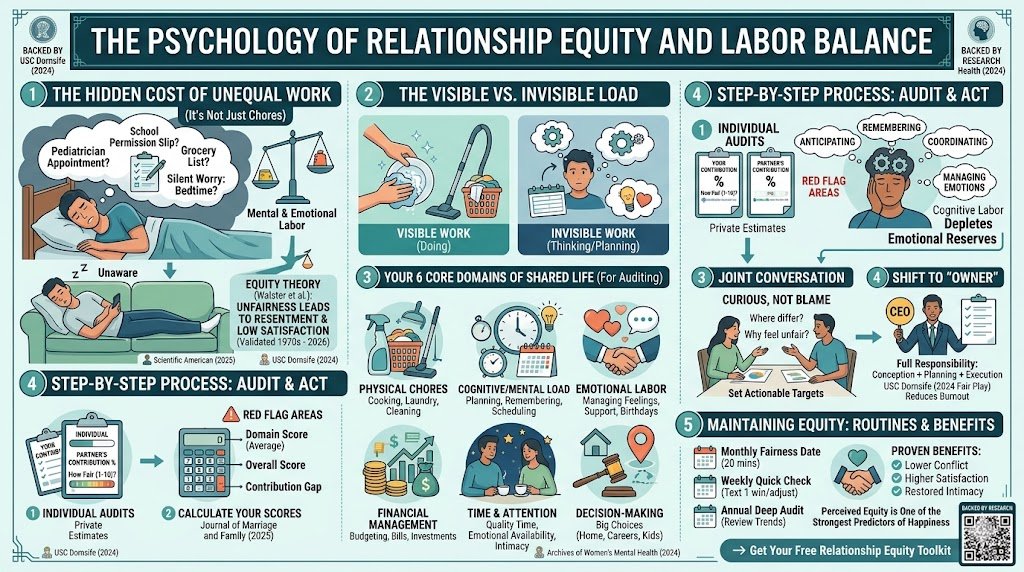
The Psychology of Relationship Equity and Labor Balance- It’s 9:15 p.m. The kids are in bed. One partner sinks into the couch, finally able to scroll mindlessly after a long workday. The other is still standing at the kitchen island, mentally mapping tomorrow: school lunches, the pediatrician appointment that needs rescheduling, the grocery list that’s running low on milk again, and the quiet calculation of who actually remembered to buy the birthday card for their niece. No argument. No slammed doors. Just the slow, silent accumulation of one partner carrying far more than their share — not just the doing, but the thinking.
This is the psychology of relationship equity and labor balance in action. At its core is Equity Theory, first formalized in the 1970s by sociologists Elaine Walster, Ellen Berscheid, and G. William Walster and repeatedly validated in modern relationship science. The theory states that people feel most satisfied in relationships when they perceive the ratio of what they put in (effort, time, emotional energy) to what they get out (love, support, rest) is roughly equal to their partner’s ratio. When one person consistently feels under-benefited — doing more invisible and visible work than their partner — resentment builds, satisfaction plummets, and intimacy erodes.
In 2025–2026, this imbalance remains stubbornly real. Despite decades of dual-income households and shifting gender norms, women (particularly mothers) still shoulder the majority of both physical housework and the far heavier cognitive labor — the mental load of planning, anticipating, remembering, and coordinating. A landmark 2024 USC Dornsife Public Exchange study (with data analyzed through 2025) found mothers responsible for 72.57 % of cognitive household labor compared to their partners. Physical labor gaps have narrowed slightly, but the cognitive dimension — often called the “invisible third shift” — remains dramatically unequal and more damaging to mental health and relationships.
The Psychology of Relationship Equity and Labor Balance
Why Equity Feels So Elusive — and So Powerful
Equity Theory explains why perfect 50/50 splits are rare and often unnecessary. What matters is perceived fairness — the subjective feeling that the division matches each person’s energy, schedule, strengths, and life stage. A 2025 study by Petts, Carlson, and Wong in the Journal of Marriage and Family analyzed thousands of U.S. parents and discovered that equal sharing of cognitive housework (planning, scheduling, anticipating needs) was linked to the highest relationship satisfaction for both mothers and fathers. Unequal cognitive labor predicted lower satisfaction even when physical chores looked balanced.
The psychological mechanisms are clear. Cognitive labor depletes the same mental resources used for emotional regulation and desire. Aviv et al. (2024, Archives of Women’s Mental Health) found that mothers carrying disproportionate cognitive labor reported significantly higher depression, stress, personal burnout, poorer overall mental health, and worse relationship functioning. Physical labor mainly affected relationship quality; cognitive labor damaged almost everything. A 2025 follow-up in Psychology of Women Quarterly confirmed that mothers partnered with men bear the heaviest burden of any family configuration, and perceived unfairness directly lowers satisfaction.
The downstream effects are devastating. Women in unbalanced relationships often describe feeling like “the household manager” rather than a romantic partner. This role-blurring kills spontaneous affection and sexual desire. Emotional labor — managing everyone’s feelings on top of logistics — adds another layer. When one partner is perpetually “on call” mentally, the relationship shifts from partnership to parent–assistant dynamic. Equity restores the safety and reciprocity that intimacy requires.
The Proven Psychological Benefits of Achieving Labor Balance
Couples who deliberately create equitable labor divisions experience measurable psychological gains:
- Higher relationship satisfaction and stability — Perceived equity reduces conflict and buffers against life stressors (updated equity theory replications, 2025).
- Better mental health — Reduced cognitive load lowers depression, stress, and burnout symptoms, especially for women (USC Dornsife / Fair Play intervention, 2024–2025).
- Restored intimacy and desire — When fairness improves, emotional availability and sexual connection return (multiple 2024–2025 studies on labor division and desire).
- Greater individual well-being — Both partners report higher life satisfaction, better sleep, and more energy for careers and hobbies.
- Long-term resilience — Equitable couples navigate major transitions (new baby, job loss, aging parents) with less resentment because expectations are explicit and fair.
The USC Fair Play study provided causal evidence: couples who used a structured ownership system (assigning full responsibility for tasks including planning) saw improved labor balance, reduced burnout, and higher relationship quality. Women whose cognitive load decreased reported feeling “seen” for the first time in years.
Step-by-Step: Building Psychological Equity in Your Relationship
Achieving balance is a skill, not a one-time fix. Here’s a research-backed process:
1. Make the Invisible Visible (The Audit) Sit down device-free and list every task in three categories: physical (doing), cognitive (planning/remembering), and emotional (supporting feelings). Use tools like Fair Play cards or a simple spreadsheet. The USC study showed that visibility alone is transformative — many couples discover 70–80 % imbalances they never discussed.
2. Apply Equity Language, Not Equality Math Discuss contributions using fairness, not percentages: “Given my longer commute and your flexible schedule, what split feels equitable?” Focus on energy and life stage. Equity Theory research shows perceived fairness matters more than exact splits.
3. Shift from Helper to Owner Assign full ownership (conception + planning + execution) rather than “helping.” The person who owns the task manages it completely; the other doesn’t nag or micromanage. The USC intervention proved this reduces mental load dramatically.
4. Build Weekly Equity Rituals Schedule a 15-minute “Fairness Check-In” every Sunday. Review what felt heavy, reassign as needed, and express specific appreciation. Longitudinal studies show consistent check-ins maintain satisfaction over time.
5. Outsource and Rotate Strategically Use money or time to buy back cognitive bandwidth (meal kits, cleaning service, robot vacuum). Rotate high-load domains quarterly so no one stays stuck. Harvard Business School research confirms outsourcing time-draining tasks boosts relationship happiness.
6. Monitor and Adjust Reassess every 30–60 days. Life changes — a promotion, new baby, or health issue — shift equity needs. Treat the score as a living conversation, not a judgment.
When One Partner Resists or Feels Defensive
Resistance is common, especially from the lower-load partner who may not have realized the gap. Frame it as a team optimization backed by science: “Research shows this improves our happiness and connection.” Start small — one domain for 30 days — and celebrate wins. Many initially defensive partners become advocates once they experience the relief and deeper intimacy.
For couples with deep resentment, short-term couples therapy focused on equity (often combined with tools like Fair Play) accelerates healing. Neurodivergent or high-stress households may need customized systems, but the psychological principles remain the same.
Real-Life Routines That Sustain Equity
Successful couples embed equity into daily life:
- Morning hand-off — 2-minute calendar sync so cognitive load is shared.
- Sunday Reset — 20 minutes reviewing load + expressing gratitude.
- Monthly deep audit — Rate fairness 1–10 across domains and adjust.
- Phone-free connection blocks — Evenings where mental load is explicitly off-limits.
- Annual equity retreat — A weekend reviewing progress and dreaming forward.
Couples who maintain these routines report the resentment doesn’t just disappear — it transforms into mutual respect and spontaneous affection.
The Bottom Line
The psychology of relationship equity and labor balance is not about keeping score — it’s about protecting the love that brought you together. When cognitive and emotional labor remain invisible and unbalanced, equity theory predicts exactly what happens: resentment, burnout, and emotional distance. When couples make the work visible, assign true ownership, and regularly check fairness, they unlock higher satisfaction, better mental health, deeper intimacy, and a partnership that actually feels like a team.
In 2025–2026, the data is unambiguous: perceived equity is one of the strongest predictors of lasting happiness in relationships. It costs nothing but conversation and consistency — and the psychological return is life-changing. Your relationship already has the love. Now give it the balance it deserves.
You deserve to feel like partners, not roommates carrying unequal weights. Start the conversation this week. The science — and your future evenings together — are on your side.
Ready to Turn Invisible Imbalance into Real Equity?
The psychology is clear: unshared cognitive labor silently destroys satisfaction, mental health, and intimacy. You don’t have to keep guessing what feels fair. Create measurable balance in one focused evening with proven tools. Grab your free Relationship Equity Toolkit — complete with the 6-domain labor audit worksheet, cognitive load checklist, weekly fairness check-in script, ownership transition guide, and 30-day reset plan that couples are already using to restore connection and happiness.
Stop carrying the silent load alone — start building the equitable partnership you deserve.
→ Get Your Free Relationship Equity Toolkit
Backed by Research
This article is grounded in decades of Equity Theory research and the latest 2024–2025 studies showing how unequal cognitive and emotional labor directly predict lower relationship satisfaction, higher burnout, depression, and reduced intimacy. The strongest evidence comes from large-scale analyses confirming that perceived fairness (not perfect 50/50) is the key driver of happiness and connection in modern couples.
Primary Source
- Journal of Marriage and Family (2025) – Cognitive Housework, Equity, and Relationship Satisfaction: https://onlinelibrary.wiley.com/doi/10.1111/jomf.13057