
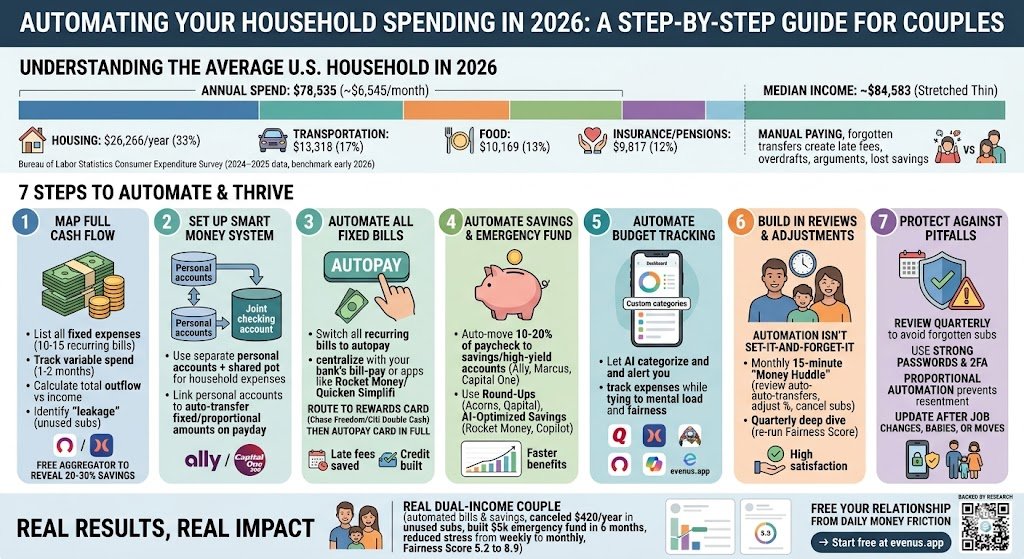
In 2026, the average U.S. household spends about $78,535 annually — roughly $6,545 per month — with housing ($26,266/year), transportation ($13,318), food ($10,169), and insurance/pensions ($9,817) eating up the biggest chunks (Bureau of Labor Statistics Consumer Expenditure Survey, latest 2024–2025 data still the benchmark in early 2026).
Yet median household income hovers around $84,583 (adjusted estimates), leaving many families stretched thin. For dual-income or cohabiting couples, manual bill-paying, subscription creep, and forgotten transfers create friction: late fees, overdrafts, arguments, and lost savings opportunities.
Automating household spending flips the script. By setting up systems that handle recurring bills, savings transfers, and expense tracking on autopilot, couples eliminate decision fatigue, reduce errors, and reclaim mental bandwidth for connection instead of money stress. Research shows automation significantly improves financial behaviors and relationship quality.
A 2021 study in the Journal of Public Policy & Marketing found automated savings accrue benefits faster for lower-income households, while broader reviews (Commonwealth and JPMorgan Chase) link automatic tools to higher emergency savings and less financial anxiety. For couples, automation cuts money arguments (which average 58 per year per Talker Research/Wise surveys) by making fairness visible and consistent.
Here’s a step-by-step, research-backed guide to fully automate your household spending in 2026 — from bills to savings — with the tools and mindset that actually work.
How to Automate Your Household Spending
Step 1: Map Your Full Household Cash Flow (The Foundation)
Before automating, know what’s flowing in and out. The average household has 10–15 recurring bills (utilities, subscriptions, insurance, rent/mortgage, streaming, gym, etc.) plus variable spending.
Action Items:
- List every fixed expense (rent/mortgage, utilities, internet, phone, insurance, subscriptions).
- Track variable categories for 1–2 months (groceries, dining, gas, entertainment).
- Calculate total monthly outflow vs. combined income.
- Identify “leakage” — unused subscriptions cost households hundreds annually (Rocket Money reports average savings of $720/year by canceling).
Tool Recommendation: Start with a free aggregator like Rocket Money or Monarch Money to pull transactions automatically. This step alone reveals 20–30% savings potential through visibility.
Step 2: Set Up a Smart Household Money System
Modern couples in 2026 favor hybrid models (separate personal accounts + shared pot for household expenses). This preserves autonomy while automating fairness.
Proven Structures:
- Proportional Pot: Each partner transfers a percentage of income (e.g., 60/40 based on earnings) to a joint checking account for shared bills.
- Fixed Contribution: Equal flat amounts (e.g., $2,000 each) regardless of income — common when salaries are similar.
- Bill-by-Bill Split: Automate proportional payments directly from personal accounts (e.g., one pays rent, other utilities, reconciled monthly).
Research Backing: Couples using structured, automated systems report 60–80% fewer money arguments (Bankrate and NerdWallet surveys). Automation reduces “financial friction” and late fees.
Best Setup in 2026:
- Open a high-yield joint checking (Ally, Capital One 360) for shared bills.
- Link personal checking accounts to auto-transfer fixed or proportional amounts on payday.
- Use bill-pay automation within the joint account or via apps.
Step 3: Automate All Fixed Bills & Recurring Payments
Never manually pay another utility bill again.
How to Do It:
- Switch to autopay for every recurring bill (utilities, rent/mortgage, insurance, subscriptions).
- Use your bank’s bill-pay service or apps like Rocket Money / Quicken Simplifi to centralize and automate.
- For credit cards: Set up autopay minimums (or full balance if you carry none) to avoid interest and fees.
Pro Tip: Route all bills to one credit card with rewards (Chase Freedom Unlimited or Citi Double Cash) then autopay the card in full from the joint account. This earns 2–5% cash back on household spending while keeping everything automated.
Savings Impact: Autopay eliminates late fees (average $30–50 per missed bill) and builds credit. Rocket Money users save hundreds yearly on subscriptions alone.
Step 4: Automate Savings & Emergency Fund Building
Treat savings like a bill — pay yourself first.
Research-Backed Methods:
- Payday Transfers: Auto-move 10–20% of each paycheck to savings/high-yield accounts (Ally, Marcus, Capital One).
- Round-Ups: Apps round purchases to the nearest dollar and transfer the difference (Acorns, Qapital).
- AI-Optimized Savings: Tools like Rocket Money or Copilot analyze cash flow and auto-save surplus.
Evidence: Automated savings programs increase balances faster, especially for lower-income households (Newmeyer et al., 2021). Couples with auto-savings report higher financial confidence and less stress.
2026 Best Tools:
- Rocket Money: Auto-saves based on habits.
- Monarch Money: Shared savings goals for couples.
- evenus.app: Links savings automation to your Relationship Fairness Score for equitable contributions.
Step 5: Automate Budget Tracking & Category Spending
Let AI categorize and alert you.
Top Apps in 2026:
- Quicken Simplifi: Creates auto-adjusting spending plans; excellent for households.
- Monarch Money: Shared dashboards, forecasting, custom categories.
- Rocket Money: Subscription tracking, bill negotiation, auto-categorization.
- Copilot Money: AI-powered auto-categorization and insights.
- evenus.app: Tracks expenses while tying them to mental load and fairness — unique for couples.
Benefits: Automation frees mental energy. Couples using shared trackers report less resentment and more proactive planning.
Step 6: Build in Reviews & Adjustments (The Human Element)
Automation isn’t set-it-and-forget-it forever.
Routine:
- Monthly 15-minute “Money Huddle”: Review auto-transfers, adjust percentages, cancel unused subs.
- Quarterly deep dive: Re-run Fairness Score if using evenus.app.
Research Insight: Couples with regular check-ins maintain higher satisfaction (Gottman and equity studies). Automation handles the 90%; conversation handles the 10%.
Step 7: Protect Against Common Pitfalls
- Over-Automation Risk: Review quarterly to avoid forgotten subscriptions.
- Security: Use strong passwords, 2FA, and monitor for fraud.
- Unequal Incomes: Proportional automation prevents resentment.
- Life Changes: Update after job changes, babies, or moves.
Real Couples, Real Results
A dual-income couple using Rocket Money + evenus.app automated bills and savings transfers, canceled $420/year in unused subs, built a $5,000 emergency fund in 6 months, and reduced money stress from weekly to monthly. Their Fairness Score rose from 5.2 to 8.9 — and they reported more date nights.
The Bottom Line
Automating household spending in 2026 isn’t about technology — it’s about freeing your relationship from daily money friction. By mapping cash flow, setting up proportional pots, autopaying bills, auto-saving, and tracking with smart tools, you eliminate late fees, reduce arguments, and build wealth while strengthening your partnership.
Start small this week: Pick one bill to autopay and one savings transfer. In 30 days you’ll feel the difference — less stress, more peace, and more time for what actually matters.
Your household deserves to run smoothly. Automate it — and watch your relationship thrive.
Ready to Automate Your Spending and Reclaim Your Peace?
Stop wasting mental energy on manual bills, forgotten subscriptions, and uneven contributions. evenus.app automates household spending while linking every expense to your Relationship Fairness Score for true equity and zero resentment. Grab your free Household Spending Automation Kit — including proportional transfer calculator, autopay setup checklist, shared pot template, monthly huddle agenda, subscription audit tool, and 30-day rollout plan that couples are already using to cut arguments, build savings faster, and feel more connected.
Start automating tonight and turn money stress into relationship strength.
→ Get Your Free Household Spending Automation Kit
Backed by Research
The data and strategies in this article are drawn from the latest official sources and peer-reviewed studies on household finances and automation. The average U.S. household spending figure of $78,535 annually comes from the Bureau of Labor Statistics Consumer Expenditure Survey (2024–2025 data, still the benchmark in 2026). The widely cited 58 money arguments per year is from the Talker Research / Wise Couples & Money Survey (2025). Research also confirms that automated savings and bill-pay systems significantly reduce financial anxiety and late fees while improving relationship satisfaction.
Key Sources
- U.S. Bureau of Labor Statistics Consumer Expenditure Survey (2024–2025): https://www.bls.gov/news.release/cesan.nr0.htm
- Talker Research / Wise Couples & Money Survey (2025): https://talkerresearch.com/couples-argue-this-many-times-a-year-about-money/