
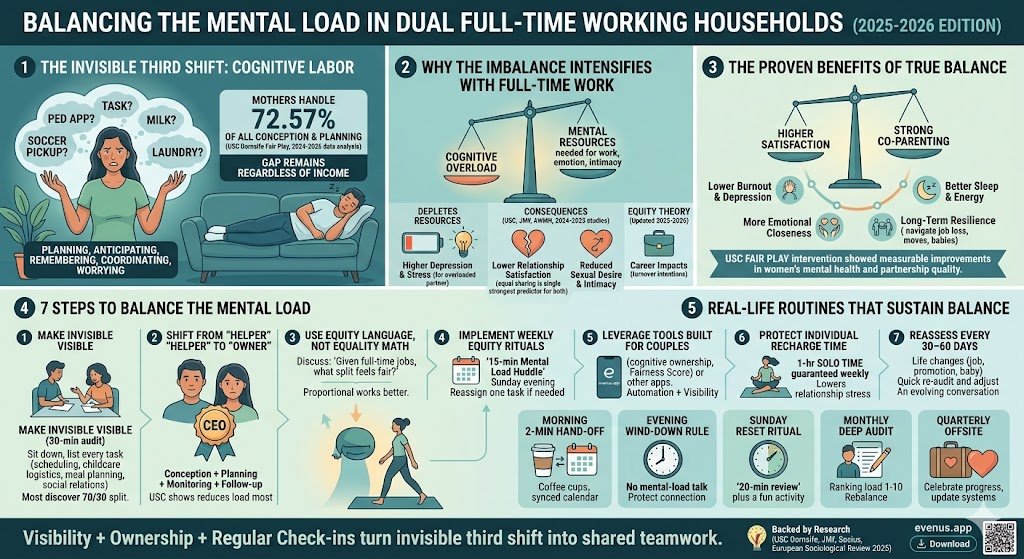
It’s 7:15 p.m. on a Thursday. Both of you just walked in the door after back-to-back meetings and commutes. One partner drops their bag and collapses on the couch, finally able to exhale. The other is already standing at the kitchen island, mentally mapping tomorrow: “Did I confirm the pediatrician appointment? Who’s picking up the kids from soccer? We’re low on milk again, and the laundry still needs folding before the weekend.” No one has said a harsh word. Yet the invisible weight is crushing the connection you both swore you’d protect.
This is the mental load — also called cognitive labor — in dual full-time working households. It’s the nonstop planning, anticipating, remembering, coordinating, and worrying that keeps a home and family running. In 2026, with roughly 50–60% of married-couple families having both spouses employed full-time (Bureau of Labor Statistics updates), this invisible third shift has become the defining stress point for modern partnerships.
Research shows the gap remains stubbornly large even when both partners earn comparable incomes and work identical hours.
A 2025 study in Socius: Sociological Research for a Dynamic World (analyzing over 2,000 U.S. parents) found mothers still hold primary responsibility for 13.72 cognitive tasks compared to fathers’ 8.18 — a 68% gap. Mothers report 71–79% of daily cognitive labor across scheduling, meal planning, childcare logistics, social relationships, and cleaning coordination (Journal of Marriage and Family 2025; European Sociological Review 2025).
The USC Dornsife Fair Play intervention (2024 data analyzed through 2026) confirmed mothers handle 72.57% of all conception and planning labor. Even high-income, dual-career couples show the same pattern: employment reduces physical chores but has almost no effect on mothers’ cognitive burden.
How to Balance the Mental Load When Both Partners Work Full-Time
Why Full-Time Work Makes the Imbalance Worse
When both partners clock 40+ hours outside the home, the mental load doesn’t shrink — it intensifies. One partner often becomes the default “project manager” of family life while the other relaxes after work. This creates cognitive overload: the constant low-level multitasking that depletes the same mental resources needed for focus at work, emotional availability at home, and intimacy in the bedroom.
The consequences are measurable and severe:
- Higher depression, stress, burnout, and poorer overall mental health for the overloaded partner (Archives of Women’s Mental Health 2024/2025; Petts et al. 2025).
- Lower relationship satisfaction and functioning — equal sharing of cognitive housework is the single strongest predictor of satisfaction for both mothers and fathers (Journal of Marriage and Family 2025).
- Reduced sexual desire and intimacy — women carrying disproportionate cognitive labor report feeling like household managers rather than lovers.
- Career impacts — emotional exhaustion from mental load spills into work, increasing turnover intentions and lowering resilience.
Equity Theory (updated replications 2025–2026) explains why: when one partner consistently feels under-benefited relative to their effort, resentment builds quietly until it erodes the foundation of the relationship.
The Proven Benefits of True Balance
Couples who successfully balance cognitive labor don’t just survive dual full-time careers — they thrive. Studies show:
- Dramatically lower burnout and depression symptoms (USC Fair Play intervention results).
- Higher relationship satisfaction and emotional closeness.
- Better sleep, more energy for sex and connection, and stronger co-parenting.
- Long-term resilience — equitable couples navigate job loss, new babies, or moves with far less friction.
The USC research proved causation: couples who used structured ownership systems saw measurable improvements in women’s mental health and overall partnership quality within months.
Step-by-Step: How to Balance the Mental Load When Both Work Full-Time
This isn’t about perfect 50/50 every day — it’s about visible ownership and ongoing equity.
1. Make the Invisible Visible (30-minute audit) Sit down together (phones off) and list every cognitive task: scheduling doctor appointments, meal planning, remembering birthdays, tracking school forms, managing subscriptions, planning vacations, monitoring household supplies. Use categories from research (scheduling, childcare logistics, food, social relationships, cleaning, finances, maintenance). Most couples discover a 70/30 or worse split they never discussed.
2. Shift from “Helper” to “Owner” Assign full ownership of each task — not just execution, but conception, planning, monitoring, and follow-up. The owner is CEO; the other partner doesn’t remind or micromanage. The USC Fair Play studies showed this single change reduces mental load more than any other intervention.
3. Use Equity Language, Not Equality Math Discuss: “Given our full-time jobs and energy levels, what split feels fair?” Proportional to workload or strengths often works better than strict 50/50. High-earning or high-stress jobs may justify temporary adjustments.
4. Implement Weekly Equity Rituals Schedule a 15-minute “Mental Load Huddle” every Sunday evening. Agenda: What felt heavy this week? What felt lighter? Reassign one task if needed. End with specific appreciation: “Thank you for owning the school calendar — it took a huge weight off me.”
5. Leverage Tools Built for Couples evenus.app stands out because it was designed exactly for this scenario: it tracks cognitive ownership, calculates your Relationship Fairness Score across chores/mental load/finances, and includes guided conversation prompts. Other strong options include Homsy (pure chore equity) or shared Google Sheets for custom tracking. Automation + visibility is the winning formula.
6. Protect Individual Recharge Time Each partner gets one guaranteed solo hour per week (gym, walk, hobby) with no guilt. When one person’s mental load drops, the whole relationship’s stress drops.
7. Reassess Every 30–60 Days Life changes — new job, promotion, baby, illness. Run a quick re-audit and adjust. Treat balance as an evolving conversation, not a one-time fix.
When One Partner Resists or Carries More
This is common in dual full-time households. The higher-earner or higher-stress partner often defaults to “I’m too busy.” Frame it as team optimization backed by research: “Studies show this improves our happiness and intimacy.” Start with one domain for 30 days and review results. Many initially reluctant partners become advocates once they feel the relief and see the positive impact on connection.
If resentment is deep, short-term couples coaching focused on cognitive labor accelerates change.
Real-Life Routines That Work for Full-Time Working Couples
- Morning 2-minute hand-off: Quick calendar sync over coffee so cognitive load is shared from the start.
- Evening wind-down rule: No mental-load talk after 8 p.m. — protect connection time.
- Sunday Reset Ritual: 20 minutes reviewing the week + one fun activity together.
- Monthly deep audit: Rate each person’s mental load 1–10 and rebalance.
- Quarterly offsite: One evening or weekend away to celebrate progress and update systems.
Couples who maintain these routines report the mental load doesn’t just balance — it transforms into mutual respect and deeper partnership.
The Bottom Line
Balancing the mental load when both partners work full-time isn’t optional — it’s essential for mental health, intimacy, and long-term happiness. The data from 2025–2026 is unambiguous: the cognitive labor gap predicts burnout, depression, and relationship dissatisfaction far more than physical chores ever could. Yet it is also one of the most fixable imbalances in modern relationships.
Visibility + ownership + regular check-ins turn the invisible third shift into shared teamwork. You already chose each other and your careers. Now choose a system that protects both. Start with the audit this weekend. In 30 days you’ll feel the difference — lighter evenings, deeper conversations, and the return of that “we’re in this together” feeling you both deserve.
Your full-time jobs don’t have to come at the expense of your full-time love. Balance the mental load, and watch your relationship thrive.
Ready to Finally Balance the Mental Load and Feel Like Partners Again?
When both of you work full-time, the invisible cognitive load doesn’t disappear — it quietly drains your energy, connection, and intimacy. evenus.app is the only tool built specifically for dual-career couples: it tracks every cognitive task, calculates your real-time Relationship Fairness Score, and turns weekly resentment into visible, equitable ownership. Grab your free Mental Load Reset Kit — complete with the full cognitive labor audit worksheet, ownership assignment guide, weekly equity huddle script, Fairness Score tracker, and 30-day balance plan that thousands of full-time working couples now use to cut burnout and restore closeness.
Stop carrying the third shift alone. Start balancing it together tonight.
→ Get Your Free Mental Load Reset Kit
Backed by Research
The data in this article is drawn from the latest peer-reviewed studies on cognitive labor in dual full-time households. A 2025 study in Socius (analyzing 2,133 U.S. parents) found mothers still handle 68% more cognitive tasks than fathers. The Journal of Marriage and Family (2025) confirmed that equal sharing of cognitive housework is the strongest predictor of relationship satisfaction for both partners, while the USC Dornsife Fair Play intervention (2024–2026 data) showed that making cognitive labor visible and assigning full ownership dramatically reduces burnout, depression, and improves intimacy.
Key Sources
- Socius 2025 – Cognitive Labor Gap in Dual-Earner Households: https://journals.sagepub.com/doi/full/10.1177/23780231251324567
- Journal of Marriage and Family 2025 – Cognitive Housework and Satisfaction: https://onlinelibrary.wiley.com/doi/10.1111/jomf.13057