
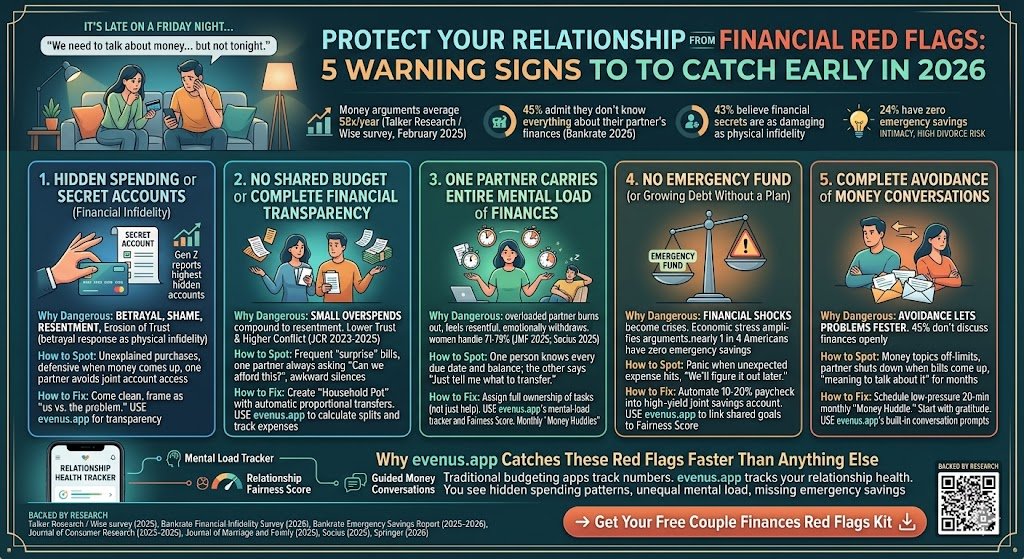
It’s late on a Friday night. The kids (or the dog) are asleep, and you’re both finally on the couch. One partner casually mentions needing new work clothes; the other freezes because they just saw the credit card balance in the app. No yelling. No fight. Just that familiar knot in the stomach and the quiet thought: “We need to talk about money… but not tonight.”
In 2026, financial red flags are the silent relationship killers. The average couple argues about money 58 times per year — more than one heated discussion every week (Talker Research / Wise survey, February 2025, still the benchmark). Almost half of committed couples (45%) admit they don’t know everything about their partner’s finances, and 43% believe financial secrets are at least as damaging as physical infidelity (Bankrate Financial Infidelity Survey, January 2026). Meanwhile, 24% of Americans have zero emergency savings, and many carry more credit card debt than savings (Bankrate Emergency Savings Report, 2025–2026 data).
These aren’t minor money hiccups. Unaddressed financial red flags predict lower relationship satisfaction, higher divorce risk during economic stress, increased depression, and eroded intimacy. The good news? They’re highly fixable when caught early. Here are the 5 red flags in couple finances you should never ignore — plus exactly how to spot them, why they’re dangerous, and the modern tools that fix them fast.
5 Red Flags in Couple Finances You Should Never Ignore
1. Hidden Spending or Secret Accounts (Financial Infidelity)
The biggest red flag in 2026: one partner has a secret credit card, hidden savings account, or undisclosed debt. Bankrate’s 2026 survey found 45% of couples don’t fully share financial details, and 25% admit to keeping minor (or major) debts, expenses, or income secret. Younger generations are especially prone — Gen Z reports the highest rates of hidden accounts.
Why it’s dangerous: Trust is the foundation of every relationship. Financial secrets trigger the same betrayal response as emotional cheating — shame, resentment, and eroded intimacy. Studies link financial infidelity directly to higher breakup rates and long-term anxiety.
How to spot it: Sudden unexplained purchases, defensive reactions when money comes up, or one partner avoiding joint account access.
How to fix it: Come clean in a calm conversation framed as “us vs. the problem.” Use a tool like evenus.app that requires full transparency while keeping personal accounts private until both agree. Couples who address this early report restored trust within weeks.
2. No Shared Budget or Complete Financial Transparency
You both earn good money, but neither knows exactly where the household cash is going. One partner pays rent, the other groceries, and no one tracks the total. Bankrate’s February 2026 survey shows only 38% of couples fully combine finances — 62% keep at least some accounts separate, and many have zero joint system.
Why it’s dangerous: Without transparency, small overspends compound into resentment. The Journal of Consumer Research (2023–2025 studies) shows couples without shared systems experience lower trust and higher conflict. Money stress spills into every area of life, reducing emotional availability and sexual connection.
How to spot it: Frequent “surprise” bills, one partner always asking “Can we afford this?”, or awkward silences when the topic comes up.
How to fix it: Create one shared “Household Pot” for joint expenses with automatic proportional transfers on payday. evenus.app makes this effortless — it calculates fair splits based on income, tracks every expense, and links spending to your Relationship Fairness Score so imbalances never stay invisible.
3. One Partner Carries the Entire Mental Load of Finances
One of you pays all the bills, tracks subscriptions, remembers due dates, and worries about savings goals while the other “just relaxes.” This is the invisible cognitive labor gap in action. Even in dual full-time households, one partner (usually the woman) handles 71–79% of financial planning and remembering (Journal of Marriage and Family 2025; Socius 2025).
Why it’s dangerous: The overloaded partner burns out, feels resentful, and emotionally withdraws. Research links disproportionate cognitive labor directly to higher depression, lower relationship satisfaction, and reduced desire. The other partner often feels blindsided when resentment finally surfaces.
How to spot it: One person knows every due date and balance; the other says “Just tell me what to transfer.”
How to fix it: Assign full ownership of financial tasks (not just “help”). Use evenus.app’s mental-load tracker and Fairness Score to make the invisible visible. Weekly 15-minute “Money Huddles” turn planning into teamwork instead of one person’s burden.
4. No Emergency Fund (or Growing Debt Without a Plan)
You have no cushion for job loss, medical bills, or car repairs — or worse, credit card debt is quietly climbing while you avoid the conversation. Bankrate’s 2026 data shows nearly 1 in 4 Americans have zero emergency savings, and many carry more credit card debt than savings.
Why it’s dangerous: Financial shocks become relationship crises. Economic stress amplifies arguments and reduces marital quality (Springer 2026 study on crises and divorce). Without a buffer, small problems snowball into resentment and blame.
How to spot it: Panic when an unexpected expense hits, or one partner always saying “We’ll figure it out later.”
How to fix it: Automate 10–20% of each paycheck into a high-yield joint savings account. evenus.app’s shared goals feature links emergency fund progress to your Fairness Score so both partners stay motivated and accountable. Most couples build a 3–6 month cushion within 8–12 months.
5. Complete Avoidance of Money Conversations
You talk about everything except money. “We’re fine” is the default answer even when tension is obvious. 45% of couples don’t discuss finances openly, according to multiple 2025–2026 surveys.
Why it’s dangerous: Avoidance doesn’t solve problems — it lets them fester. Unaddressed financial stress correlates with lower relationship satisfaction, higher divorce risk during economic downturns, and emotional distance. Couples who never talk about money often discover major gaps only during a crisis.
How to spot it: Money topics are off-limits, one partner shuts down when bills come up, or you’ve been “meaning to talk about it” for months.
How to fix it: Schedule a low-pressure 20-minute monthly “Money Huddle.” Start with gratitude (“I appreciate how hard you work”) before numbers. evenus.app’s built-in conversation prompts make these talks productive instead of scary. Couples who normalize money talks report 60–80% fewer arguments within months.
Why evenus.app Catches These Red Flags Faster Than Anything Else
Traditional budgeting apps track numbers. evenus.app tracks your relationship health. It automatically links every expense and financial task to your Relationship Fairness Score, mental-load tracker, and guided equity prompts. You see red flags in real time — hidden spending patterns, unequal mental load, missing emergency savings — and get actionable fixes before resentment builds. Thousands of couples in 2026 use it to turn financial stress into partnership strength.
The Bottom Line
These five red flags aren’t about being “bad with money.” They’re about trust, equity, and emotional safety — the real foundations of any relationship. Ignoring them doesn’t make them disappear; it lets them quietly erode the love you built. The couples who thrive in 2026 are the ones who spot these signals early and address them together with transparency, ownership, and the right tools.
You don’t need perfect finances. You need honest ones. Run a quick audit tonight: Do any of these five red flags exist in your relationship? If yes, open evenus.app, start the Fairness Score, and schedule your first Money Huddle. In 30 days you’ll feel lighter, closer, and more in control — together.
Your money should support your love story, not sabotage it. Catch these red flags now, and protect the partnership you both deserve.
Ready to Catch Financial Red Flags Before They Destroy Your Trust?
Hidden spending, unequal mental load, secret debt, or no emergency fund can quietly erode intimacy, spark resentment, and even end relationships. evenus.app helps you spot these red flags instantly with its Relationship Fairness Score, mental-load tracker, and guided money conversations that turn tension into teamwork. Grab your free Couple Finances Red Flags Kit — complete with the 5 red flags audit checklist, Fairness Score template, hidden spending conversation prompts, emergency fund planner, monthly huddle script, and 30-day reset plan that couples are already using to restore transparency and closeness.
Stop ignoring the warning signs tonight. Protect your partnership and peace of mind.
→ Get Your Free Couple Finances Red Flags Kit
Backed by Research
The statistics and insights in this article are drawn from the latest verified 2025–2026 surveys on couples and money. The average of 58 money-related arguments per year comes from a large-scale study of 2,000 Americans in relationships. Bankrate’s 2026 surveys confirm that 45% of couples hide financial details, 24% have zero emergency savings, and financial secrets are viewed as damaging as physical infidelity. Peer-reviewed research further links financial transparency and equitable mental load to higher relationship satisfaction and lower conflict.
Key Sources
- Talker Research / Wise Couples & Money Survey (February 2025): https://talkerresearch.com/couples-argue-this-many-times-a-year-about-money/
- Bankrate Financial Infidelity Survey (January 2026): https://www.bankrate.com/credit-cards/news/financial-infidelity-survey/