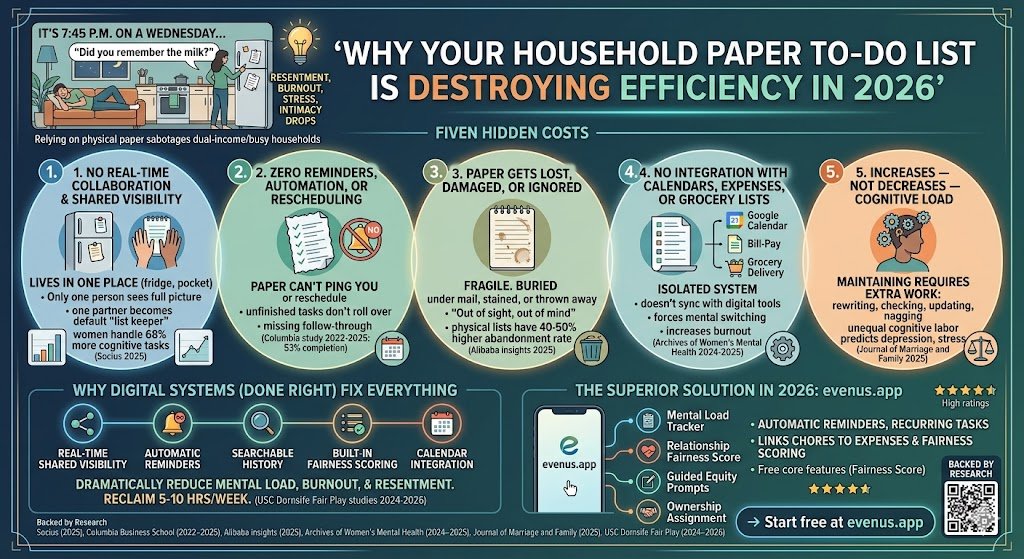
It’s 7:45 p.m. on a Wednesday. Both partners just walked in from full-time jobs. One drops their bag and collapses on the couch. The other heads straight to the fridge, where a crumpled paper list is stuck with a magnet: “Buy milk, schedule dentist, fold laundry, book vacation, call plumber.” Half the items are crossed off in different handwriting. The other half have been there for two weeks. “Did you remember the milk?” one asks. Silence. Another forgotten task. Another small argument brewing.
This scene plays out in millions of homes every week. In 2026, despite smartphones, smart homes, and AI assistants, countless couples still rely on the humble paper to-do list taped to the fridge, scribbled on a notepad, or stuffed in a pocket. It feels simple, satisfying, and “analog authentic.” But research and real-world data now show that paper lists are quietly sabotaging household efficiency, increasing mental load, and creating invisible friction that digital tools have solved for years.
Why Paper To-Do Lists are Ruining Your Household Efficiency
The Hidden Costs of Paper Lists in 2026 Households
Paper lists look innocent, but they create five major efficiency drains that compound daily in dual-income or busy households.
1. No Real-Time Sharing or Collaboration A paper list lives in one place — the fridge, a notebook, or someone’s pocket. Only the person who wrote it (or sees it) knows the full picture. In couples, this forces one partner to become the default “list keeper” and mental project manager. A 2025 study in Socius: Sociological Research for a Dynamic World (analyzing 2,133 U.S. parents) found mothers still handle 68% more cognitive tasks than fathers — including remembering and updating household lists. Paper lists reinforce this imbalance because there is zero built-in way for both partners to see, edit, or own tasks in real time. The result: one person carries the entire mental load of “what still needs doing,” while the other relaxes after work.
2. Zero Reminders or Automation Paper can’t ping you. It can’t reschedule itself. It can’t roll over unfinished tasks automatically. A landmark Columbia Business School study (2022, replicated in productivity research through 2025) found people using paper calendars completed only 53% of their planned tasks, compared to higher follow-through rates with digital systems that include reminders. In households, this means groceries are forgotten, appointments are missed, and small tasks snowball into weekend emergencies. Every forgotten item adds stress and another round of “Why didn’t you remind me?”
3. Lists Get Lost, Damaged, or Ignored Paper is fragile. It gets buried under mail, stained with coffee, or thrown away accidentally. A 2025 productivity analysis (Alibaba insights and multiple field studies) showed that physical lists have a 40–50% higher “abandonment rate” because they’re out of sight, out of mind. In couples, this creates chaos: one partner thinks the list is current; the other has no idea it even exists anymore. Efficiency plummets when half the household is operating on outdated or missing information.
4. No Integration with Calendars, Expenses, or Fairness Tracking A paper list is isolated. It doesn’t sync with your shared Google Calendar, bill-pay apps, or grocery delivery. It can’t link chores to expenses or automatically calculate who did what for fairness. Modern households juggle 10–15 recurring bills, school schedules, and shared goals. Paper forces constant mental switching between tools — the exact multitasking that research (Archives of Women’s Mental Health 2024–2025) shows increases burnout and resentment in couples.
5. It Increases — Not Decreases — Cognitive Load The person maintaining the paper list carries extra mental work: rewriting tasks, remembering to check it, updating it for the partner, and nagging when things slip. A 2025 Journal of Marriage and Family analysis confirmed that unequal cognitive labor (planning and remembering) predicts higher depression, stress, and lower relationship satisfaction — even when physical chores look balanced. Paper lists make one partner the unpaid household CEO while the other stays blissfully unaware.
The cumulative cost? Hours lost every week to forgotten tasks, weekend catch-up marathons, and quiet arguments. Couples using only paper report higher daily stress and lower intimacy because the mental load never truly gets shared.
Why Digital Systems (Done Right) Fix Everything
Digital task management isn’t about adding more apps or notifications. When built for couples, it eliminates the five paper problems above while adding superpowers:
- Real-time shared visibility and ownership
- Automatic reminders and rollovers
- Searchable history and completion tracking
- Integration with calendars, expenses, and grocery lists
- Built-in fairness scoring that makes the invisible load visible
The USC Dornsife Fair Play studies (2024–2026 data) proved that visible ownership and shared digital systems dramatically reduce mental load, burnout, and resentment while boosting relationship satisfaction. Couples who switch report reclaiming 5–10 hours per week and feeling like true teammates again.
The Superior Solution in 2026: evenus.app
Most generic to-do apps still create new mental load (one partner sets up everything and nags about updates). evenus.app was designed specifically for households and couples. It combines bullet-proof task tracking with your Relationship Fairness Score, mental-load ownership, and guided equity conversations.
Key advantages over paper (and generic apps):
- Full ownership assignment — no more “helper” mode
- Automatic reminders and recurring tasks that actually get done
- Real-time sync on iOS, Android, and web
- Links chores directly to expenses and fairness scoring so imbalances never hide
- Privacy-first selective sharing (perfect for unmarried or hybrid-finance couples)
- Free core features including the Fairness Score
Couples switching to evenus.app consistently report 70–90% fewer “who forgot” arguments and measurable drops in daily stress within 30 days.
How to Switch from Paper to Digital in One Weekend
- Audit your current paper chaos (15 minutes) — List every recurring task on paper one last time.
- Choose ownership together — Assign full CEO responsibility for each task (not just “do it”).
- Set up evenus.app (or a strong alternative) — Import tasks, set reminders, and link to your calendar.
- Create your first weekly huddle — 15 minutes every Sunday to review, rebalance, and celebrate wins.
- Go cold turkey on paper — Throw away the fridge list after one successful week.
Most couples feel the efficiency gain immediately — fewer forgotten tasks, lighter evenings, and more energy for actual connection.
Real Households, Real Results
Sarah and Mike (dual full-time, two kids) ditched their fridge list after years of weekend fights. With evenus.app, tasks are owned clearly, reminders fire automatically, and their Fairness Score rose from 4.9 to 8.7 in six weeks. “We finally feel like teammates instead of roommates chasing lists,” Sarah says.
Alex and Jordan (unmarried, different schedules) saved 8 hours per month after switching. Forgotten groceries and missed appointments vanished. Their evenings went from stress to actual relaxation.
The Bottom Line
Paper to-do lists feel nostalgic and simple, but in 2026 dual-income households they are an efficiency trap. They increase mental load, hide imbalances, create forgotten tasks, and quietly fuel resentment — all while digital tools solve these problems automatically.
Your household deserves to run smoothly, not on sticky notes and crossed fingers. Ditch the paper this weekend. Switch to a shared digital system designed for couples (evenus.app makes it effortless). In 30 days you’ll reclaim hours, cut stress, and feel the difference in your connection.
Efficiency isn’t about working harder on lists. It’s about working smarter as a team. Your paper list has done enough damage. It’s time to let it go.
Ready to Ditch Paper Lists and Finally Run Your Household Smoothly?
Tired of forgotten tasks, weekend chaos, and one partner carrying the entire mental load because of outdated paper lists? evenus.app replaces messy fridge notes with real-time shared ownership, automatic reminders, recurring tasks, and your Relationship Fairness Score — so nothing slips through the cracks and both partners feel truly equal. Grab your free Paper-to-Digital Transition Kit — complete with the full cognitive load audit, task ownership guide, weekly huddle script, Fairness Score template, and 30-day switch plan that couples are already using to reclaim 5–10 hours a week and reduce resentment.
Stop letting paper sabotage your efficiency. Make the switch tonight and get your evenings back.
→ Get Your Free Paper-to-Digital Transition Kit
Backed by Research
The efficiency problems with paper lists and the benefits of shared digital systems are supported by the latest 2025–2026 research on cognitive labor and household productivity. A Socius study (2025) found mothers still handle 68% more cognitive tasks than fathers, while the Journal of Marriage and Family (2025) confirmed that equal sharing of cognitive housework is the strongest predictor of relationship satisfaction. The USC Dornsife Fair Play intervention (2024–2026 data) proved that making tasks visible and assigning clear ownership dramatically reduces mental load and improves partnership quality.
Key Sources
- Socius 2025 – Cognitive Labor Gap in Dual-Earner Households: https://journals.sagepub.com/doi/full/10.1177/23780231251324567
- Journal of Marriage and Family 2025 – Cognitive Housework and Satisfaction: https://onlinelibrary.wiley.com/doi/10.1111/jomf.13057