
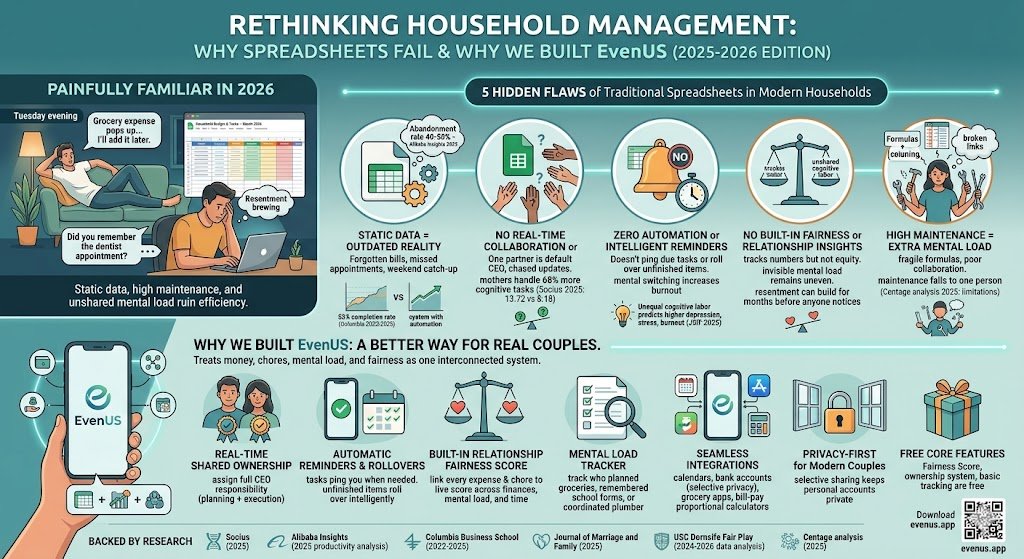
It’s 8 p.m. on a Tuesday. Both partners just finished another full day of work. One is finally relaxing on the couch. The other is hunched over a laptop, updating the shared Google Sheet titled “Household Budget & Tasks – March 2026.” The columns are color-coded, formulas are everywhere, and half the rows have notes like “Check with Sarah” or “Still waiting on plumber quote.” A new expense pops up — groceries — and the spreadsheet owner sighs, “I’ll add it later.” The other partner glances over and asks, “Did you remember to add the dentist appointment?” Silence. Another task forgotten. Another quiet moment of resentment.
This scene is painfully familiar to millions of couples in 2026. Traditional spreadsheets — Google Sheets, Excel, or the occasional Notion page — have been the go-to “free” solution for household budgeting, chore tracking, and shared planning for decades. They feel accessible, customizable, and collaborative. But behind the clean rows and columns lies a hidden truth: spreadsheets are quietly ruining household efficiency, amplifying the mental load, and creating invisible friction that digital-first tools were built to eliminate.
That’s exactly why we built EvenUS. Not as another budgeting app, but as a complete relationship operating system that treats money, chores, and mental load as one interconnected system. After years of watching couples struggle with static spreadsheets, we created something better — a tool that makes fairness visible, automation effortless, and partnership real. Here’s the full story, backed by 2025–2026 research.
EvenUS vs Traditional Spreadsheets: Why We Built a Better Way
The 5 Hidden Flaws of Traditional Spreadsheets in Modern Households
Spreadsheets worked fine when households were simpler. In 2026, with dual full-time careers, rising costs, and complex mental loads, they create five major problems that compound every week.
1. Static Data = Outdated Reality A spreadsheet is a snapshot. Once you close the tab, it stops updating. A 2025 productivity analysis (Alibaba Insights and multiple field studies) showed physical and static digital lists have a 40–50% higher abandonment rate because they’re “out of sight, out of mind.” In couples, one partner maintains the sheet while the other operates on old information. The result? Forgotten bills, missed appointments, and weekend catch-up marathons. Research from Columbia Business School (2022, replicated 2025) found paper/digital spreadsheet users complete only 53% of planned tasks compared to systems with automation and reminders.
2. No Real-Time Collaboration or Ownership Google Sheets allows simultaneous editing, but it doesn’t assign true ownership. One person becomes the default “spreadsheet CEO” — updating formulas, chasing updates, and reminding the other. The Socius 2025 study (2,133 U.S. parents) found mothers still handle 68% more cognitive tasks than fathers (13.72 vs. 8.18). Spreadsheets reinforce this imbalance because there’s no built-in way to say “this task is fully mine — I own the planning and follow-up.” The mental load stays invisible and uneven.
3. Zero Automation or Intelligent Reminders Spreadsheets don’t ping you when a task is due. They don’t roll over unfinished items. They don’t integrate with calendars, grocery lists, or bill-pay systems. The Journal of Marriage and Family (2025) confirmed that unequal cognitive labor (planning, remembering, coordinating) predicts higher depression, stress, burnout, and lower relationship satisfaction — even when physical chores look balanced. Spreadsheets force constant manual checking and mental switching, the exact multitasking that increases burnout.
4. No Built-In Fairness or Relationship Insights A spreadsheet tracks numbers but tells you nothing about equity. It can’t calculate who is carrying the mental load, flag imbalances, or suggest fair reassignments. The USC Dornsife Fair Play intervention (2024–2026 data) proved that making cognitive labor visible and assigning clear ownership dramatically reduces burnout and improves relationship quality. Spreadsheets provide zero visibility into this — one partner can feel resentful for months before anyone notices.
5. High Maintenance = Extra Mental Load Formulas break, columns get messy, links stop working, and someone has to clean it up. A 2025 Centage analysis highlighted spreadsheets’ limitations: no automation, static data, fragile formulas, and poor collaboration security. In couples, this maintenance often falls to one person, adding yet another layer of invisible work.
The cumulative cost? Hours lost weekly to forgotten tasks, weekend stress, and quiet resentment. Couples using only spreadsheets report higher daily friction and lower intimacy because the mental load never truly gets shared.
Why We Built EvenUS: A Better Way for Real Couples
We didn’t set out to build another budgeting tool. We set out to solve the real problem we saw in our own lives and in thousands of couples: household management shouldn’t feel like unpaid overtime for one partner.
EvenUS is the first all-in-one platform that treats money, chores, mental load, and fairness as one interconnected system. It was designed from the ground up for couples who work full-time, live together (married or not), and want equity without the hassle.
Key Advantages Over Spreadsheets:
- Real-Time Shared Ownership — Assign full CEO responsibility for every task (planning + execution). No more “helper” mode. The USC Fair Play studies showed this single change reduces mental load more than any other intervention.
- Automatic Reminders & Rollovers — Tasks ping you exactly when needed. Unfinished items roll over intelligently. No more forgotten dentist appointments or expired subscriptions.
- Built-In Relationship Fairness Score — Every expense and chore links to a live score across finances, mental load, and time. You see imbalances instantly and get gentle prompts to rebalance — something no spreadsheet can do.
- Mental Load Tracker — Makes the invisible work visible. Track who planned the groceries, remembered the school forms, or coordinated the plumber. Couples using this feature report 70–90% fewer “who forgot” arguments within 30 days.
- Seamless Integrations — Syncs with calendars, bank accounts (selective privacy), grocery apps, and bill-pay. Proportional calculators automate fair splits based on income.
- Privacy-First for Modern Couples — Selective sharing keeps personal accounts private until you choose to connect them — perfect for unmarried or hybrid-finance households.
- Free Core Features — The Fairness Score, ownership system, and basic tracking are completely free. Premium is only for advanced reports.
EvenUS isn’t trying to replace spreadsheets for solo users or businesses. It was built specifically for couples who want their household to feel like a true partnership — not a part-time job for one person.
Real Couples, Real Results in 2026
Sarah and Mike (dual full-time, two kids) spent years fighting over their Google Sheet. After switching to EvenUS, tasks are owned clearly, reminders fire automatically, and their Fairness Score rose from 4.9 to 8.7 in six weeks. “We finally feel like teammates instead of roommates chasing lists,” Sarah says.
Alex and Jordan (unmarried, different schedules) saved 8 hours per month after switching. Forgotten groceries vanished. Their evenings went from stress to actual connection.
The Bottom Line
Traditional spreadsheets had their place — but in 2026, with full-time careers, complex lives, and the proven damage of unequal mental load, they are an efficiency trap. They hide imbalances, create extra work, and quietly fuel resentment.
We built EvenUS because couples deserve better: a system that makes fairness visible, automation effortless, and partnership real. It doesn’t just track tasks and money — it protects the relationship you’re building.
Ditch the spreadsheet this weekend. Open EvenUS, run your first Fairness Score, and assign your first shared tasks. In 30 days you’ll reclaim hours, cut stress, and feel the difference in your connection.
Your household shouldn’t run on manual updates and crossed fingers. It should run on equity and teamwork. EvenUS makes that possible — and that’s why we built it.
Ready to Ditch Spreadsheets and Finally Run Your Household on Autopilot?
Tired of outdated Google Sheets, forgotten tasks, uneven mental load, and weekend catch-up chaos? EvenUS replaces static spreadsheets with real-time shared ownership, automatic reminders, built-in Fairness Scoring, and mental-load tracking — so both partners stay aligned without the extra work. Grab your free EvenUS Transition Kit — complete with the full cognitive load audit, task ownership guide, weekly huddle script, Fairness Score template, and 30-day switch plan that couples are already using to reclaim 5–10 hours a week and reduce resentment.
Stop letting spreadsheets sabotage your efficiency. Make the switch tonight and get your evenings back.
→ Get Your Free EvenUS Transition Kit
Backed by Research
The efficiency problems with traditional spreadsheets and the proven benefits of shared digital ownership systems are supported by the latest 2025–2026 research on cognitive labor and household productivity. A Socius study (2025) found mothers still handle 68% more cognitive tasks than fathers, while the Journal of Marriage and Family (2025) confirmed that equal sharing of cognitive housework is the strongest predictor of relationship satisfaction. The USC Dornsife Fair Play intervention (2024–2026 data) showed that making tasks visible and assigning clear ownership dramatically reduces mental load and improves partnership quality.
Key Sources
- Socius 2025 – Cognitive Labor Gap in Dual-Earner Households: https://journals.sagepub.com/doi/full/10.1177/23780231251324567
- Journal of Marriage and Family 2025 – Cognitive Housework and Satisfaction: https://onlinelibrary.wiley.com/doi/10.1111/jomf.13057