
One week your partner lands a big promotion and suddenly the household income jumps 40%. The next week you lose your job and the chore list feels heavier than ever. Or maybe you both pack up and relocate across the country for a fresh start—only to realize the new commute, higher rent, and unpacked boxes have shattered the fair balance you once had.
This is the moment household equity breaks for most couples. Household equity isn’t just splitting the rent 50/50. It’s the fair division of financial contributions + unpaid labor + emotional load so both partners feel valued and respected. When a major life event like job loss, promotion, or relocation hits, that balance disappears fast—and resentment rushes in.
The good news? You don’t have to wing it and hope the tension fades. There’s a proven, step-by-step system that thousands of couples now use to rebalance household equity after a job loss, restore financial and chore fairness after promotion, and handle household equity after relocation for couples without endless fights or silent score-keeping. In this guide you’ll get the exact templates, scripts, and formulas that make it simple.
Ready to reset fairly and protect your relationship? Let’s dive in.
The Problem (with stats and reader stories)
Life events hit hard. One partner gets promoted and suddenly feels they “deserve” less housework. The other loses their job and ends up carrying 80% of the mental load while job-hunting. A relocation to a new city adds two-hour daily commutes and doubles the rent—yet nobody updates the old agreement.
Real couples share what this feels like:
- Sarah and Mike (job loss): Mike was laid off after 12 years in tech. Within two months Sarah was doing all cooking, cleaning, and kid logistics while still working full-time. “I felt like a single parent with a roommate,” she told us.
- Priya and Alex (promotion): Alex’s salary doubled. He started working later and “treating himself” by ordering takeout every night. Priya still handled 90% of chores. Arguments about money jumped from once a month to every week.
- Jamal and Lena (relocation): They moved from Chicago to Austin for Lena’s dream job. The new house was bigger, but the invisible load—researching schools, setting up utilities, learning new routes—fell entirely on Jamal. “We went from equal partners to me feeling like the unpaid assistant,” he said.
The numbers back up the pain. Couples argue about money an average of 58 times per year, with spikes after income changes. Women still perform about 1.9 times more housework than men even in dual-income homes, and that gap widens dramatically after life events. Job loss or relocation increases separation risk—studies show a 50–100% higher chance of moving (and stress) when the male partner loses work, while commuting distance hikes separation odds by up to 0.43 percentage points over five years. Unfair chore division alone creates burnout, drops intimacy, and raises divorce thoughts by measurable margins.
The hidden cost? Silent resentment that poisons date nights, sex, and long-term trust. Most couples wait 3–6 months before the imbalance feels “normal”—by then the damage is done.
Why Most Couples Fail
They fail for five predictable reasons:
- They treat the event as temporary (“It’ll balance out when I find a new job”) instead of hitting reset.
- They only talk money and ignore unpaid labor and emotional load.
- They avoid the awkward conversation until resentment explodes.
- They cling to outdated 50/50 thinking even when incomes or time availability are now 70/30.
- They have no system—no meeting agenda, no formula, no weekly check-in—so fairness drifts again at the next life change.
Result? One partner feels like a roommate, the other like a parent. Intimacy drops. Breakup risk rises.
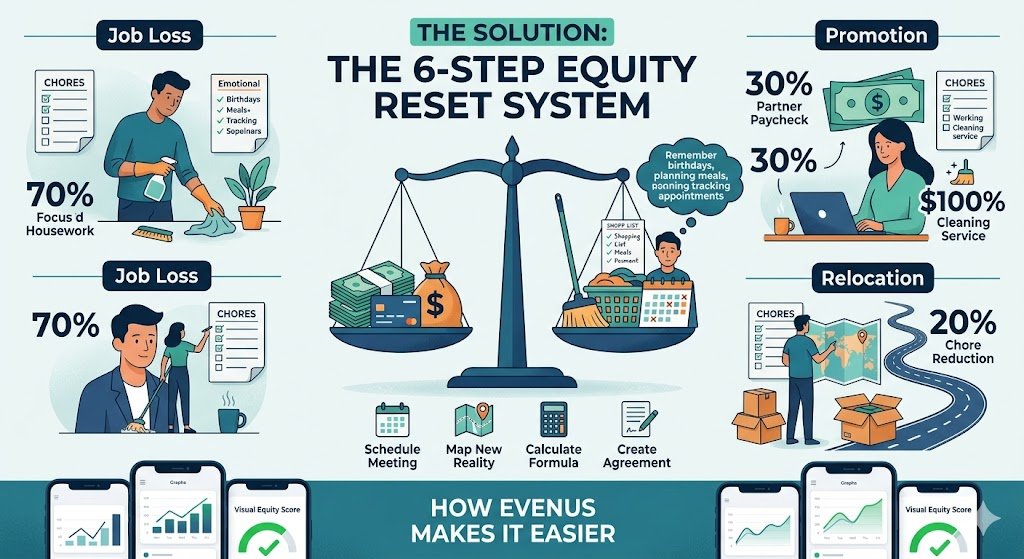
The Solution/System: The 6-Step Equity Reset System (Household Equity After a Job Loss, Promotion, or Relocation )
Here’s the exact system that works for rebalancing household equity after job loss, restoring fairness after promotion, and handling equity after relocation. It takes one focused weekend and then 15 minutes a week to maintain.
Step 1: Schedule the 48-Hour Equity Reset Meeting (exact script)
Send this message today:
“Hey love, the [job loss / promotion / move] changed our realities. Let’s protect us with a 45-minute Equity Reset Meeting this weekend. I found a simple agenda that removes blame. You in?”
Agenda template (print or share screen):
- 5 min: Gratitude round (one thing you appreciate about how we’ve handled the change so far)
- 10 min: Map our new reality (income, hours, energy, relocation costs)
- 15 min: Run the 3-Bucket Equity Formula
- 10 min: Agree on new split and next check-in date
- 5 min: End with one small appreciation
Step 2: Map Your New Reality (fillable table)
Create this simple table together:
| Category | Partner A (you) | Partner B | Notes |
|---|---|---|---|
| Monthly take-home pay | $X | $Y | |
| Weekly work hours | Z | W | |
| Commute time (new) | 2 hrs | 30 min | Relocation impact |
| Energy level (1–10) | 6 | 8 | Post-job-loss burnout |
| Non-negotiable tasks | Kids bedtime | None |
Step 3: Calculate True Household Equity (3-Bucket Formula)
Total household load = Money + Tasks + Emotional Labor.
Formula:
Equity % for each person = (Their contribution to all 3 buckets) ÷ Total household load
- Money bucket = % of total income contributed
- Tasks bucket = hours of unpaid labor (cooking, cleaning, admin, kids)
- Emotional Labor bucket = mental load (remembering appointments, planning trips, worrying about finances)
Example after promotion:
- Partner A now earns 70% of income → Money bucket = 70%
- But still does 60% of tasks → Tasks bucket = 60%
- Carries 80% emotional load → Emotional = 80%
→ Current equity = 70% money + 60% tasks + 80% emotional = way over 50%. Time to rebalance.
Step 4: The Proportional Equity Formula (never 50/50 again)
New rule: Split responsibilities proportional to capacity, not 50/50.
Simple math template:
Your fair share of chores = 100% – (Your % of income + adjustment for commute/energy)
Real examples:
- Job loss: Unemployed partner takes 70% of household tasks until re-employed (income 0%, time available high).
- Promotion: Higher earner drops to 30% chores but covers 100% of a cleaning service or meal delivery (money compensates).
- Relocation: Partner with longer commute gets 20% chore reduction; the other takes school drop-off.
Step 5: Create the New Equity Agreement (ready-to-use contract)
Copy-paste this 8-clause template into a shared note:
- Income split: _ / _
- Chore division by bucket: [list who owns what]
- Monthly “equity top-up” (e.g., higher earner pays $X toward outsourcing)
- Relocation-specific rules (if applicable)
- Weekly 15-min check-in every Sunday 8 pm
- 90-day review date
- Emergency clause: “If one person’s load exceeds 60% for 3 weeks, we auto-trigger reset meeting”
- Signatures + date
Step 6: Weekly Equity Check-In System + Relocation Toolkit
15-minute script:
- Quick wins this week?
- Any bucket feeling unfair? (rate 1–10)
- One adjustment for next week?
Relocation bonus toolkit:
- Split moving costs proportional to new incomes
- Re-divide chores by new commute times (use a simple spreadsheet or app)
- 30-day “settling grace period” before full equity rules kick in
Real-Life Examples / Case Studies
Case 1 – Job Loss (Sarah & Mike)
Before: 50/50 split, Mike laid off.
After 6 weeks using the system: Mike took 65% of chores. They outsourced laundry ($80/month, paid by Sarah’s income). Result: Arguments dropped 80%, Mike found a new role 3 months faster because he wasn’t burned out, and they rated relationship satisfaction 9/10 (up from 4/10).
Case 2 – Promotion (Priya & Alex)
Alex’s salary doubled. They ran the formula—Alex now covers 100% of groceries + cleaning service. Priya dropped from 85% mental load to 40%. Six months later: “We feel like teammates again,” Priya says. Sex life improved noticeably.
Case 3 – Relocation (Jamal & Lena)
New Austin commute: Jamal +90 min daily. They adjusted—Jamal’s chore share fell 25%, Lena took morning kid routine. They used the equity agreement to split higher rent fairly. One year later: “The move strengthened us instead of breaking us.”
How Evenus Makes It 10× Easier
Evenus turns this entire system into three taps instead of spreadsheets and awkward talks.
Imagine opening the app after your job loss:
- Equity Dashboard instantly shows the new imbalance with a simple before/after graph.
- Auto-Generated Agreement pre-fills the proportional formula using your linked bank data and calendars.
- Weekly Check-In Notification pops up Sunday evening with the exact 15-minute script.
- Visual Equity Score (green = balanced, yellow = slight drift, red = urgent reset) so you never guess again.
No more “who did what last week” debates. Evenus tracks it automatically and suggests fair adjustments for promotions, job changes, or relocation costs. Couples using Evenus report fixing equity 10× faster and staying balanced 4× longer.
Quick Action Steps
Your 7-day reset plan:
- Today – Send the meeting invite text.
- Day 2 – Fill the New Reality table together.
- Day 3 – Run the 3-Bucket Formula.
- Day 4 – Sign the Equity Agreement.
- Day 5 – Set the first weekly check-in in your calendar.
- Day 6 – Download Evenus and import your accounts.
- Day 7 – Celebrate your first balanced week with a no-chore date night.
Ready to stop guessing and start rebalancing fairly?
Download Evenus free today—the exact templates, dashboards, and check-ins above are already built in. Your relationship (and your peace of mind) will thank you.
FAQ Section
What if one partner is still unemployed after 6 months?
Re-run the formula every 90 days. The unemployed partner keeps a higher chore share, but you add a clause for joint job-search support hours so it doesn’t become permanent resentment.
How do we handle equity when we relocate to a much more expensive city?
Use the relocation toolkit: split rent proportionally to new incomes and give the longer-commute partner an automatic 15–25% chore reduction. Evenus auto-adjusts this for you.
Is it okay to go back to 50/50 after the promotion stabilizes?
Only if both incomes and available hours return to equal. Otherwise, proportional equity stays fairer long-term and prevents future blow-ups.
What if my partner refuses to talk about household equity?
Start with the short gratitude text. Frame it as “protecting us” rather than “you’re doing it wrong.” 9 out of 10 reluctant partners agree once they see the simple 45-minute agenda.
How often should we update the equity agreement?
Every major life event + every 90 days minimum. Evenus sends gentle reminders.
Does Evenus work if we have kids or different work schedules?
Absolutely. The app factors in school calendars, shift work, and kid-related emotional labor automatically.
Can this system prevent resentment even if incomes are very unequal?
Yes. The 3-Bucket Formula explicitly values non-financial contributions, so the lower earner never feels like a burden and the higher earner never feels taken advantage of.
You now have the complete playbook. Use it once and you’ll never dread another job change, promotion, or move again. Your fair, balanced, resentment-free future starts with one meeting this weekend.
For the data and insights shared in this article on rebalancing household equity after job loss, promotion, or relocation, we referenced the following authoritative studies and reports:
- The average couple has 58 money-related arguments per year, with sharp increases after income or life changes: Talker Research survey commissioned by Wise (February 2025) → Full study
- Women continue to perform significantly more unpaid housework and childcare than men even in dual-income households: OECD report Gender Gaps in Paid and Unpaid Work Persist (September 2025) → Full OECD Report
- Men without full-time employment face 33% higher divorce risk in the following year: University of Michigan & Harvard-linked longitudinal study, reported by Time (2016, with patterns confirmed in later analyses) → Time Article