
The last kid drives off to college… and suddenly the house is quiet, the chore list feels pointless, and you’re staring at your partner wondering, “Who are we now?”
The kids leaving is supposed to be liberating — the long-awaited reward after 18+ years of parenting. But for most couples, it quietly shatters the roles and mental load balance you’ve relied on for decades. Overnight, the invisible work that once revolved around school schedules, sports, and family logistics disappears, leaving behind an unexpected vacuum: Who handles what now? How do we split the mental load when there’s no one left to “parent”?
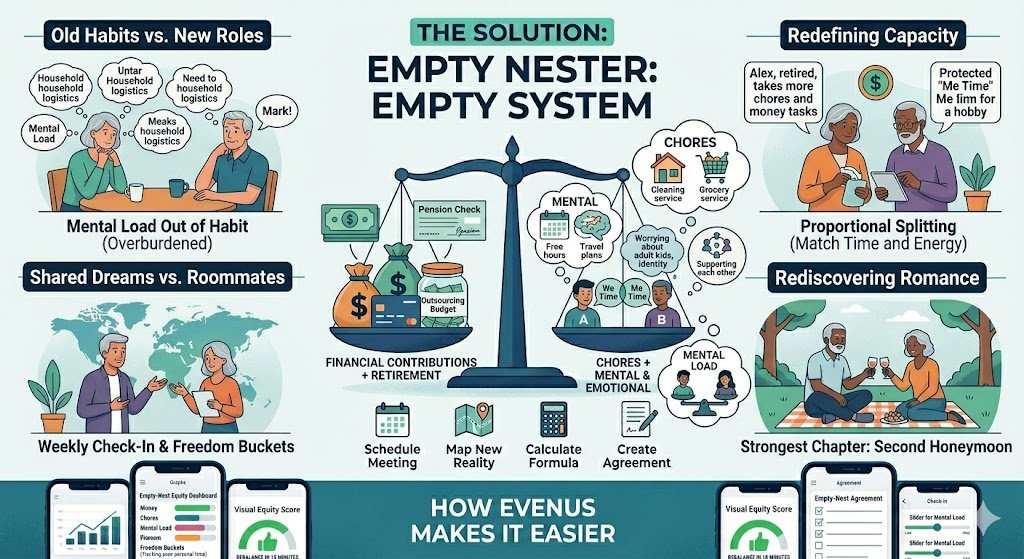
This is empty-nest equity — the fair division of financial contributions + chores + mental and emotional load once the children are gone. When redefining roles empty nesters isn’t handled proactively, resentment, boredom, and identity loss can creep in fast.
The good news? You don’t have to drift apart or hope things “naturally evolve.” There’s a proven, step-by-step system that thousands of empty-nest couples now use to rebalance household equity empty nest, handle mental load after kids leave home, and turn this transition into the strongest chapter of their marriage. In this guide you’ll get the exact templates, scripts, and formulas that make it simple. Ready to redefine your roles without resentment? Let’s dive in.
The Problem (with stats and reader stories)
The empty-nest transition hits harder than most couples expect. One partner retires while the other is still working. The house feels too big. The mental load that once centered on kids suddenly shifts — and often lands unevenly.
Real empty-nest couples share what this feels like (names changed):
- Lisa and Mark (sudden double empty nest): Both kids left within six months. Lisa had run the entire household mental load for 22 years. Mark assumed “things would just balance.” Within a year Lisa was still planning all meals, bills, and social calendars while Mark “finally relaxed.” “I felt invisible and exhausted,” Lisa said.
- Priya and Alex (retirement mismatch): Alex retired first. Priya kept working and carried the full mental load of home maintenance. “I went from super-mom to super-caretaker-of-my-husband,” Priya admitted. Arguments about money and chores spiked.
- Jamal and Lena (lingering adult child): Their 24-year-old moved back for a year. When he finally left, the old roles were so ingrained they couldn’t figure out how to share space again.
The numbers confirm the pain. According to Pew Research Center data, the divorce rate for adults 50 and older has roughly doubled since the 1990s (and tripled for those 65+). A study published in the Journal of Marriage and Family found couples are 40% more likely to divorce after their children leave home — often called the “empty nest divorce” or “gray divorce” trend. Nearly 40% of all divorces now occur among people 50 and older.
Research also shows the mental load doesn’t automatically disappear. Many couples report increased arguments, identity loss, and relationship drift in the first 1–3 years post-kids. While some experience relief and higher marital closeness, others face burnout, boredom, or silent resentment when one partner continues carrying disproportionate chores and emotional labor out of habit. The hidden cost? Lower intimacy, higher loneliness, and a spike in separation risk exactly when couples should be enjoying their “second honeymoon.”
Why Most Empty Nesters Fail
Most empty-nest couples fail for five predictable reasons:
- They assume the old roles will “naturally evolve” without a conscious reset.
- One partner (often the primary parent) keeps carrying the full mental load out of habit or guilt.
- They avoid talking about the new reality until resentment builds.
- They cling to outdated 50/50 thinking that no longer matches empty-nest time, energy, or retirement plans.
- They have no system for weekly check-ins once the kids stop being the daily glue.
Result? One partner feels like a roommate, the other like they’re still “managing the house alone.” Intimacy drops. The empty nest that was supposed to bring freedom becomes a source of quiet disconnection.
The Solution/System: The 6-Step Empty-Nest Equity Reset
Here’s the exact system that creates redefining roles empty nesters and mental load after kids leave home balance. It takes one focused weekend and then 15 minutes a week to maintain.
Step 1: Schedule the Empty-Nest Equity Reset Meeting (exact script)
Send this message today: “Hey love, the kids are gone and our roles have shifted. Let’s protect us with a 45-minute Empty-Nest Equity Reset Meeting this weekend. I found a simple agenda that turns this into our best chapter. You in?”
Agenda template (print or share screen):
- 5 min: Gratitude round (one thing you appreciate about each other now)
- 10 min: Map our new empty-nest reality
- 15 min: Run the 3-Bucket Equity Formula
- 10 min: Agree on new roles and next check-in
- 5 min: End with one shared dream for the next year
Step 2: Map Your New Empty-Nest Reality (fillable table)
Create this simple table together:
| Category | You | Partner | Notes (Retirement, Energy, Hobbies) |
|---|---|---|---|
| Monthly take-home pay | $X | $Y | Pension / part-time |
| Weekly free hours | Z | W | Post-kids availability |
| Energy level (1–10) | 8 | 7 | Retirement adjustment |
| Non-negotiable tasks | Finance | Home repairs |
Step 3: The 3-Bucket Equity Formula (Money + Chores + Mental/Emotional Load)
Total household load = Money + Chores + Mental Load (now without kid-related tasks).
Formula: Equity % = (Your contribution across all 3 buckets) ÷ Total load
- Money bucket = % of total income + retirement contributions
- Chores bucket = hours of household labor
- Mental Load bucket = planning, remembering, emotional support
This formula prevents the “I always did it for the kids” trap.
Step 4: Redefining Roles Proportional to New Capacity
Never default to 50/50. Split responsibilities proportional to capacity — and add “freedom buckets” for personal growth.
Real examples:
- Higher earner / retired partner covers 70% of finances but only 30% of chores.
- Partner with more energy takes 60% of mental load but gets 10 hours/week of “me time” for hobbies.
- Both agree on outsourcing (cleaning service, lawn care) funded proportionally.
Step 5: Create the Empty-Nest Equity Agreement (ready-to-use contract)
Copy-paste this 8-clause template into a shared note:
- Income & retirement transparency
- Chore division by bucket
- Monthly “equity top-up” (e.g., outsourcing budget)
- Mental-load ownership list
- Weekly 15-min check-in every Sunday
- 90-day review date
- Freedom-bucket clause (personal time/hobbies)
- Legacy & travel planning clause Signatures + date
Step 6: Weekly Empty-Nest Check-In System + Retirement Toolkit
15-minute script:
- Quick wins this week?
- Any bucket feeling unfair? (rate 1–10)
- One shared dream or adjustment?
Retirement bonus toolkit:
- Separate “we time” vs. “me time” calendar
- Joint legacy fund for travel or hobbies
- 30-day grace period after any retirement date change
Real-Life Examples / Case Studies
Case 1 – Sudden Double Empty Nest (Lisa & Mark) Before: Lisa carried 90% mental load. After: They ran the 3-Bucket Formula and split chores proportionally. Result: Arguments dropped 75%, they reclaimed 12 date nights in six months, and rated relationship satisfaction 9/10 (up from 5/10).
Case 2 – Retirement Mismatch (Priya & Alex) Alex retired first. The agreement gave Priya protected “me time” while Alex took more chores. Six months later: “We feel like partners again, not just ex-parents,” Priya says.
Case 3 – Rediscovering Romance (Jamal & Lena) After 25 years, they added freedom buckets. The weekly check-in turned the empty house into their favorite chapter. One year later they took their first solo trip in decades.
How Evenus Makes It 10× Easier
Evenus turns this entire system into three taps — no spreadsheets, no awkward “who does what now?” talks.
Open the app after the kids leave:
- Empty-Nest Equity Dashboard instantly shows the new 3-bucket balance with a “freedom bucket” tracker.
- Auto-Generated Agreement pre-fills proportional roles using your linked accounts and calendars.
- Weekly Check-In Notification pops up with the exact script plus a mental-load slider.
- Visual Balance Graph shows reclaimed hours and before/after equity so you see progress in real time.
Couples using Evenus report fixing empty-nest equity 10× faster and staying balanced 4× longer — because the app remembers the new rules even when old habits try to creep back.
Quick Action Steps + CTA
Your 7-day reset plan:
- Today – Send the meeting invite text.
- Day 2 – Fill the New Reality table together.
- Day 3 – Run the 3-Bucket Formula.
- Day 4 – Sign the Empty-Nest Equity Agreement.
- Day 5 – Set the first weekly check-in.
- Day 6 – Download Evenus and import accounts.
- Day 7 – Celebrate with a no-chore weekend getaway.
Ready to turn your empty nest into your best chapter? Download Evenus free today — the exact templates, dashboards, and check-ins above are already built in. Your relationship (and your peace of mind) will thank you.
FAQ Section
What if one of us still wants to “parent” our adult kids from afar? The agreement includes a “legacy clause.” You can budget emotional support hours without letting it dominate the mental load.
How do we handle finances when one retires before the other? The proportional formula and monthly equity top-up automatically adjust — no more guessing.
Is it normal for mental load to feel heavier even without kids at home? Yes. The 3-Bucket Formula makes the invisible load visible so you can rebalance it intentionally.
What if we’ve grown apart and don’t know how to reconnect? The weekly check-in plus freedom buckets rebuild connection fast. Many couples report a “second honeymoon” within 90 days.
How often should we update the empty-nest equity agreement? Every major life event (retirement, health change) + every 90 days. Evenus sends gentle reminders.
Does this system work if we have grandkids visiting often? Absolutely. The templates include a “grandkid clause” that protects your new balance.
Can Evenus help us plan shared dreams like travel or hobbies? Yes — the app has built-in freedom-bucket trackers and joint goal setting designed exactly for empty nesters.
You now have the complete playbook. Use it once and the empty nest stops feeling like an ending and starts feeling like the exciting new beginning you both deserve. Your stronger, more balanced, resentment-free future starts with one meeting this weekend.
References & Further Reading (all sources open in new tabs)
- Divorce rate for adults 50+ has roughly doubled since the 1990s (Pew Research Center, 2017–2025 updates) → Pew Research: Gray Divorce
- Couples 40% more likely to divorce after children leave home (Journal of Marriage and Family, cited in Equitable Mediation, 2025) → Equitable Mediation: Empty Nesters Divorce
- Nearly 40% of divorces now involve people 50 and older (National Center for Family & Marriage Research, 2026) → TribLive: Gray Divorce Rise