
You’re glowing in your third trimester… but already the mental load feels heavier than the baby bump. Then the baby arrives and suddenly one partner is drowning in feedings, appointments, and invisible planning while the other feels helpless. Pregnancy and the first postpartum year are beautiful — and brutally unbalanced unless you protect mental load equity from day one.
This is pregnancy & postpartum equity: the fair division of financial contributions + chores + mental/emotional load + recovery support across all three trimesters and the full first 12 months. When protecting mental load during pregnancy and postpartum mental load balance for couples isn’t handled proactively, resentment, burnout, and relationship strain spike fast.
The good news? You don’t have to wing it and hope exhaustion fades. There’s a gentle, phased, drama-free system that thousands of new parents now use for fair division of household responsibilities new parents, how to prevent resentment in first year with baby, and equitable chore and finance split postpartum. In this guide you’ll get the exact templates, scripts, and formulas that keep you connected instead of resentful. Ready to protect your mental load and your relationship from day one? Let’s dive in.
The Problem (with stats and reader stories)
Pregnancy and the postpartum year turn even the most equal couples upside down. The birthing parent battles fatigue, nausea, and recovery while the mental load of “thinking of everything” explodes. One partner returns to work while the other is home with a newborn. Sleep deprivation hits, and suddenly 80–90% of the invisible labor lands on one person.
Real new-parent couples share what this feels like (names changed):
- Rachel and Tom (third trimester burnout): Rachel was handling all doctor appointments, baby registry, and meal planning while working full-time. Tom “helped when asked.” By week 32 she was crying from exhaustion.
- Priya and Alex (immediate postpartum overwhelm): After birth Priya managed every feeding, pediatrician call, and household task while pumping. Alex went back to work after two weeks. “I felt like a single parent in my own marriage,” Priya said.
- Lena and Jamal (6-month resentment): By month 6 Lena was still doing 85% of the mental load. Jamal felt shut out. Intimacy disappeared and arguments skyrocketed.
The numbers confirm the pain. Mothers carry 71% of household mental load tasks — 60% more than fathers — including planning, scheduling, and organizing (2024 U.S. study reported across Neuroscience News and multiple outlets). Cognitive household labor (the “thinking of everything”) is linked directly to higher depression, stress, burnout, worse overall mental health, and reduced relationship quality in mothers (2024 study in Archives of Women’s Mental Health and PMC research).
Postpartum depression and anxiety affect 1 in 5 U.S. women, with PPD diagnosis rates rising from 9.4% in 2010 to 19.0% in 2021. Up to 40.1% of depressive episodes begin in the postpartum period. Relationship satisfaction drops sharply: 70% of couples experience a decline in the first three years after the first baby, with sudden deterioration persisting for many (Gottman Institute longitudinal data and Journal of Marriage and Family studies). The unpaid labor gap widens dramatically in the first year, raising resentment, breastfeeding challenges, intimacy loss, and long-term breakup risk.
The hidden cost? Higher postpartum depression/anxiety rates, silent score-keeping, and a relationship that quietly erodes exactly when you need each other most.
Why Most Couples Fail (Pregnancy & Postpartum )
Most new parents fail for five predictable reasons:
- They assume “it will balance once the baby is here” without a plan.
- The birthing parent carries 80–90% of the mental and recovery load by default.
- No conversation about phased roles, sleep, or breastfeeding support.
- They cling to old 50/50 rules that ignore pregnancy fatigue and postpartum healing.
- They wait for exhaustion or fights instead of building a proactive phased system.
Result? One partner feels invisible and resentful; the other feels shut out or guilty. Burnout sets in fast.
The Solution/System: The 4-Phase Equity Protection System
Here’s the exact gentle system that creates postpartum mental load balance for couples and protecting mental load during pregnancy. It’s phased across the full first year so it feels realistic, not overwhelming.
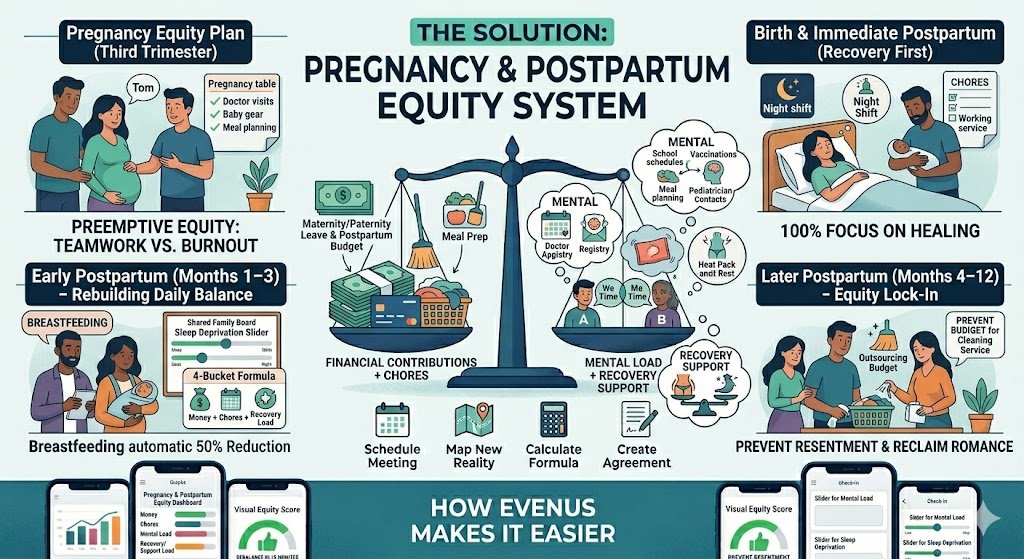
Phase 1: Pregnancy (Trimesters 1–3) – The Preemptive Equity Plan
Start now with a 30-minute “Equity Vision Meeting.”
Exact script to send: “Hey love, the baby is coming and I want us both to feel supported. Let’s do a quick 30-minute Preemptive Equity Planning session this weekend. No blame, just teamwork.”
Agenda template:
- 5 min: Share one excitement and one worry
- 10 min: Map pregnancy realities (energy, appointments, finances)
- 10 min: Agree on early splits
- 5 min: Set first check-in date
Use this simple table:
| Category | Birthing Parent | Partner | Notes |
|---|---|---|---|
| Doctor appointments | Attend | Schedule | |
| Baby registry/gear | Research | Purchase | |
| Meal & rest planning | Decide | Prep |
Phase 2: Birth & Immediate Postpartum (Weeks 1–6) – The Recovery-First Reset
Focus is 100% on healing. No “equal” chores — recovery is the priority.
Survival checklist template:
- Birthing parent: Rest, feed baby, zero mental load on household
- Partner: All cooking, cleaning, laundry, visitors, night shifts (except feeds)
- Weekly 10-minute check-in: “What’s one thing I can take off your plate?”
Phase 3: Early Postpartum (Months 1–3) – Rebuilding Daily Balance
Introduce the 4-Bucket Equity Formula: Money + Chores + Mental Load + Recovery/Support Load.
Formula: Equity % = (Your contribution across all 4 buckets) ÷ Total load.
Adapt for sleep deprivation: the partner getting more sleep takes more mental load that week.
Ready-to-use agreement clause example: “Breastfeeding/pumping parent gets automatic 50% reduction in chores and mental load for first 12 weeks.”
Phase 4: Later Postpartum (Months 4–12) – Long-Term Equity Lock-In
Shift to proportional splits based on work schedules and energy. Add “freedom buckets” (personal recharge time). Weekly 15-minute check-in becomes habit.
Bonus templates included in every phase:
- Full 8-clause Equity Agreement (covers maternity leave, return-to-work, outsourcing budget, intimacy check-ins)
- Visual scorecard for quick weekly ratings
Real-Life Examples / Case Studies
Case 1 – Third Trimester Burnout (Rachel & Tom) Before: Rachel carried 90% mental load. After Phase 1 plan: Tom handled all scheduling. Result: Rachel’s anxiety dropped; they entered birth as a team.
Case 2 – Immediate Postpartum Overwhelm (Priya & Alex) After using the Recovery-First Reset: Alex took all nights and chores for 6 weeks. Priya recovered faster; intimacy returned by month 3.
Case 3 – 9-Month Resentment Prevention (Lena & Jamal) They locked in Phase 4 proportional splits plus outsourcing. Fights dropped 80%, relationship satisfaction rebounded to pre-baby levels.
How Evenus Makes It 10× Easier
Evenus turns this entire 4-phase system into three taps — no spreadsheets, no guilt-filled conversations.
Open the app during pregnancy:
- Pregnancy Equity Dashboard shows trimester progress bar and auto-suggests splits.
- Auto-Generated Postpartum Recovery Agreement pre-fills recovery-first rules using your calendars.
- Weekly Check-In Notification pops up with the exact script plus a mental-load + sleep-deprivation slider.
- Visual Balance Graph tracks equity across the full first year so you see progress in real time.
New parents using Evenus report fixing mental load imbalance 10× faster and staying connected 4× longer — because the app remembers the rules even when you’re sleep-deprived.
Quick Action Steps + CTA
Your 7-day “Start Today” plan:
- Today – Send the Equity Vision Meeting text.
- Day 2 – Fill the Preemptive table together.
- Day 3 – Run the 4-Bucket Formula preview.
- Day 4 – Sign the first-phase agreement.
- Day 5 – Set your first check-in.
- Day 6 – Download Evenus and link calendars.
- Day 7 – Celebrate with a no-load date (even if it’s just takeout in bed).
Ready to protect your mental load and your relationship from day one? Download Evenus free today — the exact phased templates, dashboards, and check-ins above are already built in for new parents. Your peace, your bond, and your baby will thank you.
FAQ Section
What if my partner doesn’t see the mental load? Start with the short script and the 4-Bucket Formula. Most partners “get it” once they see the invisible work visualized.
How do we handle equity when one partner is breastfeeding/pumping? The agreement automatically gives the breastfeeding parent a 50% reduction in chores and mental load for the first 12 weeks.
Is it okay to outsource chores during the first year? Yes — and encouraged. The system includes a monthly “equity top-up” budget for cleaning, meal kits, or night nurses funded proportionally.
What if we have older kids too? The templates include an “older siblings clause” so everyone’s needs are balanced.
How often should we update the agreement during the first year? Every major milestone (return to work, sleep regression, 6-month mark) + every 90 days. Evenus sends gentle reminders.
Does this system help prevent postpartum depression/anxiety? Yes. Research shows equitable load sharing reduces stress, burnout, and depression risk by making the invisible labor visible and shared.
Can Evenus work for single parents or non-traditional families? Absolutely. It adapts for co-parenting, surrogacy, adoption, or solo parents by focusing on support networks and self-equity tracking.
You now have the complete playbook. Use it once and pregnancy and postpartum stop feeling like a solo marathon and start feeling like the supported, connected journey you both deserve. Your balanced, resentment-free first year starts with one gentle conversation this weekend.
References & Further Reading (all sources open in new tabs)
- Mothers carry 71% of household mental load tasks (Neuroscience News / 2024 U.S. study, December 2024) → Neuroscience News Article
- Cognitive household labor linked to depression, stress, burnout, and reduced relationship quality in mothers (PMC 2024 & Archives of Women’s Mental Health) → PMC Full Study
- Postpartum depression affects 1 in 5 women; diagnosis rates rose to 19% by 2021 (Policy Center for Maternal Mental Health) → Maternal Mental Health Fact Sheet