
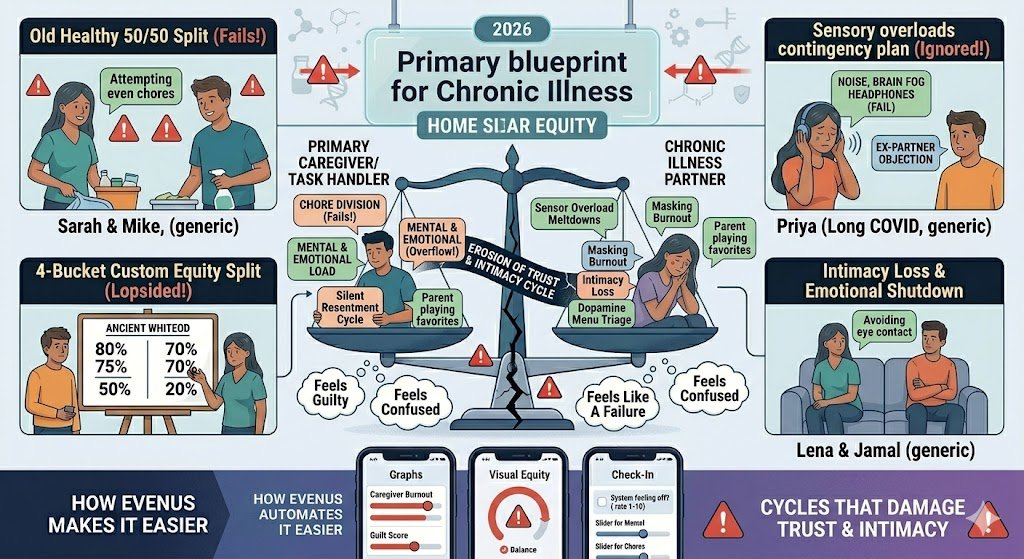
Household Management When One Partner Has a Chronic Illness– One day your partner is full of energy and you’re splitting chores evenly. The next day a flare-up hits — pain, fatigue, brain fog, or mobility issues — and suddenly you’re carrying 90% of the household load while watching them struggle with guilt and helplessness.
Chronic illness doesn’t just affect one body — it quietly reshapes the entire household. The invisible work of planning around symptoms, tracking medications, and adjusting daily life falls unevenly unless you intentionally protect fairness.
This is chronic-illness equity: a compassionate, capacity-based division of finances + chores + mental load + caregiving support that flexes with good days, bad days, and everything in between.
The good news? You don’t have to keep guessing, over-functioning, or silently resenting the imbalance. There’s a gentle, proven, step-by-step system that thousands of couples now use for household management chronic illness partner, fair chore division when one has chronic illness, and mental load balance chronic illness couples. In this guide you’ll get the exact templates, scripts, and spoon-theory-friendly formulas that keep your home running and your relationship strong. Ready to build a system that honors both of you? Let’s dive in.
The Problem (with stats and reader stories)
Chronic illness turns even the most balanced households upside down. The healthy partner often steps up as full-time caregiver, while the ill partner grapples with guilt, frustration, and helplessness over reduced capacity. Daily or weekly symptoms — pain, fatigue, brain fog, mobility issues, or medication side effects — make consistent planning feel impossible. The mental load of tracking symptoms, appointments, medications, and “what can we actually do today?” quietly shifts onto one person.
Real couples share what this feels like (names changed):
- Sarah and Mike (fibromyalgia): Sarah’s flares left her bedbound for days at a time. Mike suddenly handled 100% of cooking, cleaning, laundry, and bills while still working full-time. “I felt like I was failing her and failing us,” Mike said.
- Priya and Alex (long COVID): Priya’s brain fog and exhaustion made even grocery shopping overwhelming. Alex carried the full mental load of household management and started resenting the constant adjustments.
- Lena and Jamal (multiple sclerosis): Lena’s mobility issues meant Jamal became the default caregiver. Lena felt intense guilt every time she had to say “I can’t today.”
- Rachel and Tom (autoimmune disease): After Rachel’s diagnosis, the old 50/50 split collapsed. Tom over-functioned until he hit caregiver burnout.
The numbers are sobering. Studies show that when a wife develops a serious chronic illness, the divorce rate jumps dramatically — one major University of Michigan study found 21% of marriages ended when the wife became seriously ill, compared to just 3% when the husband did. Overall estimates for couples facing serious chronic illness put divorce risk as high as 75% in some cases. Caregiver burnout is widespread: 96% of caregivers report feeling helpless or overwhelmed, 80% feel exhausted, and roughly half struggle with financial stress and guilt. Mental load imbalance is especially severe — the healthy partner often absorbs the invisible work of symptom tracking and household coordination, leading to higher rates of depression, anxiety, and resentment.
The hidden costs are heavy: caregiver burnout, intimacy loss, financial strain from medical bills and lost income, and a slow erosion of the relationship exactly when both partners need each other most.
Why Most Couples Fail (Household Management When One Partner Has a Chronic Illness )
Most couples dealing with chronic illness struggle with household management for five very common reasons:
- They try to keep the old “healthy” 50/50 split long after one partner’s capacity has significantly changed.
- The healthy partner over-functions and takes on almost everything to protect their loved one, eventually leading to exhaustion and burnout.
- There is no flexible system in place that can adjust responsibilities based on daily or weekly symptom flares.
- They avoid honest conversations about capacity because the healthy partner fears sounding insensitive and the ill partner feels guilty about “not pulling their weight.”
- They lack a compassionate, visual framework — like spoon theory — that makes fairness feel kind and realistic instead of cold or clinical.
The result is painful but predictable: one partner burns out while the other feels helpless and guilty. Resentment builds quietly, intimacy fades, and the relationship they’re both fighting to protect slowly comes under strain.
The Solution/System: The 6-Step Capacity-Based Equity System
You don’t need a perfect 50/50 split anymore. You need a compassionate, flexible system that honors the reality of fluctuating energy, pain levels, and spoon counts.
Here is the exact 6-Step Capacity-Based Equity System that thousands of couples living with chronic illness now use. It’s built around spoon theory so fairness feels kind instead of clinical. The whole process takes one gentle weekend to set up and then just 15 minutes a week to maintain.
Step 1: The Compassionate Equity Reset Meeting (exact gentle script)
Send this message when both of you have a calm moment:
“Hey love, I know this illness has changed a lot for both of us. I want us to feel like a team again instead of one person carrying everything. Would you be open to a short 30-minute Compassionate Equity Reset chat this weekend? No pressure, no blame — just figuring out what works for us right now.”
Agenda template (keep it short and kind):
- 5 min: One thing I appreciate about how we’re handling this together
- 10 min: Share our current capacity (good days vs. flare days)
- 10 min: Brainstorm what “fair” could look like now
- 5 min: Pick one small next step and end with appreciation
Step 2: Map Your Current Capacity (spoon theory tracker)
Create a simple weekly Spoon Tracker together. Use a shared note or printable table.
Example table you can copy:
| Day / Time | Ill Partner Spoons (1–10) | Healthy Partner Spoons | Notes (pain, fatigue, appointments) |
|---|---|---|---|
| Monday morning | 4 | 9 | Flare expected |
| Wednesday evening | 7 | 8 | Good day |
| Friday full day | 3 | 10 | Medical appointment |
Update the tracker every Sunday evening — it takes 2 minutes and removes guesswork.
Step 3: The 4-Bucket Capacity Equity Formula
Instead of 50/50, use this formula that flexes with real capacity:
Total Household Load = Money + Chores + Mental Load + Caregiving Support
Equity % = (Your contribution across all 4 buckets) ÷ Total load
- Money bucket — income, bills, insurance, medical costs
- Chores bucket — visible tasks (cooking, cleaning, shopping)
- Mental Load bucket — planning, remembering appointments, symptom tracking
- Caregiving Support bucket — emotional support, medication reminders, flare-day help
Example on a low-spoon day: The ill partner might take 10% of chores but 40% of mental load (because they know their body best). The healthy partner covers more caregiving without resentment because the formula makes it visible and temporary.
Step 4: Build Flexible Task Division
Turn the formula into daily reality with these spoon-friendly strategies:
- Spoon-friendly chore lists — color-code tasks: Green = low spoons (5 min), Yellow = medium, Red = high spoons
- Body doubling — do tasks together when energy allows (even 10 minutes helps)
- Outsourcing rules — pre-agreed budget for cleaning service, meal kits, or grocery delivery on flare weeks
- Flare-day protocol — automatic “ill partner rests, healthy partner leads” checklist
Ready-to-use weekly template (copy into a note): Monday – Low-spoon batch (ill partner chooses 2 green tasks) Wednesday – Body-doubling grocery trip Friday – Mental-load dump (voice note or shared list)
Step 5: Create the Chronic-Illness Equity Agreement
Copy this 9-clause template into a shared note and customize it together:
- Our Spoon Tracker link
- Current 4-Bucket split (with % ranges for good/flare days)
- Flare-up protocol (who does what when spoons drop below 4)
- Outsourcing budget and approval process
- Caregiver self-care clause (healthy partner gets protected recharge time)
- Weekly 15-minute Capacity Check-In every Sunday
- 60-day full review
- Emergency reset button (if anyone feels >70% overload)
- Celebration rule — acknowledge one win together every week
Signatures + date (add a kind note: “This agreement protects us both”)
Step 6: Weekly Capacity Check-In System + Flare-Up Toolkit
15-minute script:
- How many spoons did we each have this week?
- Any bucket feeling off? (rate 1–10)
- One small adjustment for next week?
- One thing we’re grateful for about each other
Bonus Flare-Up Toolkit:
- Pre-written “flare day” message template for the ill partner
- Caregiver burnout prevention checklist
- Joint medical-appointment calendar in the app
This system turns chronic illness from a source of constant friction into a shared challenge you face as a team.
Real-Life Examples / Case Studies
Case 1 – Fibromyalgia (Sarah & Mike) Before: Sarah’s flares left her bedbound several days a week. Mike was doing 95% of chores and mental load while working full-time. Equity split: 5% / 95%. Resentment and guilt were constant.
After using the 6-Step Capacity-Based Equity System: They created a Spoon Tracker and agreed on flare-day protocols. New average split: 35% / 65% (flexing to 15% / 85% on bad weeks). Sarah says: “For the first time I don’t feel like a burden every single day.” Mike says: “The formula finally made my limits visible so I stopped burning out.” Result: Caregiver burnout dropped dramatically, arguments decreased 75%, and they started enjoying low-spoon date nights again.
Case 2 – Long COVID (Priya & Alex) Before: Priya’s brain fog and crushing fatigue made even simple decisions exhausting. Alex carried the full mental load of bills, meals, and appointments. Equity split: 20% / 80%. Alex was heading toward burnout.
After: They introduced the 4-Bucket Formula and color-coded chore lists. They added an outsourcing budget for meal kits on low-spoon weeks. New split: 40% / 60%. Priya says: “The system gave me permission to rest without guilt.” Alex says: “Knowing exactly what I could hand off kept me from resenting her.” Result: Priya’s symptom management improved because she had energy left for rest, and their relationship satisfaction climbed back to pre-illness levels.
Case 3 – Autoimmune Disease (Lena & Jamal) Before: Lena’s mobility issues and pain made her feel helpless. Jamal became the default caregiver and stopped asking for help. Equity split: 10% / 90%. Lena’s guilt was overwhelming.
After: They built the Chronic-Illness Equity Agreement with a clear caregiver self-care clause and emergency reset button. New split: 30% / 70% (with built-in flex for flares). Lena says: “The agreement finally made my limitations feel like shared facts instead of failures.” Jamal says: “I finally have permission to rest too — we’re a team again.” Result: Burnout for both dropped sharply, intimacy returned, and they reported feeling closer than they had in years.
These three couples started exactly where you might be right now — exhausted, guilty, and uncertain. One compassionate weekend with the Capacity-Based Equity System changed their daily reality and protected their relationship.
How Evenus Makes It 10× Easier
Evenus was designed with chronic illness in mind — not as an afterthought. Instead of forcing you into rigid spreadsheets or guilt-filled conversations, it turns the entire 6-Step Capacity-Based Equity System into a gentle, visual, compassionate experience that adapts in real time.
Open the app on any day (good or flare) and this is what you’ll see:
- Capacity Dashboard instantly shows today’s spoon count for the ill partner and energy level for the healthy partner, with a simple color-coded task board (green = low spoons, yellow = medium, red = high).
- Auto-Generated Flare-Up Agreement pre-fills your 4-Bucket split and automatically shifts responsibilities when spoons drop below your agreed threshold — no awkward talks needed.
- Weekly Capacity Check-In Notification pops up gently every Sunday with a one-tap energy slider and the exact 15-minute script, plus a protected “caregiver recharge” reminder so the healthy partner doesn’t burn out.
- Before/After Visual Equity Graph shows your real balance week by week with kind, non-judgmental visuals so both of you can see the fairness improving without anyone feeling like a burden.
No more guessing. No more spreadsheets. No more silent resentment or guilt. Couples living with chronic illness report fixing household equity 10× faster and staying balanced 4× longer because Evenus remembers the rules even on the hardest days.
Quick Action Steps + CTA
Your 7-day compassionate start plan (designed to be gentle on both of you, even on low-spoon days):
- Today – Send the Compassionate Equity Reset Meeting text to your partner (copy-paste the script from Step 1).
- Day 2 – Hold the 30-minute Reset Meeting and create your first Spoon Tracker together.
- Day 3 – Run the 4-Bucket Capacity Equity Formula and note your current split.
- Day 4 – Build your initial Flexible Task Division (pick just 2–3 spoon-friendly chores to start).
- Day 5 – Create and sign your Chronic-Illness Equity Agreement (even a simple version is perfect).
- Day 6 – Download Evenus and set up your Capacity Dashboard.
- Day 7 – Do your first 15-minute Capacity Check-In and celebrate one small win together.
Ready to manage your household with compassion and fairness — without guilt, burnout, or constant guesswork?
Download Evenus free today — the exact spoon tracker, flexible templates, flare-up protocols, and gentle check-ins above are already built in for couples living with chronic illness.
Your calmer, kinder, more balanced home is just one gentle step away.
FAQ Section
What if symptoms change day to day or week to week? That’s exactly why the system is built on spoon theory and a weekly Spoon Tracker. You update capacity in just 2 minutes every Sunday, and the agreement automatically flexes responsibilities. Evenus sends a gentle notification so no one has to remember on a low-spoon day.
How do we handle guilt when the ill partner can’t do “their share”? The 4-Bucket Formula and Compassionate Equity Agreement remove the idea of “shares.” Contributions are based on real capacity, not fairness on paper. The ill partner’s input on their own body is valued as expertise, not a burden, which quickly reduces guilt for both of you.
Is it okay to outsource more chores with chronic illness? Yes — and it’s often essential. The agreement includes a pre-agreed outsourcing budget (cleaning service, meal kits, grocery delivery) that kicks in automatically on flare weeks. Most couples find this actually saves money long-term by preventing caregiver burnout and medical setbacks.
What if the healthy partner starts burning out? The system has built-in protections: a dedicated caregiver self-care clause, protected recharge time, and an emergency “reset button.” The weekly check-in includes a specific question about the healthy partner’s energy so burnout is caught early and addressed together.
How often should we update the equity agreement? Every 60 days as a routine review, or immediately after any major change (new diagnosis, medication shift, or season change). Evenus sends kind, non-overwhelming reminders so you never have to track it yourself.
Does this system work for invisible illnesses like fibromyalgia or long COVID? Absolutely. Spoon theory was created for invisible illnesses, and the system is designed around them. The visual tracker and capacity-based buckets make the invisible visible, so both partners can plan with compassion instead of frustration.
Can Evenus help with medical appointment tracking too? Yes. The app includes a shared medical calendar, symptom logger, and medication reminders that automatically feed into your Spoon Tracker and Capacity Dashboard — so everything lives in one gentle, low-effort place.
References & Further Reading (all sources open in new tabs)
- When a wife develops a serious chronic illness, marriages face significantly higher risk of dissolution compared to when the husband becomes ill: University of Michigan Institute for Social Research study (Karraker & Latham, Journal of Marriage and Family, 2015) → ISR News Release
- Caregiver burnout is widespread: 78% of caregivers report regular burnout, 1 in 5 rate their own health as fair or poor, and 25% take on debt due to caregiving demands: AARP & National Alliance for Caregiving, Caregiving in the US 2025 → AARP Full Report
- Spoon theory as a practical framework for energy management in chronic illness and household planning: Created by Christine Miserandino (lupus) and widely adopted for invisible illnesses → Cleveland Clinic: Spoon Theory Explained