
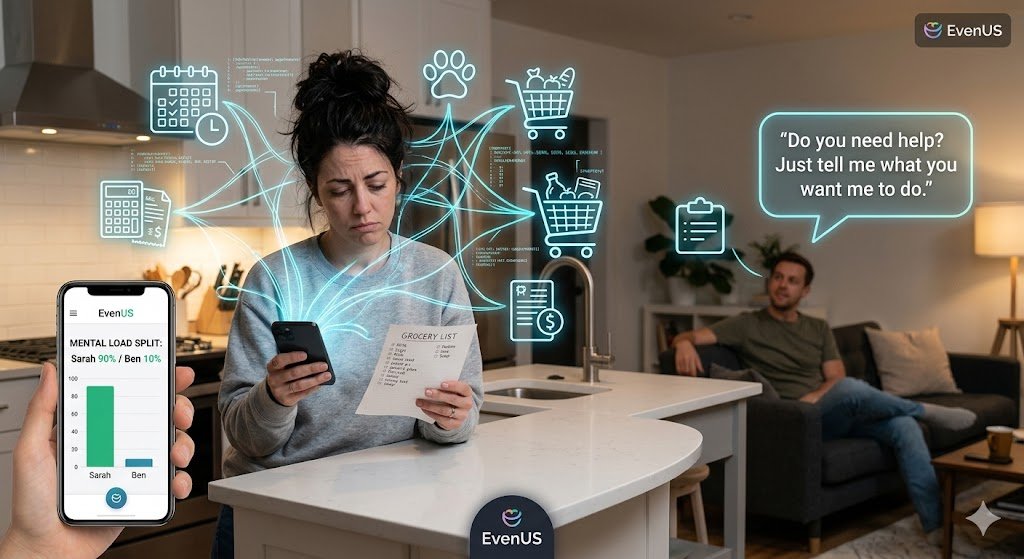
Asking for Help – Picture this incredibly common Tuesday evening scenario: One partner is rushing around the kitchen. They are simultaneously stirring a pot of pasta, wiping down a sticky counter, mentally calculating if there is enough milk for tomorrow’s coffee, and stepping over a pile of mail that needs sorting.
The other partner is sitting on the couch, scrolling through their phone. They look up, see the frantic energy, and offer what they genuinely believe are the most supportive words possible:
“Do you need help? Just tell me what you want me to do.”
They expect a grateful smile and a simple task. Instead, they are met with a heavy sigh, a tightened jaw, or an irritated, “Never mind, I’ll just do it myself.” The partner on the couch is left feeling confused and defensive. They offered to help! Why is their partner angry?
The answer lies in the phrasing itself. While “how can I help?” sounds like a lifeline, it is actually a trigger. It implies that the ultimate responsibility for the household belongs entirely to one person, and the other is merely a temporary, voluntary assistant. It is a fundamental misunderstanding of how a shared life should operate, and it is quietly destroying modern relationships.
The Helper vs. Manager Dynamic
To understand why asking for help is problematic, we have to look at how couples unintentionally structure their homes. Most households slowly devolve into a corporate hierarchy featuring a “Manager” and a “Helper.”
The Manager is the partner who holds the mental load. They are constantly scanning the environment, anticipating needs, and tracking the household inventory. They know the dog needs his shots next week, the in-laws are visiting next month, and the toilet paper is dangerously low.
The Helper is the partner who executes tasks, but only when prompted. They are willing to go to the store, but they need the Manager to write the grocery list. They will happily vacuum, but they need the Manager to point out that the floors are dirty.
The fatal flaw here is that a home with two adult partners should not operate like a boss and an intern. When you ask, “What do you want me to do?” you are forcing your partner to act as your manager. You are not taking work off their plate; you are just changing the type of work they have to do.
Why Delegating is Exhausting (The 3 Hidden Steps)
The core reason the “Manager” partner gets so frustrated is that delegating a task is, in itself, a significant chore. It requires a heavy use of executive function. According to Psychology Today, the cognitive labor required to manage a household drains mental energy faster than the physical execution of the chores themselves.
When you ask your partner to “just tell you what to do,” you are forcing them to execute three distinct, exhausting steps:
Step 1: The Audit Before they can assign you a task, the Manager has to stop what they are doing and mentally scan the entire house. They have to review the master to-do list in their head, prioritize what needs to happen immediately, and determine which task is appropriate to hand off.
Step 2: The Pitch Once they identify a task, they have to figure out how to ask you to do it without sounding like a nag. They have to calculate their tone of voice, provide enough context so you don’t ask a dozen follow-up questions, and time the request so it doesn’t cause a fight.
Step 3: Quality Control The Manager’s job isn’t over once the task is assigned. They now have to hold open a “mental tab” to ensure the task actually gets done. If you forget to do it, they have to decide whether to remind you (and risk an argument) or just quietly do it themselves out of frustration.
Tired of the endless delegation cycle? Transition from managing to partnering. Track mental load, finances, and chores in one app with EvenUS.
The Solution: Shift from “Tasks” to “Ownership”
If asking for help is the problem, what is the solution? Couples need to completely eliminate the Helper/Manager dynamic by shifting from executing tasks to taking ownership.
In the book Fair Play by Eve Rodsky, she introduces a brilliant framework called CPE: Conceive, Plan, and Execute. A “Helper” only does the Execute part. An “Owner” does all three. Let’s look at the difference using the classic “Dinner Dilemma.”
The Helper Approach (Execution Only): You walk into the kitchen at 6:00 PM and ask, “What can I chop?” You are helping, but your partner still had to conceive the meal idea, plan the recipe, check the pantry, and buy the groceries. You are just acting as a sous-chef.
The Ownership Approach (CPE): You notice on Tuesday that the fridge is getting empty (Conceive). You decide to make tacos on Wednesday, check the pantry to see if you have shells, and swing by the store after work to buy ground beef (Plan). You cook the meal on Wednesday night (Execute).
When you take full ownership of a household zone—whether it is weekday dinners, pet care, or vehicle maintenance—you completely remove that mental burden from your partner’s brain. You don’t ask for instructions; you just handle it.
Automating the Home: Let the System Be the Manager
The reality of modern life is that neither partner truly has the time or energy to be the sole Household Manager. Between demanding careers, raising children, and maintaining a social life, human memory is a terrible place to store a household’s operating manual.
Instead of fighting over who forgot to schedule the HVAC maintenance or who is supposed to pay the water bill, you can let technology act as the ultimate, neutral manager.
By setting up digital automations—like utilizing Zapier to automatically generate calendar invites for recurring household tasks or pushing utility due dates to a shared dashboard—you remove the burden of memory entirely. The brain is meant for generating ideas and connecting with your partner, not for storing the expiration date of your dog’s heartworm medication.
Stop Asking, Start Owning with EvenUS
The problem with traditional shared to-do list apps is that they still require one person to sit down and write the list. They track the execution, but they ignore the conception and planning. They keep you trapped in the Helper/Manager dynamic.
EvenUS is built differently. It is designed to help couples transition from simply splitting chores to achieving true relationship equity. EvenUS stands out by combining all three pillars of a modern household: it tracks the mental load, allows for proportional finance splitting, and facilitates total chore ownership.
It visualizes the invisible labor so you can finally see exactly who is managing what. It removes the need to ask, “How can I help?” because the answers are already mapped out, equitable, and clear.
Stop waiting for instructions and start building a balanced partnership. See your own fairness score in EvenUS — try the free demo here.