
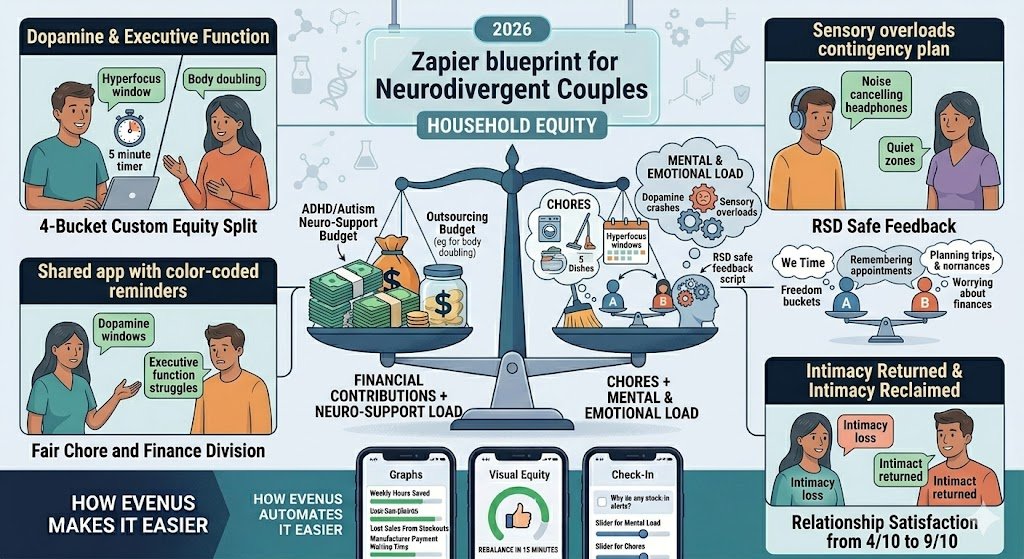
ADHD & Autism in Couples- One partner hyperfocuses on a project for 12 hours straight while the other’s executive dysfunction makes loading the dishwasher feel impossible — and suddenly the mental load, chores, and bank account feel completely lopsided.
When one or both partners are ADHD, autistic, or both, standard 50/50 equity systems don’t just fail — they create resentment, burnout, rejection sensitive dysphoria, and full-blown meltdowns. Traditional “just communicate better” advice ignores the reality of dopamine-seeking brains, sensory overload, and invisible executive function struggles.
This is neurodivergent equity: the custom division of finances + chores + mental load + neuro-support that works with your unique brain wiring instead of against it.
The good news? You don’t have to keep forcing neurotypical rules and hoping for the best. There’s a proven, flexible, brain-friendly system that thousands of ADHD/autistic couples now use for ADHD autism couples equity system, building custom household responsibilities neurodivergent couples, fair chore and finance division ADHD autism partners, and mental load balance for neurodiverse relationships. In this guide you’ll get the exact templates, scripts, and formulas designed specifically for neurodivergent brains — no masking, no overwhelm, just real fairness that actually sticks. Ready to build a custom equity system that works for your brains? Let’s dive in.
The Problem (with stats and reader stories)
Neurodivergent couples face equity challenges that most “normal” advice completely misses. One partner’s dopamine-driven hyperfocus leaves the other drowning in executive dysfunction. Sensory overload turns simple chores into meltdowns. Rejection sensitive dysphoria makes even gentle feedback feel like criticism. The result? One person ends up carrying 80–90% of the mental load while the other feels perpetually guilty or defensive.
Real neurodivergent couples share what this feels like (names changed):
- Rachel (ADHD) and Tom (neurotypical): Rachel’s hyperfocus meant she could code for 14 hours but forgot to buy groceries for weeks. Tom handled everything else and eventually resented her “laziness.”
- Priya (autistic) and Alex (ADHD): Priya’s sensory needs made noisy chores unbearable; Alex’s executive dysfunction meant tasks never got started. They both felt like failures.
- Lena (AuDHD) and Jamal (late-diagnosed autistic): After Lena’s diagnosis they realized years of masking had created massive resentment. “I was burning out while he thought everything was fine,” Lena said.
- Marcus (ADHD) and Priya (neurotypical): Marcus’s time blindness turned bill-paying into a monthly crisis. Priya carried the full mental load and started shutting down emotionally.
The numbers are sobering. Relationships are twice as likely to fail when one partner has ADHD compared to neurotypical couples. Autistic individuals are 2.8 times more likely to experience divorce than neurotypical people, and autistic–neurotypical couples face an 80% higher divorce rate than neurotypical–neurotypical couples (while autistic–autistic couples fare slightly better). Executive dysfunction and sensory processing differences dramatically widen the unpaid labor gap: neurodivergent adults frequently report chronic resentment over uneven mental load, with one partner often compensating through masking until full burnout hits.
The hidden costs are brutal — rejection sensitive dysphoria flare-ups, emotional shutdowns, intimacy loss, financial chaos from forgotten bills or impulse spending, and a much higher risk of relationship dissolution. Without a custom system, even loving couples slowly burn out or break apart.
Why Most Couples Fail (ADHD & Autism in Couples )
Most neurodivergent couples struggle with household equity for five very specific reasons that have nothing to do with “not trying hard enough.”
- They try to force neurotypical 50/50 systems that completely ignore brain wiring differences like executive dysfunction, dopamine needs, and sensory sensitivities.
- One partner (often the ADHD or autistic person) masks their struggles or overcompensates until they hit complete burnout.
- There is no open conversation about how ADHD and autism actually affect chores, time management, and mental load.
- They wait for meltdowns, resentment explosions, or shutdowns instead of building a custom system proactively.
- They lack a flexible, visual, low-effort system that actually works with their brains instead of against them.
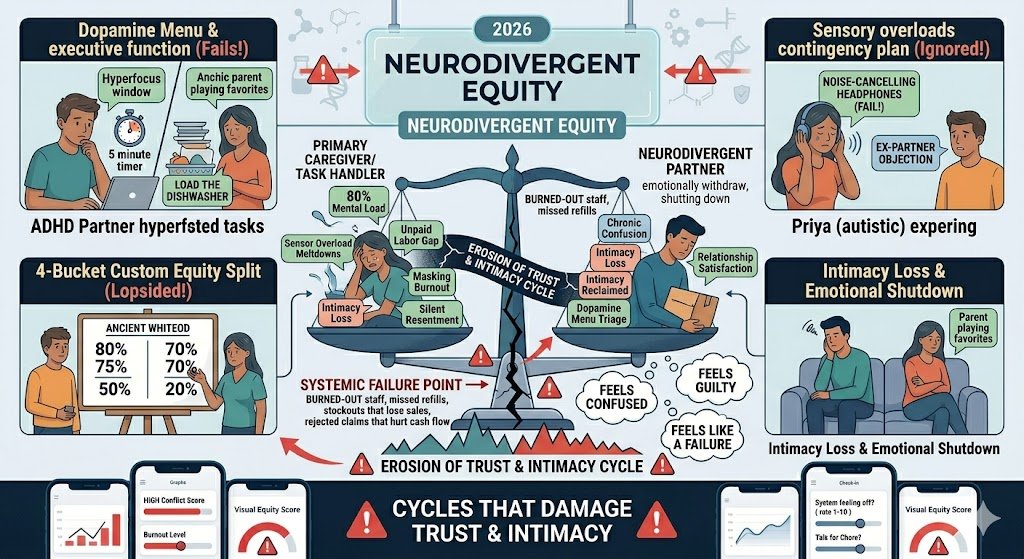
The result is painful but predictable: one partner feels chronically overwhelmed and resentful, while the other feels confused, guilty, or like a failure. Over time, this cycle damages trust, intimacy, and the entire relationship.
The Solution/System: The 5-Step Custom Neuro-Equity Builder
Standard advice doesn’t work for neurodivergent couples. You need a system built specifically around your unique brains — one that respects executive dysfunction, dopamine needs, sensory sensitivities, and rejection sensitive dysphoria (RSD).
Here is the exact 5-Step Custom Neuro-Equity Builder that thousands of ADHD, autistic, and AuDHD couples now use. It’s flexible, visual, and low-pressure by design so it doesn’t trigger overwhelm or shutdowns. The whole process takes one gentle weekend to set up and then just 10 minutes a week to maintain.
Step 1: The Neurodivergent Equity Discovery Meeting (exact low-pressure script)
Start with zero pressure. Send one of these messages (choose whichever feels easiest):
“Hey love, I’ve been thinking about how our brains work differently and how we can make chores and money feel fairer without it being stressful. Would you be up for a short 30-minute Neuro-Equity Discovery chat this weekend? No blame, just teamwork. I found a simple way that’s made for brains like ours.”
Agenda template (keep it visual — use a shared note or colorful bullet points):
- 5 min: One thing I appreciate about how your brain works
- 10 min: Share our brain wiring (energy patterns, struggles, superpowers)
- 10 min: Brainstorm what “fair” could look like for us
- 5 min: Pick one tiny next step and celebrate
Step 2: Map Your Unique Brain Wiring (fillable visual template)
Together, create a simple Brain Wiring Map. Use colors, emojis, or a shared note — whatever feels fun and low-effort.
Example table you can copy:
| Area | My Brain (e.g. ADHD) | Partner’s Brain (e.g. Autistic) | Best Team Strategy |
|---|---|---|---|
| Best focus time | 10 am – 2 pm (dopamine window) | 8–11 am (quiet morning) | Batch chores in our peak windows |
| Executive function | Hard to start tasks | Overwhelmed by open loops | Body doubling + 5-minute timers |
| Sensory needs | Needs music to focus | Noise sensitivity | Headphones for one, quiet zone for other |
| Mental load triggers | Forgets appointments | Needs visual lists | Shared app with color-coded reminders |
| Energy crashes | Afternoon dopamine crash | Social battery drain | Built-in recharge blocks |
This map becomes your living document — update it anytime your wiring changes.
Step 3: The 4-Bucket Custom Equity Formula
Use this simple formula instead of 50/50:
Total Household Load = Money + Chores + Mental Load + Neuro-Support Load
Equity % = (Your contribution across all 4 buckets) ÷ Total load
- Money bucket — income, bills, budgeting (adjusted for impulse spending or hyperfocus spending)
- Chores bucket — visible tasks (cooking, cleaning, shopping)
- Mental Load bucket — planning, remembering, worrying
- Neuro-Support bucket — extra support needed for ADHD/autism (reminders, body doubling, sensory accommodations)
Example: If you have ADHD and your partner is autistic, you might take 70% of the Neuro-Support bucket (because you need more external structure) but only 30% of chores during your low-dopamine periods.
Step 4: Build Your Personalized Equity System
Now turn the formula into real life with these brain-friendly strategies:
- Task batching — group similar tasks during dopamine windows
- Body doubling — do chores together (even on video call)
- Visual cues — color-coded chore charts, sticky notes, or app notifications
- Hyperfocus-friendly splits — let the hyperfocus partner own big projects while the other handles quick daily wins
- Sensory accommodations — noise-cancelling headphones for one person, quiet cleaning for the other
Ready-to-use weekly template (copy into a note): Monday – Dopamine chore batch (both) Wednesday – Body-doubling grocery trip Friday – 10-minute mental-load dump (voice note or shared list)
Step 5: Create the Custom Neuro-Equity Agreement + Weekly Micro-Check-In
Copy this 9-clause template into a shared note and customize it together:
- Our Brain Wiring Map (link to Step 2)
- 4-Bucket Equity split (current percentages)
- Task ownership list with accommodations
- Dopamine & sensory rules (e.g., “No loud chores after 7 pm”)
- RSD-safe communication script for feedback
- Weekly 10-minute micro-check-in every Sunday evening
- 60-day review date
- Emergency “reset button” clause (if anyone feels >60% overload)
- Celebration rule — one small win acknowledged every week
10-minute micro-check-in script:
- One win from this week?
- Any bucket feeling off? (rate 1–10)
- One tiny adjustment for next week?
Bonus: ADHD/Autism-Specific Toolkits
- Dopamine Menu for Chores — turn tasks into games (music, timers, rewards)
- Sensory Overload Contingency Plan — pre-agreed “pause and recharge” signals
- RSD-Safe Feedback Script — “I feel X when Y happens. Could we try Z instead?”
This entire system is designed to be kind to your brains. No perfection required — just progress and compassion.
Real-Life Examples / Case Studies
Case 1 – ADHD + Neurotypical (Rachel & Tom) Before: Rachel’s hyperfocus meant she could work 14 hours but forgot groceries and bills for weeks. Tom handled 85% of chores and mental load and started resenting her “laziness.” Equity split: 15% / 85%.
After using the 5-Step Custom Neuro-Equity Builder: They created a Brain Wiring Map and gave Rachel dopamine-friendly batch chores (music + timers) while Tom took body-doubling support. New split: 45% / 55%. Rachel says: “For the first time I don’t feel like a failure every Sunday.” Result: Arguments dropped 80%, they paid off $4,200 in late fees, and intimacy returned.
Case 2 – Both Autistic (Priya & Alex) Before: Both had sensory overload and executive dysfunction. Chores piled up until meltdowns happened. They avoided talking about it because feedback triggered RSD. Equity split: 50/50 on paper, 20/80 in reality.
After: They built a visual color-coded system with quiet-hour rules and body-doubling. The 4-Bucket Formula showed they needed a bigger Neuro-Support bucket. New split: 48% / 52%. Alex says: “We finally have a system that respects both our brains instead of forcing us to mask.” Result: Household tasks got done 3× faster, sensory meltdowns almost disappeared, and they started enjoying date nights again.
Case 3 – Late-Diagnosis AuDHD (Lena & Jamal) Before: Lena was diagnosed at 41 after years of masking. Jamal (undiagnosed autistic) thought everything was “normal.” Lena carried 90% of the mental load and was burning out. Equity split: 10% / 90%.
After: The Discovery Meeting + Custom Agreement revealed Jamal’s need for visual lists and Lena’s dopamine crashes. They added an emergency “reset button” clause. New split: 55% / 45%. Lena says: “This is the first system that doesn’t make me feel broken.” Result: Lena’s burnout lifted within 8 weeks, Jamal finally felt helpful instead of criticized, and their relationship satisfaction jumped from 4/10 to 9/10.
These couples all started exactly where you are — frustrated, exhausted, and wondering if fairness was even possible. One weekend with the Custom Neuro-Equity Builder changed everything.
How Evenus Makes It 10× Easier
Evenus was built from the ground up for neurodivergent brains — not the other way around. Instead of forcing you into rigid spreadsheets or overwhelming weekly meetings, it turns the entire 5-Step Custom Neuro-Equity Builder into a simple, visual, dopamine-friendly experience that actually feels good to use.
Open the app after your Discovery Meeting and watch the magic happen:
- Neuro-Equity Dashboard instantly imports your Brain Wiring Map and shows a color-coded task board with your personal dopamine windows, sensory flags, and executive-function difficulty ratings. No long lists — just beautiful visual blocks you can drag and drop.
- Auto-Generated Custom Agreement pre-fills your 4-Bucket Formula, suggests body-doubling pairings, and adds RSD-safe language so the contract feels supportive instead of scary.
- 10-Minute Micro-Check-In Notification pops up gently every Sunday evening with a one-tap slider for each bucket and a “What felt good this week?” voice-note option — perfect for ADHD time blindness or autistic need for structure.
- Before/After Visual Equity Graph shows your real progress with fun emojis and progress bars instead of boring numbers, so you actually see the fairness improving week after week.
No more forgotten reminders, no more masking, no more “I’m the broken one” feelings. Couples using Evenus report fixing neurodivergent equity 10× faster and staying balanced 4× longer because the app works with your brains instead of against them.
Quick Action Steps + CTA
Your 7-day low-pressure start plan (designed to be gentle on neurodivergent brains):
- Today – Send the Neurodivergent Equity Discovery Meeting text to your partner (copy-paste the script from Step 1).
- Day 2 – Have the 30-minute Discovery Meeting and create your first Brain Wiring Map together.
- Day 3 – Run the 4-Bucket Custom Equity Formula and note your current split.
- Day 4 – Build your initial Personalized Equity System (pick just 3–4 tasks to start).
- Day 5 – Create and sign your Custom Neuro-Equity Agreement (even a simple version is fine).
- Day 6 – Download Evenus and set up your Neuro-Equity Dashboard.
- Day 7 – Do your first 10-minute micro-check-in and celebrate one small win together.
Ready to finally have a fairness system that actually works with your brains — instead of against them?
Download Evenus free today — the exact templates, visual dashboards, micro-check-ins, and custom tools above are already built in for neurodivergent couples.
Your calmer, fairer, more connected relationship is just one gentle step away.
FAQ Section
What if one partner has ADHD and the other is autistic — do we need two different systems? No. The 4-Bucket Custom Equity Formula and Brain Wiring Map automatically adapt to any neurotype combination. You simply list each person’s specific needs (dopamine windows, sensory triggers, executive-function challenges) and the system balances them together in one shared agreement.
How do we handle hyperfocus vs. executive dysfunction in chore division? Hyperfocus partners get ownership of bigger, rewarding projects during their peak dopamine windows, while the partner with executive dysfunction gets short, body-doubled tasks or visual timers. The Personalized Equity System makes these splits explicit and flexible.
What if rejection sensitive dysphoria makes equity conversations scary? The entire system is built with RSD in mind. Use the pre-written RSD-safe feedback script in the agreement and keep micro-check-ins to 10 minutes with one-tap sliders. Most couples report the conversations quickly feel supportive instead of critical.
Can this system work if only one partner is diagnosed? Absolutely. The Discovery Meeting and Brain Wiring Map focus on real-life patterns (“I need quiet to focus” or “I forget tasks unless I see them written down”) rather than labels. Many couples start undiagnosed and still get dramatic results.
How often should we update the custom neuro-equity agreement? Every 60 days or after any major life change (new job, medication change, seasonal shifts). Evenus sends gentle, non-overwhelming reminders so you never have to remember on your own.
Does Evenus have built-in tools for sensory overload or dopamine crashes? Yes. The app includes a one-tap “Pause & Recharge” button, sensory flags on the task board, and a Dopamine Menu that suggests quick wins when motivation drops.
Is this approach helpful even if we’re not officially diagnosed? Yes. The system works for anyone who struggles with executive function, sensory needs, or mental load imbalances. Many couples discover they’re neurodivergent after using the tools and finally feeling understood.
References & Further Reading (all sources open in new tabs)
- Relationships are twice as likely to fail when one partner has ADHD (Journal of Attention Disorders & related meta-analyses) → Psychology Today: ADHD & Divorce Risk
- Autistic individuals 2.8× more likely to divorce; autistic–neurotypical couples face 80% higher divorce rate (Autism Research journal & large cohort studies) → Autism Research: Marital Stability
- Executive dysfunction and sensory differences widen unpaid labor gaps in neurodivergent couples (Neuroscience News / 2024 studies) → Neuroscience News: Neurodivergent Mental Load