
It’s Sunday evening. The takeout containers are still on the coffee table, and one partner is quietly checking the bank app while the other scrolls through Netflix. Neither says anything, but the unspoken question hangs in the air: “Did we overspend again this month?”
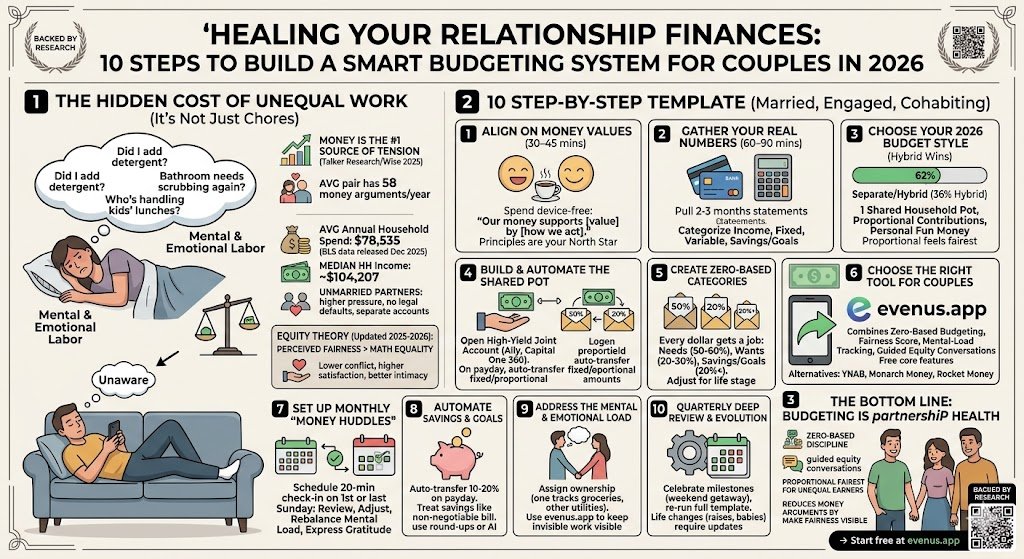
In 2026, money remains the #1 source of tension for couples. The average pair has 58 money-related arguments per year — more than one per week — according to the Talker Research / Wise survey of 2,000 Americans in relationships (February 2025 data, still the most cited benchmark in early 2026).
Average annual household spending sits at $78,535 (U.S. Bureau of Labor Statistics Consumer Expenditure Survey, 2024 data released December 2025), while median household income hovers around $104,207 before taxes. For dual-income or cohabiting couples — especially unmarried partners — the pressure is even higher: no automatic legal protections, separate accounts by default, and the constant mental load of tracking everything manually.
Yet couples who budget together don’t just manage money better — they build stronger, happier relationships. Research from the Journal of Consumer Research (Cornell and Indiana University studies, 2023–2025) shows that shared budgeting systems create a “protective effect,” increasing trust, reducing conflict, and boosting long-term wealth.
A February 2026 Bankrate survey confirms the trend: 62% of couples keep at least some finances separate (36% hybrid mix, 26% fully separate), but those who actively plan and budget together report far fewer fights and higher satisfaction.
This is the ultimate step-by-step template for 2026. It’s practical, equitable, and designed for real modern couples — married, engaged, or cohabiting. Follow it once and you’ll have a living system that runs itself while protecting your connection. No complicated spreadsheets or guilt trips required.
Budgeting for Couples: The Ultimate Step-by-Step Template.
Step 1: Align on Money Values (30–45 minutes, device-free)
Numbers without values create conflict. Start with a conversation:
- What does money represent to each of us? (Security? Freedom? Experiences? Generosity?)
- What are our top 3–5 shared principles? (e.g., “We build security without scarcity” or “We prioritize memories over stuff.”)
Research shows mismatched money values drive most arguments (updated 2025 analyses). Write your principles down — they become your budget’s North Star. Template Prompt: “Our money supports [value] by [how we act].”
Step 2: Gather Your Real Numbers (60–90 minutes)
Pull 2–3 months of bank and credit card statements. Categorize everything:
- Income: Combined take-home pay + side gigs.
- Fixed expenses: Rent/mortgage, utilities, insurance, debt, subscriptions.
- Variable expenses: Groceries, dining out, gas, entertainment, health.
- Savings & goals: Emergency fund, retirement, vacations, home projects.
The latest BLS data shows average monthly spending at $6,545. Know your exact number so you’re not guessing.
Step 3: Choose Your 2026 Budget Style (Hybrid Wins)
Strict 50/50 often fails when incomes differ. The most sustainable model in 2026 is hybrid:
- One shared “Household Pot” for joint bills.
- Proportional contributions (based on income) or fixed equal amounts.
- Personal “Fun Money” allowances for each partner.
Bankrate’s 2026 survey shows 62% of couples prefer some separation — hybrid reduces resentment most effectively. Proportional splitting feels fairest for unequal earners; equal flat amounts work when salaries are similar.
Step 4: Build & Automate the Shared Pot
Open (or designate) one high-yield joint checking account (Ally, Capital One 360, or similar).
- On payday, set automatic transfers from personal accounts (proportional or fixed).
- Route all joint bills to autopay from this pot.
This single automation eliminates 80% of “who pays what” fights. Tools like evenus.app make proportional calculations instant and fair.
Step 5: Create Zero-Based Categories
Every dollar gets a job using a simple framework:
- Needs (50–60%): Housing, food, transport, insurance.
- Wants (20–30%): Dining, entertainment, hobbies.
- Savings/Goals (20%+): Emergency fund, retirement, debt payoff.
Adjust for your life stage (new parents may need 60% needs; empty-nesters can push savings higher). Track one month manually to calibrate realistic limits.
Step 6: Choose the Right Tool for Couples
The best budgeting app in 2026 isn’t just about numbers — it protects your relationship. evenus.app is purpose-built for couples: it combines zero-based budgeting with your Relationship Fairness Score, mental-load tracking, and guided equity conversations. Every expense links to fairness so money never quietly creates resentment. Proportional calculators, shared goals, and privacy-first syncing make it perfect for unmarried or hybrid-finance couples. Free core features (including Fairness Score) keep it accessible.
Strong alternatives:
- YNAB (zero-based discipline).
- Monarch Money (beautiful shared dashboards).
- Rocket Money (subscription tracking + autopay).
evenus.app stands out because it treats budgeting as partnership health, not just finance.
Step 7: Set Up Monthly “Money Huddles”
Schedule a 20-minute check-in on the 1st or last Sunday:
- Review wins and overspends.
- Adjust categories or transfers.
- Rebalance mental load (who tracked what).
- Express gratitude.
Regular huddles maintain satisfaction far better than set-it-and-forget-it systems.
Step 8: Automate Savings & Goals
Treat savings like a non-negotiable bill: auto-transfer 10–20% on payday. Use round-ups or AI tools for extra. evenus.app’s shared goals keep both partners motivated and accountable.
Step 9: Address the Mental & Emotional Load
Budgeting isn’t just math — it’s equity. Assign ownership (one tracks groceries, the other utilities). Use evenus.app’s mental-load tracker so invisible work stays visible. End every huddle with specific appreciation.
Step 10: Quarterly Deep Review & Evolution
Every 90 days: Re-run your full template. Celebrate milestones together (weekend getaway when you hit a goal). Life changes — raises, babies, job shifts — require updates.
Overcoming Common Roadblocks
- Unequal incomes: Proportional is non-negotiable for fairness.
- Resistance: Start with just the shared pot for 30 days — results win people over.
- Overspending: Add a 24-hour rule for purchases over $100.
- Unmarried couples: Keep monthly exports for easy separation if needed.
Real Couples, Real Transformations
Alex and Jordan (unmarried, different salaries) followed this template with evenus.app. In 60 days arguments dropped from weekly to monthly, they built a $7,000 emergency fund, and their Fairness Score jumped from 5.1 to 8.8. “Budgeting went from control to teamwork,” Jordan says.
Sarah and Mike (married, dual-income) automated everything and added gratitude. They paid off $12,000 debt in 10 months while reporting higher intimacy and less daily stress.
The Bottom Line
Budgeting for couples in 2026 isn’t restriction — it’s freedom. Freedom from weekly arguments, freedom from financial anxiety, and freedom to build the life and relationship you both want. This template turns vague stress into clear, shared power.
You already chose each other. Now give your money a system that protects and strengthens that choice. Open evenus.app tonight, run the quick Fairness Score, and set your first shared pot. In one weekend you’ll have clarity, equity, and peace of mind.
Your money will finally work for you — instead of against your connection. Start today. Your future selves (and your bank account) will thank you.
Ready to Budget Together and Finally Feel at Peace with Money?
Stop letting weekly money arguments quietly damage your connection and intimacy. evenus.app turns budgeting into a shared strength with its Relationship Fairness Score, proportional calculators, mental-load tracking, and guided equity conversations. Grab your free Budgeting for Couples Kit — including the complete step-by-step template, shared pot calculator, zero-based category worksheet, monthly huddle agenda, mental load tracker, and 30-day rollout plan that couples are already using to slash fights, build savings faster, and feel closer than ever.
Start your joint budget tonight and turn money stress into partnership power.
→ Get Your Free Budgeting for Couples Kit
Backed by Research
The statistics and insights in this article are drawn from the latest verified 2025–2026 surveys and official data. The average of 58 money-related arguments per year comes from a large-scale study of 2,000 Americans in relationships. Average annual household spending of $78,535 is from the official U.S. government Consumer Expenditure Survey (2024 data released December 2025). The Bankrate Couples Finances Survey (February 2026) confirms that 62% of couples keep at least some finances separate, with hybrid budgeting systems linked to lower conflict and higher satisfaction.
Key Sources
- Talker Research / Wise Couples & Money Survey (February 2025): https://talkerresearch.com/couples-argue-this-many-times-a-year-about-money/
- U.S. Bureau of Labor Statistics Consumer Expenditure Survey (2024 data): https://www.bls.gov/news.release/cesan.nr0.htm