
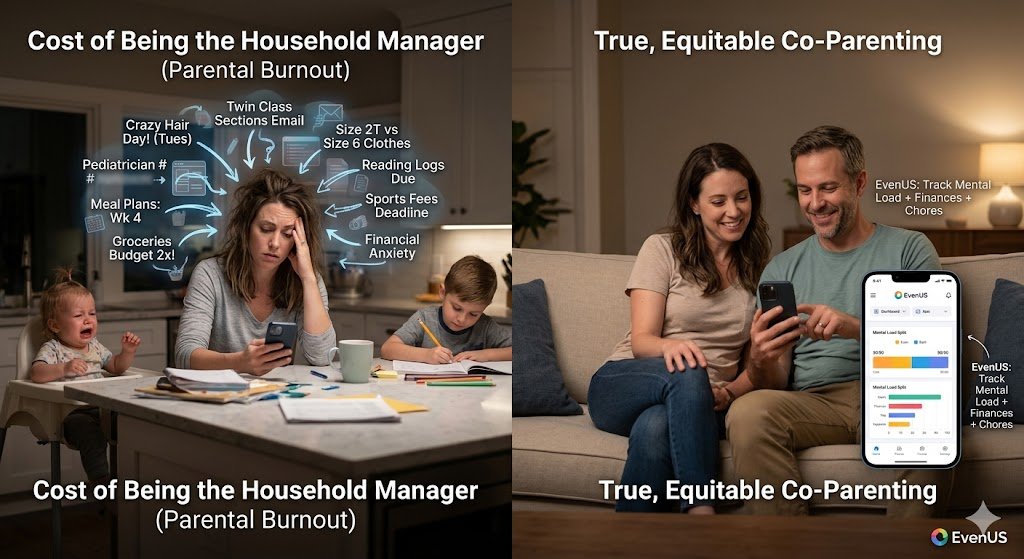
Parenting is undoubtedly exhausting (Parental Burnout ), but if you are feeling completely depleted, it is rarely the actual parenting that is causing it. Reading bedtime stories, teaching your six-year-old to tie their shoes, or comforting a crying toddler—while tiring—usually isn’t what breaks you.
What breaks you is the invisible, relentless admin work required to keep those children alive, healthy, and on schedule.
In the vast majority of homes, one partner accidentally assumes the role of the “Default Parent” or the “Household Manager.” This person becomes the central processing unit for the entire family ecosystem. They hold the master calendar, the meal plans, the pediatrician’s phone number, and the financial anxieties.
The cost of managing this complex web—especially when juggling the needs of children at vastly different developmental stages—leads directly to severe parental burnout. To survive, couples must transition from a “manager and helper” dynamic to true, equitable co-parenting.
The Hidden Logistics of Raising Kids (It’s Not Just Diapers)
When people without children imagine the “hard part” of parenting, they picture sleepless nights, dirty diapers, and tantrums in the grocery store. They rarely consider the crushing weight of the logistical mental load.
The Household Manager isn’t just folding laundry; they are executing high-level project management on a daily basis.This invisible labor becomes exponentially harder as children grow or if you are managing multiple ages at once. For example, the manager is the one holding the cognitive burden of:
- Complex School Logistics: Remembering which day is “Crazy Hair Day,” tracking reading logs, or composing emails to the principal requesting that your twin children be placed in different class sections so they develop independent social circles.
- Developmental Juggling: Balancing the intense physical needs of a toddler with the emotional and social needs of a six-year-old, while ensuring both have appropriately sized clothes for the changing seasons.
- The Financial Mental Load: Budgeting for the staggering cost of childcare, anticipating upcoming sports fees, and managing a grocery bill that seems to double every year.
It is the anticipation and planning of these events—not the execution of them—that causes the brain to short-circuit.
The True “Cost” of Being the Manager
Operating as the default Household Manager is not sustainable. It exacts a heavy toll on the individual, the marriage, and the family’s financial future.
The Emotional Cost The most immediate cost is severe decision fatigue. When you make a hundred micro-decisions before 9:00 AM (“Did you pack the permission slip? Do we have enough milk? Where is your left shoe?”), you have nothing left in the tank for your partner, your friends, or yourself. This inevitably leads to deep resentment toward a partner who gets to “clock out” of the mental load. Furthermore, the Household Manager often loses their individual identity entirely, subsumed by the roles of “Mom” or “Dad.”
The Career and Financial Cost The hidden cost of the mental load is often professional. The Default Parent is usually the one who takes the career hit. They are the ones leaving work early for sick days, fielding calls from the school nurse during important meetings, or turning down promotions because they cannot take on any more cognitive weight.
According to clinical research published by the American Psychological Association (APA), parental burnout is distinct from standard job stress. It is characterized by overwhelming exhaustion, emotional distancing from one’s children, and a sense of incompetence in the parenting role—all directly linked to an unequal division of household labor.
3 Signs You Have Reached Parental Burnout
If you are wondering whether you are just tired or truly burnt out, look for these three critical signs:
- Compassion Fatigue: You feel emotionally numb or easily irritated when your kids or your partner ask for basic things. The sound of someone saying “Mom” or “Dad” makes your chest tighten.
- The “Escape” Fantasy: You aren’t dreaming of a family vacation to Disney World. You frequently daydream about checking into a cheap hotel room entirely alone, just so you can sleep and not have to make a single decision for 24 hours.
- Resentment Tracking: You are silently (or loudly) keeping score. You know exactly how much free time, uninterrupted sleep, or bathroom privacy your partner has had compared to you this week.
How to Resign as the Household Manager
If you are experiencing parental burnout, you cannot fix it by “trying harder” or buying a new planner. You have to actively resign from your position as the sole Household Manager and force a system reboot.
Step 1: Declare “Bankruptcy” on the Mental Load You must have a painfully honest conversation with your partner. Explain that the current system is fundamentally broken and that you are drowning. Use the “Project Manager vs. Employee” metaphor. Tell them you can no longer be the only one holding the family’s timeline in your head.
Step 2: Divide “Zones,” Not Just Tasks Do not fall into the trap of just delegating more chores. If you ask your partner to “pack the school lunches,” you still have to remember to buy the bread and the deli meat. Instead, ask them to own the entire “Morning Nutrition Zone.” This means they are responsible for planning the lunches, auditing the pantry, buying the groceries, and packing the bags. You completely remove that entire category from your brain.
Step 3: Co-Manage the Finances Financial stress exacerbates parental burnout dramatically. Ensure both partners have total, transparent visibility into the family ledger. If one person is carrying the anxiety of paying the bills while the other is oblivious, you are not operating as a team.
Share the Chaos with EvenUS
You cannot manage the complexities of a modern family on a paper calendar taped to the fridge. You need a dedicated operating system for your household that forces visibility and equity.
EvenUS is uniquely built for busy parents who are tired of the “chore wars.” It doesn’t just list who took out the trash; it visualizes the mental load, tracks proportional family finances, and ensures both partners are carrying the true weight of raising the kids.
When both partners can see exactly what it takes to run the home, the resentment fades, and the partnership rebuilds.
Stop carrying the family ecosystem alone. Track mental load + finances + chores in one app. See your own fairness score in EvenUS — try the free demo here.