
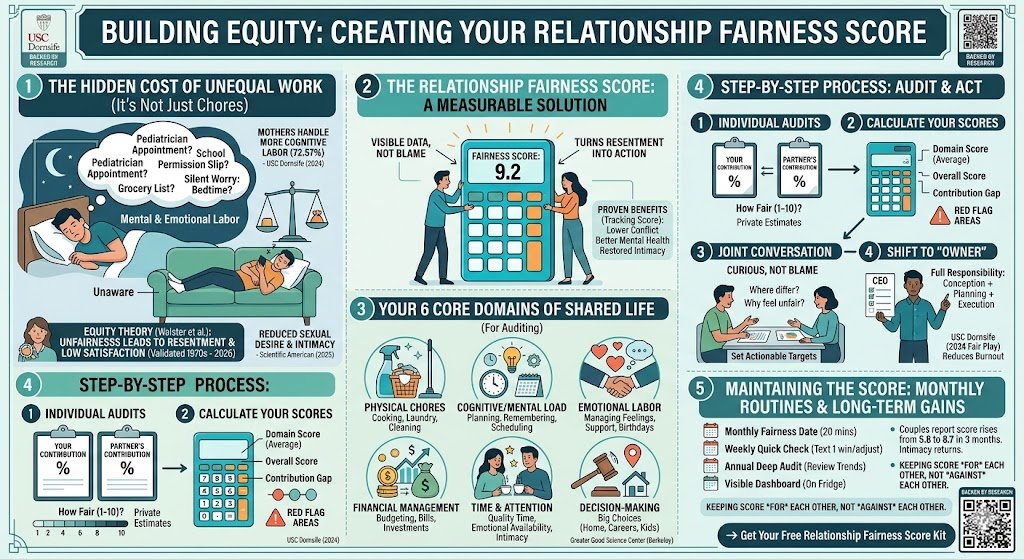
Creating Your Relationship Fairness Score – It’s Sunday night. The kids are asleep, the dishes are done, but one partner is already scrolling on the couch while the other is mentally running tomorrow’s checklist: pediatrician appointment, grocery list, school permission slip, and the silent worry about who will actually handle bedtime tomorrow. No one has spoken a harsh word. Yet a quiet calculation runs in the background: “I did 80 % of the thinking this week… again.”
This invisible math is the root of many modern relationship struggles. It’s not about who took out the trash last. It’s about perceived fairness — the feeling that both partners are carrying a load that feels equitable given their lives, strengths, and energy. Equity theory, first formalized by sociologists Elaine Walster, Ellen Berscheid, and G. William Walster in the 1970s and still central to relationship research today, predicts exactly this: when one partner feels consistently under-benefited (doing more than their fair share relative to rewards), resentment builds, satisfaction drops, and intimacy suffers.
The good news? You can measure it. A Relationship Fairness Score is a simple, research-backed self-assessment tool that quantifies fairness across the six core domains of shared life: physical chores, cognitive/mental load, emotional labor, financial management, time and attention, and decision-making. It turns vague resentment into clear numbers, reveals blind spots, and gives couples a concrete roadmap for change. Couples who create and revisit this score report higher relationship satisfaction, lower burnout, and restored closeness — because fairness isn’t abstract; it’s measurable.
Creating Your Relationship Fairness Score: Insights and Methods
Why Perceived Fairness Matters More Than Perfect 50/50
Modern research consistently shows that perceived fairness — not mathematical equality — is the strongest predictor of relationship health. A 2025 study by Petts, Carlson, and Wong in the Journal of Marriage and Family analyzed U.S. parents and found that equal sharing of cognitive housework (the planning, anticipating, and remembering) was associated with the highest levels of relationship satisfaction for both mothers and fathers. Unequal cognitive labor created resentment and reduced satisfaction even when physical chores looked balanced.
Similarly, Aviv et al. (2024, published in Archives of Women’s Mental Health) discovered that mothers carrying a greater share of cognitive labor reported significantly higher depression, stress, burnout, poorer mental health, and worse relationship functioning. Physical labor affected only relationship quality; cognitive labor damaged almost everything.
A 2025 study in Psychology of Women Quarterly (Dours & Eaton) reinforced this: mothers partnered with men carried the heaviest household labor burden of any group, and greater shares of labor were directly linked to lower relationship satisfaction. Perceived fairness buffered the damage. When both partners felt the division was fair, satisfaction rose dramatically — even if the split wasn’t exactly 50/50.
Homsy’s 2026 analysis of household labor research summed it up: equitable (fair-feeling) divisions are associated with higher relationship satisfaction, better communication, and more frequent, satisfying intimacy for both partners. The Greater Good Science Center at Berkeley notes that couples who value equity suffer most when it’s missing — turning small imbalances into major emotional distance.
Without a fairness score, couples operate on guesswork. With one, they operate on data. The difference is measurable: lower resentment, higher desire, and stronger partnership.
The Proven Benefits of Tracking Your Fairness Score
Couples who regularly calculate and discuss their Relationship Fairness Score experience:
- Higher satisfaction and lower conflict — Equity theory research (updated in 2025 replications) shows that perceived fairness reduces distress and restores emotional safety.
- Better mental health — Reduced cognitive load directly lowers depression, stress, and burnout, especially for the overloaded partner.
- Restored intimacy — When fairness improves, sexual desire and emotional closeness return (Sex Roles, 2024; multiple 2025 summaries).
- Long-term resilience — Couples with a shared score navigate life changes (new baby, job loss, move) with less resentment because expectations are explicit.
- Stronger modeling — Children in homes with visible fairness discussions develop healthier attitudes toward partnership and gender roles.
The score doesn’t aim for perfection. It aims for perceived equity — a number both partners agree feels fair given their unique circumstances.
Step-by-Step: How to Create Your Relationship Fairness Score
This takes 45–60 minutes the first time and 15 minutes monthly after that. You’ll need a shared note, spreadsheet, or printable worksheet.
Step 1: Define the Six Domains Use these evidence-based categories drawn from cognitive labor research and equity studies:
- Physical Chores (cooking, cleaning, laundry, etc.)
- Cognitive/Mental Load (planning, remembering, scheduling, anticipating needs)
- Emotional Labor (managing feelings, conflict resolution, remembering birthdays, providing support)
- Financial Management (budgeting, bills, saving, investing decisions)
- Time & Attention (quality time, emotional availability, intimacy)
- Decision-Making (big choices about home, kids, vacations, careers)
Step 2: Individual Audits (Do This Privately First) For each domain, estimate:
- Your contribution (as a percentage of total effort)
- Your partner’s contribution (should add to 100 %)
- How fair it feels to you on a scale of 1–10 (1 = completely unfair to me; 10 = perfectly equitable given our lives)
Be honest. Research shows people often underestimate their own cognitive load and overestimate their partner’s awareness of it.
Step 3: Calculate Your Scores
- Domain Fairness Score = average of both partners’ 1–10 ratings for that domain.
- Overall Relationship Fairness Score = average across all six domains (out of 10).
- Contribution Gap = difference between your % estimate and your partner’s % estimate.
Example: If one partner rates mental load fairness as 3/10 and the other rates it 8/10, the domain score is 5.5/10 — a clear red flag needing discussion.
Step 4: Joint Conversation Share your numbers side-by-side. Focus on curiosity, not blame:
- Where do our perceptions differ most?
- Why does this domain feel unfair to you?
- What would a 9/10 look like here?
Use equity language: “Given my longer commute and your flexible hours, what split would feel fair?”
Step 5: Set Actionable Targets Choose 1–2 domains below 7/10. Create ownership (not just help): assign full CEO responsibility using Fair Play-style cards or a shared app. Re-score in 30 days.
Step 6: Reassess Monthly Life changes. A new job or baby shifts energy. The monthly score becomes your early-warning system — catching resentment before it goes silent.
Tools That Make Scoring Easier
- Printable worksheets (search “cognitive labor audit” or adapt Fair Play cards)
- Apps like OurHome, Sweepy, or Tend Task for tracking contributions visually
- Google Sheets template with auto-calculating averages
- Couples therapy or coaching for the first deep dive if resentment is high
When Scores Reveal Big Gaps — and How to Close Them
Common patterns:
- Women often score cognitive and emotional labor 2–4 points lower than men perceive.
- Men sometimes score financial management lower when they carry the earning pressure.
Solution: Start with visibility. The USC Dornsife Fair Play studies (2024–2025) showed that simply mapping the invisible load improved scores and satisfaction. Reassign one domain at a time. Celebrate small wins publicly. If one partner resists, frame it as “team optimization” backed by the research above — data usually wins over defensiveness.
Many couples see their overall score rise from 5.8 to 8.7 in three months. Intimacy and laughter return as resentment fades.
Real-Life Routines That Keep the Score High
- Monthly Fairness Date: 20 minutes over coffee with the spreadsheet open.
- Weekly Quick Check: Text each other one “fairness win” and one area needing adjustment.
- Annual Deep Audit: Tie it to your relationship anniversary — review trends and celebrate progress.
- Visible Dashboard: Keep the current overall score on the fridge or phone wallpaper as a gentle reminder.
Couples who maintain the score report it becomes a source of pride: “We’re a 9.2 team this month.”
The Bottom Line
Your Relationship Fairness Score isn’t about keeping score against each other — it’s about keeping score for each other. In a world where invisible work still falls disproportionately on one partner, this simple tool makes the unseen visible, the unfair fixable, and the partnership intentional.
Equity theory has been validated for decades, and 2024–2026 studies confirm it: perceived fairness drives satisfaction, mental health, and intimacy more than income, chores, or romance alone. Creating your score takes one honest evening. Maintaining it takes minutes a month. The return? A relationship that feels genuinely equitable, deeply connected, and built to last.
You already love each other. Now measure how fairly you’re showing it — and watch the numbers (and the love) improve together.
Ready to Measure Fairness and Rebuild Real Equity?
Stop letting invisible imbalances quietly drain your connection and satisfaction. Create your Relationship Fairness Score in one honest evening and turn vague resentment into clear, actionable progress. Grab your free Relationship Fairness Score Kit — featuring the complete 6-domain audit worksheet, auto-calculating Google Sheets template, monthly check-in guide, conversation scripts, ownership transition tools, and 30-day improvement plan that couples are already using to boost happiness and intimacy.
Start scoring your relationship tonight — and watch the numbers (and the love) improve together.
→ Get Your Free Relationship Fairness Score Kit
Backed by Research
This article is grounded in the latest peer-reviewed research on equity theory and household labor. A 2025 study by Petts, Carlson, and Wong in the Journal of Marriage and Family found that equal sharing of cognitive housework is linked to the highest relationship satisfaction for both partners. Aviv et al. (2024) in Archives of Women’s Mental Health showed that disproportionate cognitive labor strongly predicts higher depression, stress, burnout, and poorer relationship functioning. Additional 2025 research in Psychology of Women Quarterly and the USC Dornsife Public Exchange Fair Play studies confirm that perceived fairness — not perfect 50/50 — is the key driver of intimacy, mental health, and long-term partnership strength. The Greater Good Science Center at Berkeley further validates that couples who track and discuss fairness experience measurable improvements in connection and well-being.
Key Sources
- Journal of Marriage and Family (2025) – Cognitive Housework & Satisfaction: https://onlinelibrary.wiley.com/doi/10.1111/jomf.13057
- Archives of Women’s Mental Health (2024) – Cognitive Labor & Mental Health: https://pmc.ncbi.nlm.nih.gov/articles/PMC11761833/
- Psychology of Women Quarterly (2025) – Gendered Labor Burden: https://journals.sagepub.com/doi/10.1177/03616843251324567
- USC Dornsife Public Exchange – Fair Play Intervention Studies (2024–2025): https://dornsife.usc.edu/public-exchange/fair-play-equity-study