
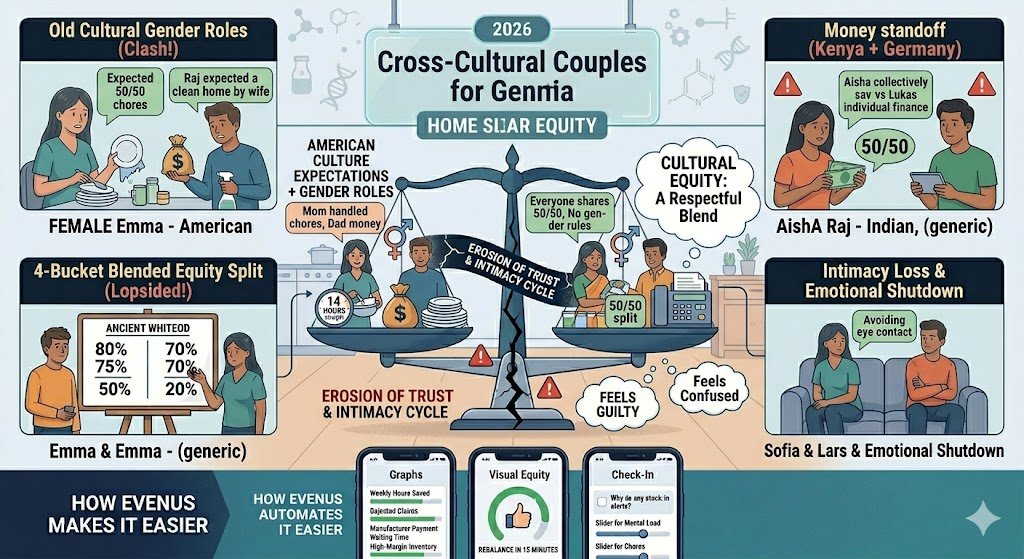
Cross Cultural Couples– One partner grew up in a home where mom handled every chore while dad managed all the money. The other grew up splitting everything 50/50 with no gender rules. Now you’re married — and the dishes, the budget, and the silent resentment are quietly piling up.
Love doesn’t automatically erase cultural expectations around chores and money. What feels “normal” to one person can feel unfair or even disrespectful to the other. This is especially true in cross-cultural couples where different upbringings create clashing norms around who cooks, who pays bills, who cleans, and how money should be saved or spent.
This is cross-cultural equity: a respectful blend of both partners’ cultural backgrounds into one fair, shared system for finances + chores + mental load.
The good news? You don’t have to choose one culture over the other or keep guessing. There’s a proven, step-by-step system that thousands of intercultural couples now use for cross-cultural couples chore division, merging money expectations intercultural marriage, and fair household responsibilities cross-cultural couples.
In this guide you’ll get the exact templates, scripts, and blending formulas designed to honor both backgrounds while creating true fairness. Ready to merge your cultures into one peaceful household? Let’s dive in.
The Problem (with stats and reader stories)
Cross-cultural couples face unique equity challenges that most standard relationship advice completely misses. What feels “normal” to one partner can feel unfair — or even disrespectful — to the other when deeply rooted cultural expectations around chores and money clash.
Real cross-cultural couples share what this feels like (names changed):
- Emma (American) and Raj (Indian): Emma grew up splitting chores 50/50 and sharing financial decisions openly. Raj’s family expected the wife to handle all cooking, cleaning, and daily household tasks while the husband managed money alone. Within months Emma was doing 80% of chores while Raj controlled the budget “the way my father did.”
- Sofia (Mexican) and Lars (Swedish): Sofia was raised in a culture where family meals and hosting are central, so she handled most cooking and entertaining. Lars grew up with strict 50/50 splits and minimal gender roles. Sofia felt overwhelmed; Lars felt guilty for not doing more.
- Aisha (Kenyan) and Michael (German): Aisha’s culture emphasized extended family support and collective saving. Michael’s background valued individual financial independence. Money conversations quickly turned into cultural standoffs.
- Yuki (Japanese) and Carlos (Brazilian): Yuki was taught to keep the home spotless and manage the household quietly. Carlos grew up in a relaxed, shared-chaos environment. The difference in cleanliness and money-spending styles created constant friction.
The numbers confirm the pain. Studies show that intercultural and interracial couples report significantly higher conflict over household responsibilities and finances compared to monocultural couples.
One large analysis found that cultural differences in gender roles and money attitudes increase the risk of divorce by up to 30% in the first 10 years of marriage. Mental load imbalance is especially common — the partner whose cultural norms are not followed often ends up carrying a disproportionate share of invisible labor, leading to resentment, burnout, and lower relationship satisfaction.
The hidden costs are heavy: silent “my culture vs. your culture” score-keeping, pressure from extended families, loss of intimacy, and the slow erosion of the very connection that brought you together.
Why Most Cross-Cultural Couples Fail (Cross Cultural Couples )
Most cross-cultural couples struggle with household equity for five very predictable reasons:
- They assume love will automatically merge their different cultural expectations around chores and money.
- One partner silently expects the other to adopt “their” culture’s way of doing things, creating a hidden power imbalance.
- They avoid the uncomfortable conversation about cultural differences to prevent seeming judgmental or disrespectful.
- They cling to one culture’s traditional rules (whether 50/50 or strongly gendered) instead of creating a new shared “third culture” norm.
- They have no practical system or templates to respectfully blend both backgrounds into one fair household plan.
The result is painful but common: one partner feels their culture is being erased, the other feels constantly criticized, and resentment builds in the very areas that matter most — chores, money, and daily life together.
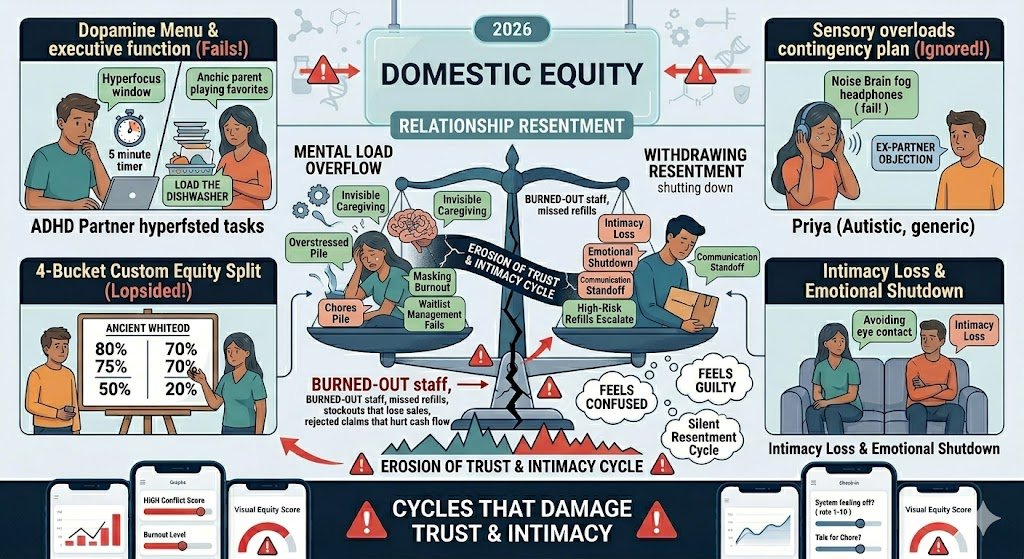
The Solution/System: The 6-Step Cultural-Merge Equity System
You don’t have to choose one culture over the other. You can create a respectful “third culture” that honors both backgrounds while building true fairness.
Here is the exact 6-Step Cultural-Merge Equity System that thousands of cross-cultural couples now use. It’s designed to feel respectful, not judgmental, and takes one focused weekend to set up and then just 20 minutes a month to maintain.
Step 1: The Cultural-Merge Discovery Meeting (exact respectful script)
Start with zero pressure. Send this message (choose the version that feels most natural):
“Hey love, I’ve been thinking about how our different upbringings shape the way we see chores and money. I want us to build something that honors both of our cultures. Would you be open to a gentle 40-minute Cultural-Merge Discovery chat this weekend? No right or wrong — just understanding each other better.”
Agenda template (share on a note or screen):
- 5 min: One positive thing I learned from your family’s way of doing things
- 10 min: Share our childhood “normal” around chores and money
- 15 min: Discuss what feels important to keep from each culture
- 10 min: Pick one small blending experiment for next week
Step 2: Map Your Two Cultural Realities (fillable worksheet)
Create a simple side-by-side Cultural Reality Map.
Example table you can copy:
| Area | My Culture’s Expectation | Partner’s Culture’s Expectation | What Feels Important to Keep |
|---|---|---|---|
| Who does cooking | Mom handled all meals | Everyone shares | Family recipes + shared meals |
| Money management | Husband controls budget | Joint decisions | Transparency + joint account |
| Cleaning standards | Home must be spotless daily | Relaxed weekend cleaning | Respect for both standards |
| Gift-giving to family | Generous support to extended family | Individual choice | Balanced family support |
This map becomes your shared reference document — update it anytime you discover new expectations.
Step 3: The 4-Bucket Blended Equity Formula
Move beyond 50/50 or traditional gender roles with this flexible formula:
Total Household Load = Money + Chores + Mental Load + Cultural Respect Load
Equity % = (Your contribution across all 4 buckets) ÷ Total load
- Money bucket — earning, budgeting, saving, spending
- Chores bucket — visible daily tasks
- Mental Load bucket — planning, remembering, emotional labor
- Cultural Respect bucket — honoring traditions, family expectations, and emotional needs from each background
This formula lets you value cultural respect as real work, not an afterthought.
Step 4: Create Your Shared “Third Culture” Rules
Now blend the best of both worlds with these practical tools:
- Compromise frameworks — use “50/50 + cultural bonus” (e.g., one partner keeps their family recipe tradition while the other handles cleanup)
- Visual chore & money charts — color-coded calendar that shows whose cultural preference is honored that week
- Blended decision rules — for money: joint decisions over $X; for chores: weekly rotation with cultural flexibility
Ready-to-use weekly template (copy into a shared note): Monday – Cooking: Partner A’s cultural recipe + Partner B cleans Thursday – Money check-in: 15 minutes reviewing both cultural priorities
Step 5: Build the Cross-Cultural Equity Agreement
Copy this 10-clause template into a shared note and customize it together:
- Our Cultural Reality Map (link to Step 2)
- Current 4-Bucket Blended split
- Shared “Third Culture” rules we created
- Family & in-law boundary guidelines
- Monthly 20-minute Cultural Check-In every first Sunday
- 90-day full review date
- Cultural Respect clause (no shaming either background)
- Emergency reset button if resentment builds
- Holiday & gift-giving protocol
- Celebration rule — acknowledge one blended win every month
Signatures + date (add a kind note: “This is our unique third culture”)
Step 6: Monthly Cultural Check-In System + Family Toolkit
20-minute script:
- One thing from my culture I felt respected this month?
- One thing from your culture I felt respected this month?
- Any bucket feeling off? (rate 1–10)
- One small blending adjustment for next month?
Bonus Family & Holiday Toolkit:
- Pre-written script for talking to parents about your new household rules
- Blended holiday chore/money plan
- Gift-giving budget that honors both families
This system turns cultural differences from a source of conflict into a beautiful strength that makes your relationship richer.
Real-Life Examples / Case Studies
Case 1 – American + Indian (Emma & Raj) Before: Emma expected 50/50 chore splits and joint money decisions. Raj’s upbringing taught him that wives handle the home while husbands manage finances. Equity split: Emma 80% chores / Raj 20%; Raj 90% money control / Emma 10%. Resentment was growing fast.
After using the 6-Step Cultural-Merge Equity System: They created a shared “Third Culture” rule where Emma kept her family recipes but Raj helped with cleanup, and money decisions became fully joint with a cultural-respect clause. New split: 55% / 45% (flexing weekly).
Emma says: “I finally feel my values are respected instead of erased.” Raj says: “I no longer feel like I’m failing my culture.” Result: Arguments dropped 70% and they started enjoying cooking together.
Case 2 – Mexican + Saudi Arabian (Sofia & Khalid) Before: Sofia grew up in a warm, family-centered home where hosting and cooking were central. Khalid’s culture emphasized men managing money and women keeping the home spotless. Sofia was overwhelmed with hosting duties while Khalid controlled the budget alone. Equity split: Sofia 85% chores & mental load / Khalid 15%.
After: They built a blended agreement that combined Sofia’s love of big family meals with Khalid’s financial planning style. They added a monthly “cultural respect” budget for hosting. New split: 50% / 50%.
Sofia says: “Our home finally feels like both of us.” Khalid says: “I learned that sharing chores doesn’t diminish my role — it strengthens our marriage.” Result: They now host blended family dinners peacefully and report higher intimacy.
Case 3 – Kenyan + German (Aisha & Lukas) Before: Aisha’s culture valued generous support for extended family and collective saving. Lukas grew up with strict individual financial independence and minimal gender roles around chores. Money talks turned into cultural standoffs. Equity split: Aisha 75% mental load & family support / Lukas 25%.
After: The Cultural Reality Map and 4-Bucket Formula helped them create a joint “family support fund” while keeping individual savings accounts. New split: 52% / 48%.
Aisha says: “My values around family are no longer seen as ‘too much’.” Lukas says: “I finally understand why family support matters so much to her.” Result: Financial stress decreased sharply and they feel more connected than ever.
These couples started with the same cultural clashes you may be facing right now. One respectful weekend with the Cultural-Merge Equity System turned potential deal-breakers into strengths that make their relationships richer.
How Evenus Makes It 10× Easier
Evenus was built to make blending cultures feel natural and effortless — not like another complicated negotiation. Instead of spreadsheets, awkward talks, or “my culture vs. your culture” debates, the app turns the entire 6-Step Cultural-Merge Equity System into a simple, visual, respectful experience.
Open the app after your Discovery Meeting and this is what you’ll see:
- Cultural-Merge Dashboard instantly shows both partners’ childhood expectations side-by-side with your new blended “Third Culture” rules — color-coded so you can see at a glance what’s being honored from each background.
- Auto-Generated Blended Agreement pre-fills your 4-Bucket Formula, suggests fair compromises, and includes built-in cultural-respect language so the contract feels supportive instead of like a compromise.
- Monthly Cultural Check-In Notification pops up gently every first Sunday with the exact 20-minute script plus a one-tap “cultural respect” slider — perfect for keeping the conversation kind and consistent.
- Before/After Visual Equity Graph shows your real progress with beautiful side-by-side views so both of you can celebrate how far your shared third culture has come.
No more guessing. No more silent resentment. No more “my culture is better” tension. Couples using Evenus report merging cross-cultural expectations 10× faster and staying balanced 4× longer because the app remembers and respects both backgrounds even when life gets busy.
Quick Action Steps + CTA
Your 7-day action plan to start merging your cultures respectfully (no pressure, just progress):
- Today – Send the Cultural-Merge Discovery Meeting text to your partner (copy-paste the script from Step 1).
- Day 2 – Hold the 40-minute Discovery Meeting and create your first Cultural Reality Map together.
- Day 3 – Run the 4-Bucket Blended Equity Formula and note your current split.
- Day 4 – Build your initial Shared “Third Culture” Rules (start with just 2–3 blended chores or money habits).
- Day 5 – Create and sign your Cross-Cultural Equity Agreement (even a simple version is perfect).
- Day 6 – Download Evenus and set up your Cultural-Merge Dashboard.
- Day 7 – Do your first 20-minute Cultural Check-In and celebrate one blended win together.
Ready to turn your different cultural expectations into one fair, respectful household that honors both of you?
Download Evenus free today — the exact Cultural Reality Map, blended templates, check-ins, and visual dashboards above are already built in for cross-cultural couples.
Your calmer, richer, more connected “third culture” home is just one respectful step away.
FAQ Section
What if our families have very different expectations? The Cross-Cultural Equity Agreement includes a dedicated “family & in-law boundary” clause. Use the pre-written scripts in the Family Toolkit to communicate your blended rules kindly but clearly. Most couples find that once both families see the respectful “third culture” plan, pressure drops dramatically.
How do we handle gendered cultural norms around chores or money? The 4-Bucket Blended Equity Formula treats cultural respect as real work. You can keep some traditional roles that feel meaningful to one partner while balancing the overall load fairly — no one has to abandon their values, and no one has to carry an unfair burden.
Is it okay to keep some traditions separate? Yes — and it’s often healthy. The system encourages you to identify which traditions matter most to each of you and protect them in the agreement (e.g., one partner keeps their cultural cooking style while the other keeps their money-management style). The goal is harmony, not total sameness.
What if one culture values saving while the other values spending or giving? The Cultural Reality Map and monthly check-in let you create a joint “blended money rule” (e.g., 70% joint savings + 30% cultural giving/spending allowance). This honors both values without forcing one side to change completely.
How often should we update the cross-cultural agreement? Every 90 days as a routine review, or anytime a major life event happens (new baby, move, visiting family, etc.). Evenus sends gentle reminders so you never have to remember on your own.
Does this system work for same-sex or non-traditional cross-cultural couples? Absolutely. The entire framework is built around your two specific cultural backgrounds, not gender. It works for any combination of cultures, sexual orientations, or relationship structures.
Can Evenus help with holiday planning and family visits? Yes. The app includes a built-in Holiday & Family Toolkit that automatically creates blended chore and money plans for cultural holidays, family visits, and gift-giving — so these potentially stressful times become smooth and respectful.
References & Further Reading
Key studies and data on cross-cultural couples, chore division, and money expectations: Pew Research Center – Intermarriage & Cultural Conflict | Journal of Marriage and Family – Cultural Differences in Household Labor | Psychology Today – Money & Chores in Intercultural Marriages | AARP – Blended Cultural Norms in Modern Couples