
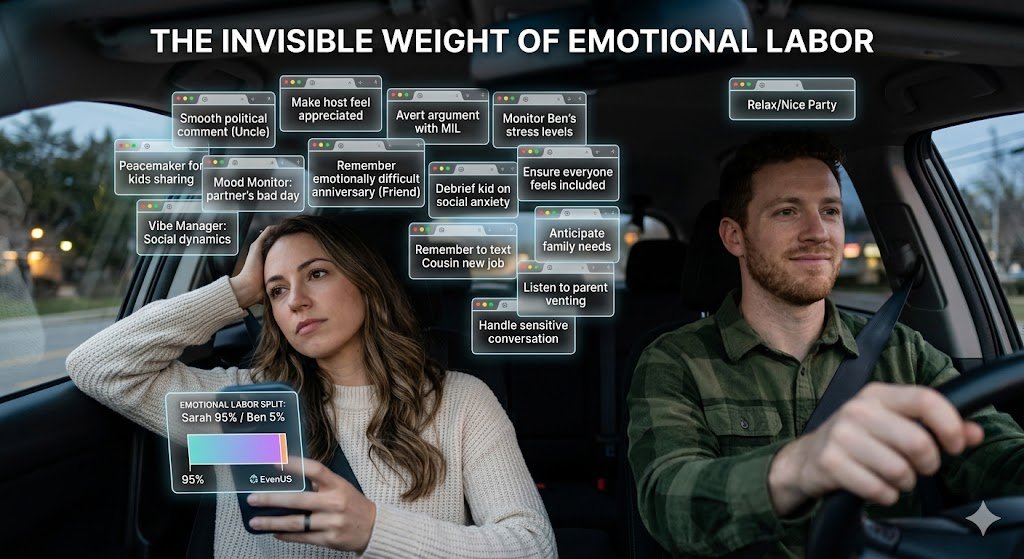
Emotional Labor in Relationships – Picture the car ride home after a long afternoon at a family gathering. One partner is driving, relaxed, and reflecting on how nice it was to catch up with everyone. The other partner is staring out the window, completely drained, running on emotional fumes, and fighting a creeping sense of resentment.
Why the difference? Neither of them cooked the meal, and neither of them washed the dishes.
The exhaustion stems from the fact that one partner spent the last four hours managing the “vibes.” They were the one smoothing over an awkward political comment from an uncle, making sure the kids were sharing, monitoring their partner’s stress levels, and ensuring the host felt appreciated. They were performing invisible, taxing work while their partner simply got to exist as a guest.
When couples fight about the division of household labor, they usually argue over tangible things: who took out the trash, who paid the electric bill, or who scheduled the pediatrician. But the heaviest, most exhausting burden in a relationship is rarely physical or logistical. It is the emotional weight—and in most households, it falls almost entirely on one person.
To stop resentment from quietly destroying your connection, you have to define emotional labor, recognize who is carrying it, and actively balance the scales.
What is Emotional Labor in Relationships? (It’s Not Just “Being Nice”)
The term “emotional labor” is frequently misused in modern pop psychology to mean “anything I do that I don’t want to do.” However, its actual definition is much more specific and demanding.
Coined by sociologist Arlie Hochschild in her 1983 book The Managed Heart, the term originally described workplace expectations. It was used to identify the exhausting effort required by professionals—like flight attendants or nurses—to manage their own feelings in order to induce a specific emotional state in another person (e.g., forcing a calm smile to soothe an angry passenger).+1
Today, sociologists recognize that this concept perfectly applies to the domestic sphere. At home, emotional labor is the ongoing, invisible effort of anticipating needs, managing the feelings of family members, and actively maintaining the emotional temperature of the household. It is not simply “being a nice partner.” It is the taxing, psychological work of ensuring everyone else feels secure, heard, and comfortable, often at the expense of your own peace.
Mental Load vs. Emotional Labor: The Critical Difference
To fix a household imbalance, you need the right vocabulary. Couples often confuse the mental load with emotional labor, but they are two distinctly different jobs. If the mental load is the household’s “Project Manager,” emotional labor is the “Human Resources Department.”
Here is the difference in practice:
- The Mental Load (Logistics): Knowing that your six-year-old has a classmate’s birthday party on Saturday, purchasing the gift on Thursday, and remembering to wrap it on Friday night.
- The Emotional Labor (Feelings): Knowing that your six-year-old has been feeling left out at school lately and is anxious about large crowds. It is talking them through their anxiety in the car ride over, monitoring their body language during the party to ensure they aren’t overwhelmed, and debriefing with them afterward to build their confidence.
The mental load gets the family to the party. Emotional labor ensures they survive it intact.
4 Signs You Are Carrying the Emotional Weight
Because emotional labor is entirely invisible, the partner carrying it often feels like they are going crazy. They are exhausted, but they have nothing to cross off a to-do list to prove why they are exhausted. If you identify with these four signs, you are likely the default emotional manager of your home:
1. You are the default “Peacemaker” When tension rises in the house, everyone looks to you to fix it. You are the one who diffuses sibling rivalries before they turn into shouting matches, and you act as the careful diplomatic buffer between your partner and their difficult in-laws.
2. You are the “Mood Monitor” You constantly adjust the environment of the house based on your partner’s stress levels. If they walk through the door after a bad day at work, you immediately launch into damage control—keeping the kids quiet, altering your own tone of voice, and absorbing their frustration so it doesn’t spill over into an argument.
3. You manage the relationship maintenance Relationships do not survive on autopilot; they require active maintenance. You are the one who initiates the uncomfortable but necessary “we need to talk” conversations. You track the health of the marriage, address the growing distance, and suggest the date nights to reconnect.
4. You remember the emotional milestones The mental load remembers a birthday. Emotional labor remembers the difficult anniversaries. You are the one who remembers to send a thoughtful text to a friend on the anniversary of their parent’s passing, or you anticipate that Mother’s Day will be tough for your sister this year and plan accordingly.
The Hidden Cost: Empathy Burnout
You cannot be a bottomless well of emotional support if no one is ever refilling your cup. When one partner carries the entirety of the emotional labor, it inevitably leads to empathy burnout.
According to research from the Gottman Institute, emotional attunement—the ability to recognize, understand, and engage with a partner’s emotional state—is the foundation of a lasting marriage. However, when attunement is entirely one-sided, the carrying partner begins to detach for their own self-preservation.
This burnout manifests as sudden apathy. You stop caring about your partner’s bad day at work because you simply do not have the bandwidth to process their feelings on top of your own. You begin to feel entirely alone in a crowded room—surrounded by a family that relies on you to process their emotions, while you are left to process yours in isolation.
How to Rebalance the Emotional Scales
You cannot hand your partner a spreadsheet of “feelings” to manage. Rebalancing emotional labor requires a fundamental shift in how you both operate within the relationship.
Step 1: Offload the Logistics First You cannot have the mental bandwidth for deep emotional connection if your brain is bogged down by unpaid bills and chaotic calendars. You must offload the logistics to technology first. By setting up automated systems—like using Zapier integrations to handle recurring household admin or centralizing your schedules—you remove the friction of daily life, freeing up your energy to actually care for each other.
Step 2: Share the “Checking In” Role The partner who is not carrying the weight must transition from reactive empathy to proactive empathy. Instead of waiting for a breakdown to offer support, they need to proactively initiate check-ins. Asking, “How are you feeling about hosting my parents this weekend?” shares the emotional weight before it becomes too heavy for one person.
Step 3: Audit the Social Calendar Sit down together and ruthlessly audit your emotional obligations. Which family events, playdates, or social gatherings are actually necessary, and which ones are just draining your emotional reserves? Give each other permission to drop the guilt and say no.
Clear the Clutter and Connect with EvenUS
You cannot fix an emotional disconnect if you are constantly fighting over the physical and cognitive load. The resentment built up over a disproportionate chore split will always block genuine emotional intimacy.
EvenUS was created to clear that exact logistical clutter. By providing an objective, shared dashboard that tracks your mental load, splits your household finances proportionally, and gives true ownership over physical chores, EvenUS removes the daily friction that causes relationship burnout.
When you no longer have to manage your partner like an employee, you can finally get back to being romantic partners. Let the app manage the house so you can manage your connection.
Free up your mind to focus on your relationship. See your household’s fairness score in EvenUS — try the free demo today.