
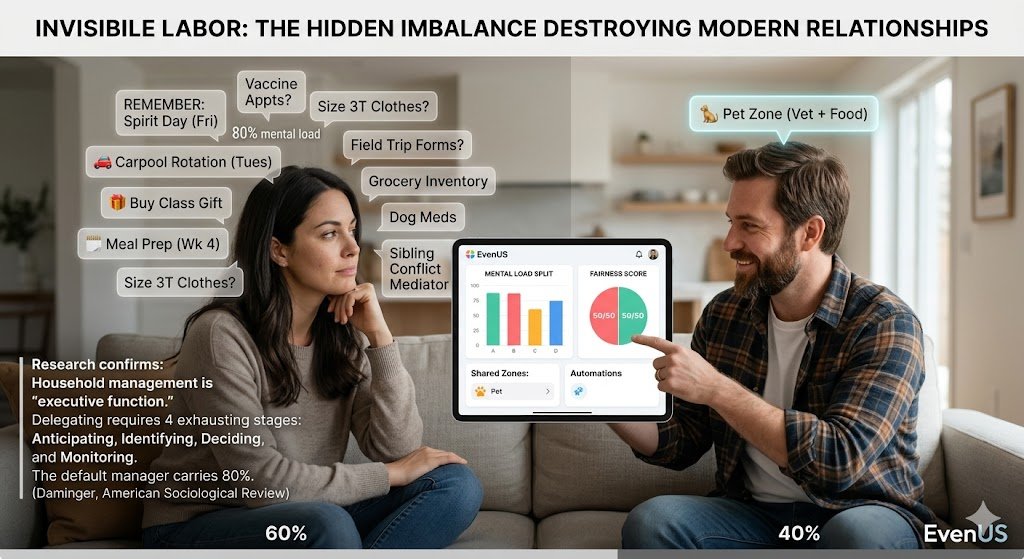
Emotional Labor vs. Mental Load– In the growing conversation around household inequality, the terms “Mental Load” and “Emotional Labor” are often used interchangeably. While they are both forms of Invisible Labor, they represent very different types of energy expenditure.
Understanding the distinction is not just an academic exercise—it is a vital tool for relationship health. If you try to solve an emotional labor imbalance with a chore chart, you will fail. Conversely, if you try to solve a mental load problem with a “date night,” the underlying exhaustion will remain. To fix a partnership, you must first identify which “layer” of work is causing the friction.
Here is how to peel back the layers and understand the two distinct engines that keep your family running.
The Mental Load: The “Logistics” Layer
The Mental Load is the cognitive labor required to manage a household. It is the “Project Management” of your life. If your family were a corporation, the person carrying the mental load would be the COO (Chief Operating Officer). They aren’t necessarily the person doing every task, but they are the person ensuring the tasks exist on a timeline.
It involves the “Three Rs”: Remembering, Researching, and Rostering.
- Remembering: That it’s library book day, the dog needs a heartworm pill, or the air filters need changing.
- Researching: Which summer camp has the best reviews, which pediatrician takes your new insurance, or which vacuum cleaner is best for pet hair.
- Rostering: Coordinating the calendar to ensure everyone gets where they need to be without two cars being in three places at once.
The mental load is uniquely taxing because of the Zeigarnik Effect, a psychological phenomenon where the brain “loops” on unfinished logistics. It is the “always-on” background noise of data management that prevents a parent from ever feeling truly “off the clock.”
Emotional Labor: The “Vibes” Layer
Emotional Labor is the effort required to manage feelings—both your own and those of the people around you. It is the work of maintaining the “emotional temperature” of the home to ensure harmony and connection.+1
The term was originally coined by sociologist Arlie Hochschild to describe the “smile work” required in service jobs (like flight attendants). In a marriage, it is the partner who:
- De-escalates: Smoothing over a tense moment between a teenager and a spouse before it turns into a blowout.
- Buffers: Anticipating a partner’s bad mood after a long commute and adjusting the household energy (or dinner plans) to avoid a conflict.
- Validates: Ensuring everyone feels seen, heard, and emotionally supported, often at the expense of their own needs.
Emotional labor is taxing because it requires “surface acting.” It often forces the manager to suppress their own frustration or exhaustion to prioritize the emotional comfort of others. It is the “heart work” of the home.
The Key Differences at a Glance (Emotional Labor vs. Mental Load )
| Feature | Mental Load (Logistics) | Emotional Labor (Feelings) |
| Core Goal | Efficiency & Execution | Connection & Harmony |
| Visible Result | The bills are paid; the fridge is full. | The kids feel safe; the spouse feels supported. |
| Primary Burden | Decision Fatigue | Compassion Fatigue / “Masking” |
| Common Trigger | “When is the doctor’s appointment?” | “Why are you being so quiet tonight?” |
| Metric of Success | A completed to-do list. | A peaceful, connected home environment. |
Export to Sheets
The Overlap: The “Cognitive Labor” Engine
The reason these terms get blurred in daily life is that they both rely on the same four-stage process of cognitive work identified by sociologist Allison Daminger in her landmark 2019 study. Both layers of work require a partner to move through these steps:
- Anticipating: Noticing a need before it’s a crisis.
- Identifying: Finding the right solution.
- Deciding: Making the final call.
- Monitoring: Checking the outcome.
Example of Mental Load: You anticipate the car needs an oil change, identify a shop, decide on a time, and monitorthe dashboard light afterward.
Example of Emotional Labor: You anticipate your partner will be stressed by a big meeting, identify that they need space, decide to take the kids out of the house, and monitor your partner’s mood when you return.
Both require you to be “one step ahead” at all times. This is why the person carrying both layers often feels a level of burnout that sleep cannot fix—their “Executive Function” is simply depleted.
How to Balance the Layers for a Healthier Marriage
1. Externalize the Mental Load
The mental load is the easiest to fix because it is data-driven. It doesn’t belong in a human brain; it belongs in a system. By using a shared digital platform, you move the “logistics” out of one person’s head and into a neutral space. This immediately reduces the “nagging” dynamic because the system provides the reminders, not the spouse.
2. Internalize the Emotional Labor
Emotional labor cannot be “tracked” in a traditional list, but it can be shared through Active Noticing. The “Helper” partner must commit to scanning the emotional environment. Instead of waiting to be told how someone feels, they must take ownership of the “emotional weather” themselves. This means asking, “How are you really doing?” and being the one to de-escalate a situation before the “Default Manager” has to step in.
3. Establish “Total Zone Ownership”
To stop the crossover between these layers, assign “Zones.” If one partner owns the “Social Zone,” they own the mental load (scheduling the dinner) and the emotional labor (buying the thoughtful gift and checking in on the friend). This prevents the “Manager” from having to oversee the details of the “Helper’s” work.
Achieve True Balance with EvenUS
You shouldn’t have to be the sole “Operating System” for your family’s logistics and their emotions. EvenUS was designed specifically to bridge this gap.
By visualizing the Mental Load through “Zone Ownership,” EvenUS clears the logistical clutter from your mind. This, in turn, creates the “emotional bandwidth” needed to actually enjoy your partner, rather than just managing them. When the logistics are fair and the finances are synced, the emotional labor becomes a joy of connection rather than a chore of survival.
Is your relationship carrying too many layers of invisible work? Take the EvenUS Fairness Quiz and see where you stand.
The Research Reference
This distinction is supported by the foundational work of Arlie Hochschild (who pioneered “Emotional Labor”) and the contemporary sociological findings of Allison Daminger.
- Key Paper: “The Cognitive Dimension of Household Labor”
- Journal: American Sociological Review (2019)
- Key Finding: Daminger’s study proves that “Anticipating” and “Monitoring” (the two most invisible stages of labor) are disproportionately carried by women, even in high-earning, self-described egalitarian couples.
- Link: Read the full research paper here