
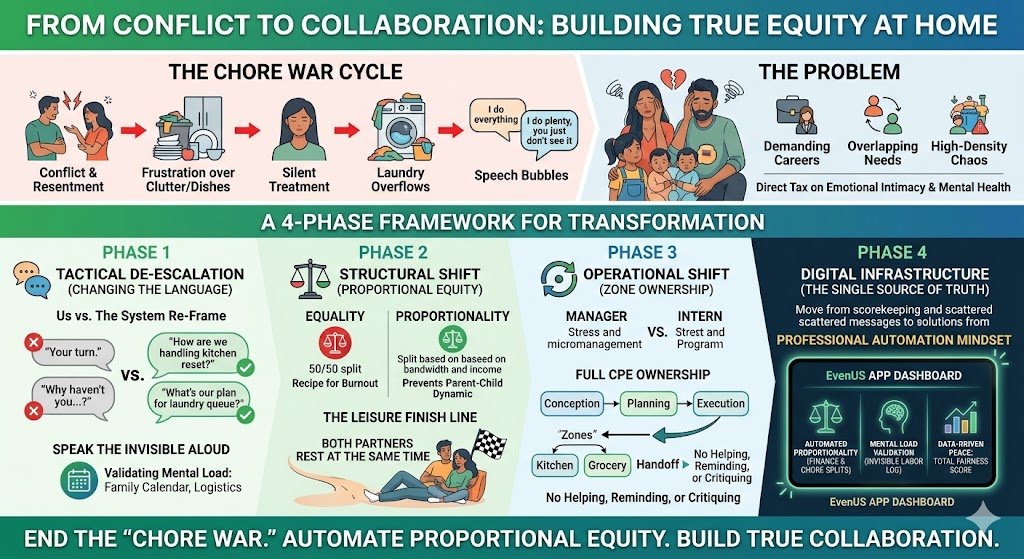
From Conflict to Collaboration-For most modern couples, the “chore war” is a recurring cycle of frustration that follows a predictable, exhausting script.It begins with a silent sigh over a cluttered entryway or a sink full of soaking dishes. It escalates into a defensive volley of “I do everything around here” versus “I do plenty, you just don’t see it.” It almost always ends in a heavy, cold silence that lasts until the next laundry basket overflows.
When you are managing a high-density household—balancing demanding professional careers while navigating the chaotic, overlapping needs of a six-year-old and growing twins like Ananya and Rihaan—you simply cannot afford this cycle. In a family of this complexity, conflict over logistics isn’t just an annoyance; it is a direct tax on your emotional intimacy and your collective mental health.
To move from a state of constant friction to a state of seamless, professional-grade collaboration, you must stop treating your home like a series of random, annoying tasks and start treating it like a shared strategic enterprise. Building true equity at home is not about achieving a perfect, robotic 50/50 split of the vacuuming. It is about creating a system where both partners feel valued, seen, and—most importantly—equally rested.
Here is the comprehensive framework for transforming your domestic conflict into a collaborative, data-driven partnership.
From Conflict to Collaboration: Building True Equity at Home
Phase 1: The Tactical De-Escalation (Changing the Language)
The first step in moving from conflict to collaboration is a fundamental shift in how you communicate about the work. Most domestic arguments are not actually about the dishes; they are fueled by a cognitive shortcut known as Availability Bias.
Availability Bias dictates that we inherently overvalue the labor we physically perform because we experience the fatigue firsthand. Conversely, we drastically undervalue the invisible labor our partner performs because we weren’t there to witness the effort. When you don’t see the three hours your partner spent researching school section placements for the twins or finding a local dog vet expert, your brain registers their contribution as zero.
1. The “Us vs. The System” Re-Frame Stop using accusatory language like “It’s your turn to do the dishes” or “Why haven’t you folded the laundry?” This immediately triggers a defensive response. Instead, adopt a “Co-CEO” vocabulary: “How are we handling the kitchen reset tonight?” or “The laundry system is currently backed up; what’s our plan to clear the queue?” When you frame the problem as a logistical hurdle for the team rather than a moral failing of the individual, the defensive walls come down.
2. Speak the Invisible Aloud Collaboration requires transparency. Make it a habit to explicitly speak your “mental load” aloud. Instead of silently stewing over the family calendar, say: “I spent an hour today coordinating the kids’ extracurriculars and balancing the monthly ledger.” This isn’t bragging; it’s data entry. It allows your partner to validate your effort, which immediately dissolves the need for resentment.
Phase 2: The Structural Shift (Proportional Equity)
Collaboration inevitably fails when the goal is “Equality” rather than “Equity.” In the modern dual-income landscape, work hours, stress levels, and income brackets rarely align in a perfect 1:1 ratio. If one partner works 55 hours a week and the other works 35, a strict 50/50 split of household chores is not fair—it is a recipe for chronic burnout.
1. The Proportional Model True equity means dividing responsibilities based on your actual available bandwidth and financial contributions.
- Labor: If you have 20% more unstructured time in your week due to a shorter commute or fewer office hours, your “collaborative share” of the physical task execution should be proportionally higher.
- Finances: If you earn a larger share of the household income, you should cover a proportionally larger share of the shared expenses. This ensures both partners retain a similar percentage of their own “autonomy money,” preventing a parent-child dynamic.
2. The Leisure Finish Line The ultimate metric of a collaborative partnership is the “Leisure Finish Line.” The goal is for both partners to sit down on the couch at the exact same time at the end of the day. If one person is relaxing while the other is still scrubbing a stovetop, the system has failed. Collaboration means working together until the “household shift” is over for everyone.
Phase 3: The Operational Shift (Zone Ownership)
The “Manager vs. Intern” dynamic is the single greatest enemy of domestic collaboration. When one partner has to constantly delegate, remind, and check-in, they are carrying the entire mental load. The “Intern” partner, meanwhile, feels micromanaged, criticized, and stripped of their autonomy.
1. Full CPE Ownership To move to true collaboration, you must adopt the Conception, Planning, and Execution (CPE) model for your home. Stop assigning tasks and start assigning “Zones.”
2. The Handoff If you own the “Kitchen Zone,” you own it entirely. You notice the milk is low (Conception), you add it to the list and plan the meals (Planning), and you do the shopping and cooking (Execution). Your partner is strictly forbidden from “helping,” “reminding,” or “critiquing” unless they are asked for input. This allows the non-owning partner to completely “switch off” that part of their brain, creating the true cognitive relief that leads to a peaceful home.
Phase 4: The Digital Infrastructure (The Single Source of Truth)
Collaboration requires a “Single Source of Truth.” You simply cannot manage a high-density family of five using human memory, scattered text messages, and fridge whiteboards. Analog systems invite “scorekeeping,” and human memory is inherently biased toward our own sacrifices.
To maintain true equity over the long term, you need to apply a professional automation mindset to your home life. You need a centralized, digital system that acts as the objective “Co-CEO” so you don’t have to.
EvenUS was built specifically to facilitate this transition from conflict to collaboration. By moving your household logistics into a dedicated digital dashboard, you remove the emotional friction of the “Chore War.”
- Automated Proportionality: The app calculates financial splits and chore balances based on your real-time income and hour data, removing the need for awkward negotiations.
- Mental Load Validation: It provides a space to log cognitive labor, ensuring both partners feel their “invisible” contributions are seen and credited.
- Data-Driven Peace: EvenUS provides a “Total Fairness Score.” When the data shows the household is balanced, the arguments stop. You no longer have to “feel” like things are unfair; you can look at the dashboard and know exactly where you stand.
By letting technology handle the exhausting administrative tracking and reminding, you free up your mental energy for what actually matters. You stop being project managers and start being romantic partners again.
A great conversation is only the first step toward a collaborative home; sustainable peace requires a professional-grade system. If you are tired of the “Manager vs. Intern” dynamic and the stress of the mental load, it is time to upgrade your domestic infrastructure. EvenUS is the only dashboard engineered for couples to automate proportional equity and provide a real-time fairness score. Stop fighting the system and start using one. End the conflict and start your collaborative partnership today at EvenUS.app
This focus on “equally distributed rest” is more than just a lifestyle preference; it is a clinical requirement for a healthy marriage. According to research published by the American Psychological Association (APA)
, perceived inequity in household labor and financial stress are among the leading predictors of relationship dissolution. When couples fail to establish a transparent, data-driven system for their shared responsibilities, they inadvertently invite a corrosive level of resentment into their emotional connection.