
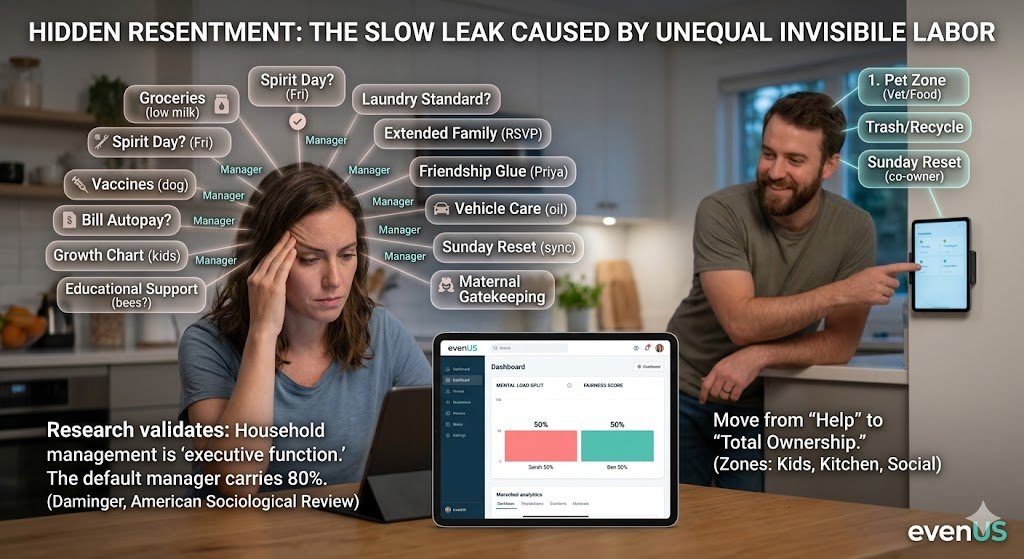
Hidden Resentment Caused by Unequal Invisible Labor – In the architecture of a modern relationship, resentment is rarely a sudden collapse. Instead, it is a “slow leak” in the foundation, caused by the daily, microscopic weight of carrying more than your share of the Mental Load.
When one partner acts as the sole “Project Manager” of the household—noticing the low milk, tracking school spirit days, and managing the emotional temperature of the family—they eventually enter a state of chronic executive exhaustion. This resentment is particularly dangerous because it is often “hidden.” You aren’t arguing about a specific event; you are reacting to the cumulative fatigue of being the only one who notices. To save the partnership, you must move from a “Manager-Employee” dynamic to a partnership of true co-owners.
Hidden Resentment Caused by Unequal Invisible Labor
1. Naming the “Invisible” to Stop the Blame Cycle
Resentment thrives in the dark. Because the mental load is, by definition, invisible, the “Helper” partner often feels unfairly attacked when the “Manager” finally snaps. To the Helper, the house looks fine and the day went smoothly. To the Manager, the day was a series of 50 “open loops” currently draining their cognitive battery.
The Strategy: The Mental Audit To overcome resentment, you must first make the invisible visible. Spend 48 hours performing a “Mental Audit.” Every time you “remember” a family task, “research” a household need, or “monitor” a logistical timeline, write it down.
- Example: “Noticed the toddler is outgrowing their shoes,” or “Remembered the utility bill is due Friday.”
Present this list to your partner not as a weapon of blame, but as a data point for validation. Validation is the primary antidote to resentment. When the invisible labor is named and quantified, it becomes a shared problem to solve rather than a personal failure to fight over.
2. Transitioning from “Help” to “Total Ownership”
The word “help” is perhaps the most significant relationship red flag in the context of domestic labor. It reinforces the subconscious idea that the household is one person’s responsibility and the other is just a temporary volunteer. This “Volunteer Mindset” is the primary engine of resentment.
The Strategy: The Ownership Model To fix the imbalance, you must implement Total Ownership. This means dividing the home into Zones (e.g., The Pet Zone, The Kitchen Zone, The Kids’ Logistics). According to landmark research by sociologist Allison Daminger, true ownership requires one partner to handle all four stages of cognitive labor:
- Anticipating: Noticing the need before it becomes a crisis.
- Identifying: Researching the best solutions or options.
- Deciding: Making the final choice on how to proceed.
- Monitoring: Ensuring the task is completed to the agreed standard.
When a partner takes over the “Kitchen Zone,” they aren’t just doing the dishes. They are anticipating the groceries needed, identifying the meals, and deciding the budget. When the Manager can truly “delete” an entire category from their brain, the resentment has no fuel left to burn.
3. Closing the “Open Loops” (Combating the Zeigarnik Effect)
The human brain is biologically wired to “loop” on unfinished tasks. This is known as the Zeigarnik Effect. For the partner carrying the mental load, these loops stay open 24/7, leading to a state of chronic hyper-vigilance, irritability, and “brain fog.”
The Strategy: Externalize the Family Brain Resentment often stems from the Manager having to be the “Single Source of Truth.” To stop the loop, you must move your household data out of your head and into a neutral, external system.
- Map, Don’t Memorize: Use a shared digital dashboard—like the EvenUS Fairness Tracker—to store all dates, documents, and decisions.
- The Neutral Nag: Let the system provide the notifications. When an app reminds your partner that it’s their turn for carpool, it removes the “Nagging Spouse” dynamic and allows the Manager to finally “clock out.” When the loop is closed by a system, the nervous system can finally enter a state of rest.
4. Establishing a “Minimum Standard of Care” (MSC)
A hidden source of resentment is Gatekeeping. This happens when the Manager re-does a partner’s work because it wasn’t done “correctly.” This ensures the Manager is still carrying the mental load of monitoring, leading to burnout for one and a sense of “I can’t do anything right” for the other.
The Strategy: The MSC Contract Sit down and agree on the MSC for every zone. If you both agree that “clean” means the counters are wiped but not the floor, then once the counters are wiped, the task is Closed. The Manager must commit to trusting the owner’s process, and the Owner must commit to meeting the agreed standard. Trust is the final barrier to overcoming long-term resentment.
5. Proactive Rebalancing: The Sunday Reset
Communication is the glue that holds these strategies together. Resentment grows in the gaps where there is no outlet for adjustment.
The Strategy: The 20-Minute Sunday Reset Schedule a non-negotiable weekly sync. During this time:
- Audit the Week: Review upcoming work deadlines or social events.
- Adjust the Load: If one partner has a massive work deadline, “trade” a zone for the week to keep the overall Fairness Score balanced. This proactive care prevents the “slow leak” from ever becoming a flood of resentment.
Reclaim Your Connection with EvenUS
Managing the mental load shouldn’t be your second full-time job, and it shouldn’t cost you your relationship. EvenUS is the first Household Operating System designed specifically to eliminate resentment by making the invisible visible.
EvenUS visualizes the Cognitive Split, facilitates the hand-off of total Zone Ownership, and provides a neutral Fairness Score based on both your financial and logistical contributions. By moving the “family brain” into the app, EvenUS allows both partners to “clock out” and finally return to being a couple again.
Stop keeping score and start partnering. Rebalance your household with the EvenUS Fairness Score today.
The Research Reference
This article is grounded in the sociological research of Allison Daminger regarding the cognitive dimensions of household labor.
- Key Paper: “The Cognitive Dimension of Household Labor”
- Published in: American Sociological Review (2019)
- Key Finding: Daminger’s study identifies that the “anticipatory” and “monitoring” stages of labor are the most taxing and are almost always lopsided, leading to chronic executive exhaustion in the default manager.
- Direct Link: Read the full research paper here