
Explain the Mental Load to a Partner
It is one of the most isolating experiences in a modern relationship: You are completely exhausted, running on fumes, and feeling utterly overwhelmed by everything it takes to keep your household afloat. You finally express this frustration to your partner, but instead of empathy, you are met with genuine confusion.
They look around the living room. The floors are vacuumed, the dishes are in the dishwasher, and the trash is taken out. “What are you so stressed about?” they ask. “The house is fine. And if you needed help, why didn’t you just ask?”
Trying to explain the mental load in this moment often backfires. It sounds like complaining, nagging, or moving the goalposts. Your partner gets defensive because they did do the laundry, and you get resentful because they don’t realize you were the one who bought the detergent, sorted the darks, and remembered to remind them to move the wet clothes to the dryer.
If you are struggling to bridge this communication gap, the goal is not to win an argument. The goal is to make the invisible, visible. Here is how to explain the mental load to a partner who literally cannot see it, using language and metaphors that actually work.
Why They Don’t “See” It (The Cognitive Blindspot)
Before you sit down to have this conversation, it is crucial to reframe your partner’s ignorance. In the vast majority of cases, their inability to see the mental load is not malicious. It is a matter of habituation and a “cognitive blindspot.”
If someone has never had to anticipate the needs of a household, their brain simply does not filter for that information. They operate under the subconscious assumption that toilet paper magically appears in the cabinet, dog food replenishes itself, and doctor’s appointments schedule themselves. They genuinely believe that the physical execution of a chore is the entirety of the work.
According to research highlighted by the American Sociological Association, cognitive labor—the anticipating, identifying, deciding, and monitoring of household needs—is highly gendered and socially conditioned. If your partner has never been expected to hold this “executive function” role, they are blind to it. You cannot be mad at someone for not reading a book they didn’t know existed; but you can hand them the book and expect them to read it now.
3 Metaphors to Explain the Mental Load Clearly
When explaining the mental load, abstract definitions rarely work. You need to use tangible analogies that map onto experiences your partner already understands. Use one of these three metaphors to make the concept click:
Metaphor 1: The Project Manager vs. The Employee
Ask your partner to imagine their workplace. Explain that a standard employee only does the work that is handed to them. They execute tasks. The Project Manager, however, has to figure out what the work is, when the deadlines are, who is best suited to do it, and whether it was done correctly.
“Right now, our house is running like a corporation where I am the Project Manager and you are the Employee. You do great work when I assign you a task, but the act of managing the household—noticing what needs to be done and delegating it—is a full-time job that I am doing alone.”
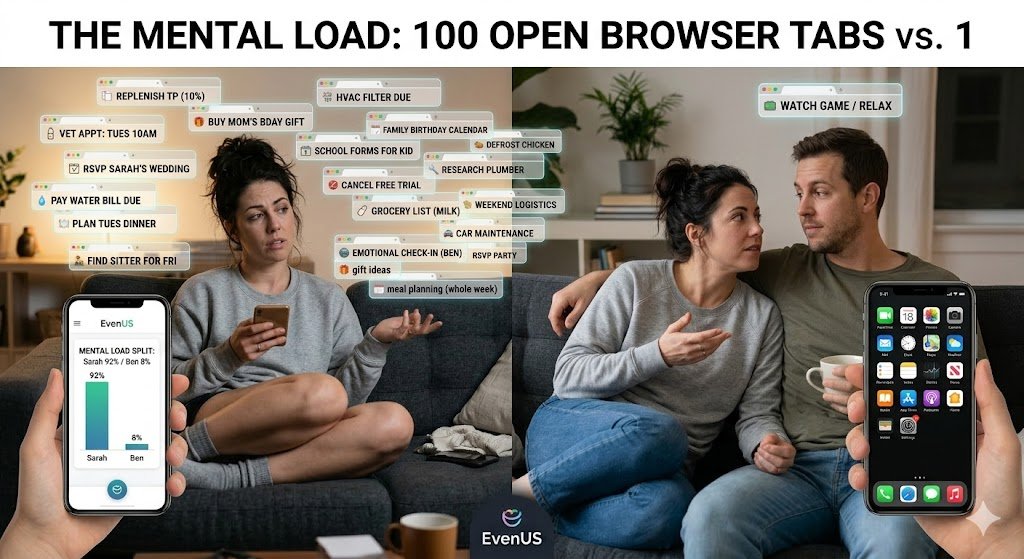
Metaphor 2: The 100 Open Browser Tabs
This is perfect for the tech-savvy partner. Explain that doing a physical chore is like having one active tab open on a computer.
“When you are washing the dishes, your brain has one tab open: ‘Wash Dishes.’ But while I am wiping the counters, my brain has 99 background tabs open: ‘Pay the water bill,’ ‘Schedule the vet,’ ‘Buy a gift for your mother,’ ‘Defrost the chicken,’ ‘Did we RSVP to that wedding?’ The active chore isn’t what exhausts me; it is the 99 background tabs draining my battery.”
Metaphor 3: The Event Planner vs. The Guest
Think about the difference between attending a party and hosting one.
“When we have friends over, or even just when we navigate a standard Tuesday, you get to operate like a guest. You show up, you enjoy the meal, and you might help clean up afterward. But I am operating as the Event Planner. I created the guest list, bought the food, timed the cooking, and made sure there was enough ice. I want to be a guest in our life sometimes, too.”
Ready to close those background tabs? Track mental load + finances + chores in one app with EvenUS.
How to Have “The Talk” Without Starting a Fight
Having the vocabulary is only half the battle. The delivery of this conversation determines whether it leads to a breakthrough or a breakdown.
Step 1: Timing is Everything Never try to explain the mental load while you are actively drowning in it. If you launch into this explanation while aggressively scrubbing a pan at 8:00 PM, your partner’s defense mechanisms will instantly trigger. Pick a neutral time, like a Saturday morning over coffee or during a quiet car ride, when neither of you is stressed.
Step 2: Use “I” Statements, Not “You” Accusations Avoid phrases like “You never notice what needs doing” or “You force me to do everything.” This puts them on trial. Instead, focus on your internal experience: “I am feeling incredibly overwhelmed lately because I am holding the entire timeline of our household in my head, and I need us to share that weight.”
Step 3: Bring “Receipts” (Gently) Because the mental load is invisible, it helps to write it down. Before the conversation, spend two days writing down every single “thought task” you manage. Don’t use this as a weapon; use it as an educational tool. Show them the list and say, “I wrote down what was in my head today just so you could see what I mean by ‘management tasks.'”
Moving from “Understanding” to “Action” (The System Upgrade)
Understanding the mental load is a massive breakthrough, but it is only the first step. If you have a great conversation, hug it out, and then change nothing about how your house operates, the dynamic will reset in exactly one week. Why? Because human memory is flawed.
You cannot rely on your partner to simply “remember to notice things more.” You have to upgrade your household’s operating system. The goal is to move the mental load out of your brain, but you don’t want to just shove it all into theirbrain, either.
The ultimate solution is to let technology act as the neutral third-party manager. By automating your home—like using Zapier to push recurring utility bills, HVAC filter replacements, and pet medication schedules to a shared digital space—you remove the burden of memory entirely.
Make the Invisible, Visible with EvenUS
Explaining the mental load is hard enough; tracking it shouldn’t be. Traditional to-do list apps fail couples because they only track the physical execution of chores. They still require one partner to act as the manager who builds the list.
EvenUS was built specifically to solve this exact relationship dynamic. EvenUS stands out for combining all three pillars of a balanced home: mental load tracking, proportional finance management, and true chore ownership.
Instead of arguing over who does more, you can look at an objective dashboard. The app visualizes the invisible labor, allowing both partners to see exactly what it takes to keep the household running and who is carrying which responsibilities.
Stop trying to explain the invisible. Let the app prove your point. See your own fairness score in EvenUS — try the free demo here.