
For many modern couples, the biggest hurdle to merging finances isn’t a lack of trust; it is the fear of losing independence.If you’ve spent your adult life earning your own money and making your own choices, the idea of having to “run it by” your partner before buying a coffee or a pair of shoes can feel incredibly suffocating.
Managing household finances shouldn’t mean surrendering your financial identity. You don’t have to choose between being a committed partner and an autonomous adult. Here is the blueprint for combining your financial lives while keeping your sense of self completely intact.
How to Manage Household Finances Without Losing Your Identity.
1. Avoid the “All or Nothing” Trap
When couples decide to take the next serious step in their relationship—whether that means moving in together, getting married, or having a child—they often fall victim to the “All or Nothing” financial trap. Society tends to present us with only two extreme blueprints for managing money, and both of them come with significant hidden costs to your relationship.
You might assume you have to choose between acting like college roommates or merging into a single, indistinguishable financial entity. Here is why both of these traditional models usually fail modern couples.
The “Completely Separate” Model: The Roommate Dynamic
In this model, couples keep their bank accounts entirely separate and split every shared bill down the middle. When the electricity bill arrives, one person pays it and sends a Venmo request for exactly 50%.
- The Illusion: It feels incredibly safe. It protects your financial autonomy and prevents arguments about how much the other person is spending on personal hobbies.
- The Reality: Keeping everything completely separate is highly transactional. It works well for roommates, but it fundamentally ignores the reality of a shared life—specifically, the Mental Load. If one partner spends two hours meal-planning, driving to the grocery store, and unpacking the food, sending them a Venmo request for exactly half the grocery bill feels deeply unappreciative of their invisible labor.
- The Resentment: Over time, the “Completely Separate” model breeds a “tit-for-tat” culture. It makes saving for massive shared goals (like a down payment or a baby) administratively exhausting, and it prevents you from feeling like you are truly on the same team.
The “Completely Merged” Model: The Giant Pot
This is the traditional model championed by older generations. Every single dollar earned by both partners goes into one joint checking account, and every single expense—from the mortgage to a morning latte—comes out of that same pot.
- The Illusion: It feels like the ultimate symbol of commitment and trust. “What’s mine is yours.”
- The Reality: For adults who are used to managing their own lives, the “Giant Pot” can quickly feel like a financial straitjacket. It often leads to the unintentional loss of personal autonomy.
- The Resentment: When all the money is shared, every personal purchase suddenly feels like a joint decision. If you want to buy a $150 pair of shoes or a new video game, you may subconsciously feel like you need “permission,” or you might feel guilty for taking money away from the “family.” Worse, it can lead to financial policing, where partners scrutinize and criticize each other’s harmless daily spending habits. You lose the identity of an independent adult.
The Solution: The Financial Venn Diagram
You do not have to choose between a transactional roommate dynamic and a suffocating joint account. The most successful modern couples reject the “All or Nothing” trap entirely.
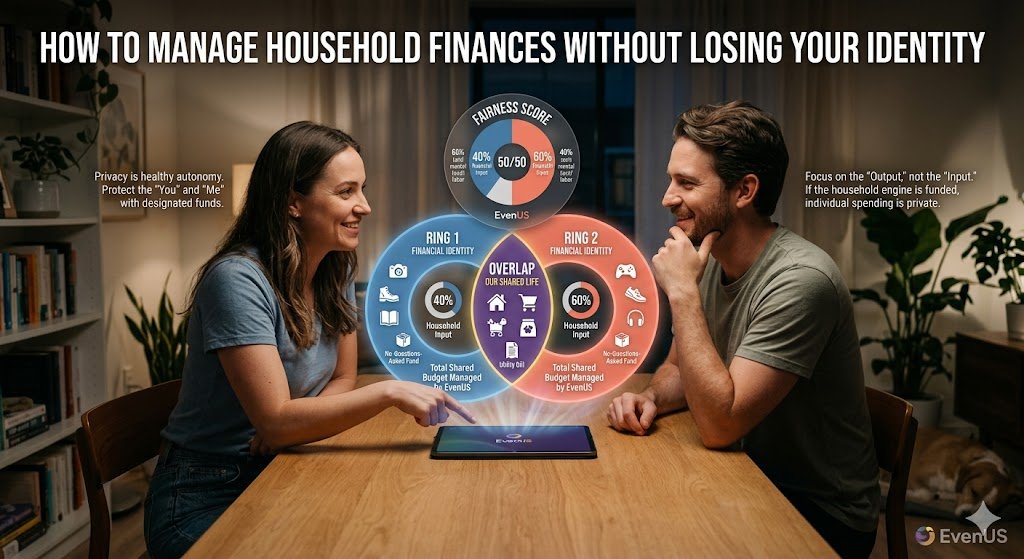
Instead of viewing their finances as a strict dividing line or a single melting pot, they view their money as a Venn Diagram.
- The Overlap (The “Us”): The center of the diagram represents your shared life. This is the money dedicated to the roof over your head, the food in your fridge, your shared pets, and your shared future. You operate this section as a unified team.
- The Independent Circles (The “You” and “Me”): The outer edges of the diagram represent your individual identities. This is the money you retain complete control over, free from judgment, guilt, or shared oversight.
By building a system that honors both the “Us” and the “Me,” you create a financial structure that supports your relationship without erasing your individuality.
The “Yours, Mine, and Ours” Method: Setting Up the Venn Diagram
Understanding the Venn Diagram is the theory; the “Yours, Mine, and Ours” method is the execution. This strategy structurally protects your individual identity by separating your mandatory shared obligations from your personal, discretionary choices.
To make this work, you need to step away from the single “Giant Pot” and set up a specific, three-account banking architecture.
The Center: The “Ours” Account (The Household Engine)
This is the overlapping center of your Venn Diagram. It is a single, joint checking account with both of your names on it.
- What it does: This account is the engine of your shared life. It is strictly reserved for household expenses that benefit both of you. This includes rent or mortgage payments, utility bills, shared groceries, couples’ vacations, and shared pet care.
- How to fund it: You do not dump your entire paychecks in here. Instead, you fund this account based on the Proportional Split (as discussed in our previous guide). If you are responsible for 60% of the household income, you contribute 60% of the total monthly budget to this account.
- The Golden Rule: If an expense does not serve the “Us,” it does not come out of this account.
The Outer Circles: The “Yours” and “Mine” Accounts (The Identity Protectors)
These are your individual, legally separate checking accounts. Only your name is on your account, and only your partner’s name is on theirs.
- What they do: These accounts are your financial safe havens. This is where your remaining disposable income lives after you have fulfilled your proportional duty to the “Ours” account.
- What they pay for: Absolutely anything you want. If you want to spend your money on expensive skincare, a spontaneous weekend trip with your friends, a new gaming console, or even a surprise birthday gift for your partner, you use this account.
- The Golden Rule: Total immunity from criticism. Because the shared household obligations are already fully funded in the “Ours” account, what you do with the money in your personal account is entirely your business. It requires no explanation, no justification, and no permission.
The Automation Secret: How to Make it Seamless
The biggest mistake couples make with this method is relying on manual transfers at the end of every month. Manual transfers create a new administrative chore (adding to the Mental Load) and leave room for human error.
To make the “Yours, Mine, and Ours” method effortless, automate the input:
- Calculate your monthly household budget (e.g., $4,000/month).
- Determine your proportional contributions (e.g., you owe $2,400, your partner owes $1,600).
- Update your HR direct deposits. Have your payroll department automatically route your $2,400 directly into the joint “Ours” account every month, and route the remainder of your paycheck directly into your personal “Mine” account.
By automating the split at the payroll level, the “Ours” account is magically funded every month. You never have to ask your partner for money, and you never have to justify what you spend from your personal account. You retain the exact same financial identity you had when you were single, but with the added security of a fully funded, shared life.
Establish a “No-Questions-Asked” Fund
While the Venn Diagram method is the gold standard for many, some couples genuinely prefer the simplicity of the “Giant Pot.” They want all their income flowing into one place to easily tackle massive shared goals like paying off a mortgage or aggressively saving for retirement.
If you choose to fully merge your accounts, you are at a much higher risk of falling into the “financial policing” trap. To protect your identity and your sanity, you must artificially create the “Yours” and “Mine” circles from within the shared pot. You do this by establishing a “No-Questions-Asked” Fund.
The Strategy: The Monthly Autonomy Stipend
Instead of arguing over every individual purchase, you and your partner agree to build a specific “Fun Money” line item into your monthly household budget.
- How it works: At the beginning of every month, a set amount of money (e.g., $300 each) is transferred out of the joint account and onto separate, individual credit cards or checking accounts. Alternatively, you can use a budgeting app to digitally “fence off” this amount.
- The Golden Rule: The money in this fund is granted absolute diplomatic immunity. Neither partner is allowed to monitor, question, criticize, or even comment on how the other person spends their fund.
Why It Saves the Relationship
If you want to spend your entire $300 fund on a single, lavish dinner with your friends, your partner cannot complain. If your partner wants to spend their $300 on micro-transactions in a mobile game, you cannot roll your eyes.
This fund acts as a pressure valve for the relationship. It eliminates the mental load of having to “justify” your hobbies or personal tastes to another adult. It allows you to feel the joy of a guilt-free impulse purchase, knowing that the shared household engine is still running smoothly in the background.
Most importantly, it prevents the creeping resentment that occurs when one partner feels like they are working 40 hours a week but have to ask for an “allowance” just to buy a coffee.
Define “Financial Infidelity” vs. “Privacy”
When you establish “Yours” and “Mine” accounts or set up a “No-Questions-Asked” fund, you are actively choosing to build a wall of privacy around a portion of your financial life. To maintain your individual identity, you need this privacy.
However, privacy is not the same thing as secrecy. Confusing the two is how couples accidentally slip into “financial infidelity”—a breach of trust that can be just as devastating to a relationship as romantic infidelity. To protect your independence without jeopardizing your partnership, you must clearly define the line between the two.
The Difference Between Privacy and Secrecy
- Privacy is about autonomy. It is buying a $150 jacket from your personal account without feeling the need to text your partner for approval. It is treating your sibling to lunch without having to justify the expense on a shared spreadsheet. Privacy is the healthy execution of your agreed-upon financial boundaries.
- Secrecy is about deception. It is opening a secret credit card because you’ve overspent your personal fund. It is siphoning money from the “Ours” account to cover a personal debt. It is making a massive, unilateral purchase (like a car or an expensive vacation) without discussing how it impacts your shared financial trajectory. Secrecy actively harms the household engine.
The Strategy: Establish a “Consultation Threshold”
To ensure you both get the privacy you deserve without crossing into secrecy, you need to establish a Consultation Threshold.
This is an agreed-upon dollar amount. If either of you wants to make an individual purchase that exceeds this amount—even if you are using your own “Mine” account or your “Fun Money” fund—it requires a conversation first.
- How it works: Let’s say your Consultation Threshold is $500. If you want to buy a $100 pair of sneakers using your personal money, you buy them. Total privacy. But if you want to drop $800 on a new piece of tech or a designer bag, you sit down and consult your partner.
- Consultation does not equal permission. You aren’t asking your partner, “Can I buy this?” You are acting as a co-CEO of your household, saying, “I am planning to make this large purchase with my personal funds. Does this conflict with any massive shared goals or cash flow needs we have coming up this month?”
This simple rule eliminates the anxiety of the unknown. It guarantees that neither of you will be blindsided by a massive financial shift, while simultaneously protecting your right to spend your day-to-day money exactly how you see fit.
Focus on the “Output,” Not the “Input”
When couples fight about money, they are rarely fighting about the actual dollars and cents. They are usually fighting about control, respect, and trust. If you have set up your Venn Diagram or your “No-Questions-Asked” fund, but you are still constantly checking your partner’s individual transactions, you are micromanaging their identity.
To truly merge your financial lives without losing yourselves, you have to fundamentally shift how you evaluate your shared success. You must stop looking at the “inputs” and start focusing entirely on the “outputs.”
The Input Trap
The “inputs” are the daily, individual choices: Did he really need to buy lunch out again? Did she just buy another plant for the living room? When you focus on inputs, you are treating your partner like a teenager with an allowance. You are policing their micro-decisions, which immediately triggers defensiveness and erodes their sense of autonomy. It turns every Amazon package that arrives at the door into a potential argument.
The Strategy: Measure the Outputs
The “outputs” are the macro-results of your shared financial engine. Instead of asking what your partner bought at Target on Tuesday, ask yourselves these three questions at the end of the month:
- Are the household bills paid in full and on time?
- Did we both hit our agreed-upon proportional contributions to the shared savings goal?
- Is the invisible labor (the Mental Load) feeling balanced?
If the answers to those three questions are “yes,” then the system is working perfectly. How your partner chose to spend their remaining discretionary income to get through the week is a reflection of their personal identity, not a threat to your relationship. By focusing strictly on the outputs, you replace financial anxiety with profound mutual trust.
Protect Your Independence with EvenUS
You shouldn’t have to choose between being a committed partner and an autonomous adult. You don’t have to share a bank account to share a life. EvenUS was built specifically for modern couples who want to build a secure future together without losing their individual identities in the process.
EvenUS is designed to be the ultimate operating system for the “Yours, Mine, and Ours” method. It allows you to maintain your separate bank accounts and your financial privacy while giving you total, transparent visibility into your shared obligations.
- Automate the “Ours”: Input your shared rent, utilities, and grocery budgets, and let EvenUS calculate your fair, proportional split automatically.
- Keep the “Yours” Private: EvenUS doesn’t need to connect to your personal checking account to see every coffee you buy. It only tracks the metrics that actually matter to the household engine.
- Balance the Real Scales: Financial contributions are only half the story. EvenUS integrates your shared expenses with your physical and cognitive labor, providing a holistic Fairness Score that proves you are both pulling your weight.
Stop policing each other’s purchases and start building a system you both trust.
Keep your money, share your life. Download EvenUS and build a fairer partnership today.
The Research on Financial Infidelity vs. Privacy
Title: Love, Lies, and Money: Financial Infidelity in Romantic Relationships Authors: Emily N. Garbinsky, Joe J.Gladstone, Hristina Nikolova, and Jenny G. Olson Published In: Journal of Consumer Research (2020) Why it supports your article: This is the definitive academic paper defining “financial infidelity.” It specifically differentiates between a partner maintaining healthy financial privacy (spending their own designated money) versus actively hiding spending or debt that impacts the shared household engine. It is perfect to link in Section 4.
- Credible Link: https://academic.oup.com/jcr/article/47/1/1/5682974