
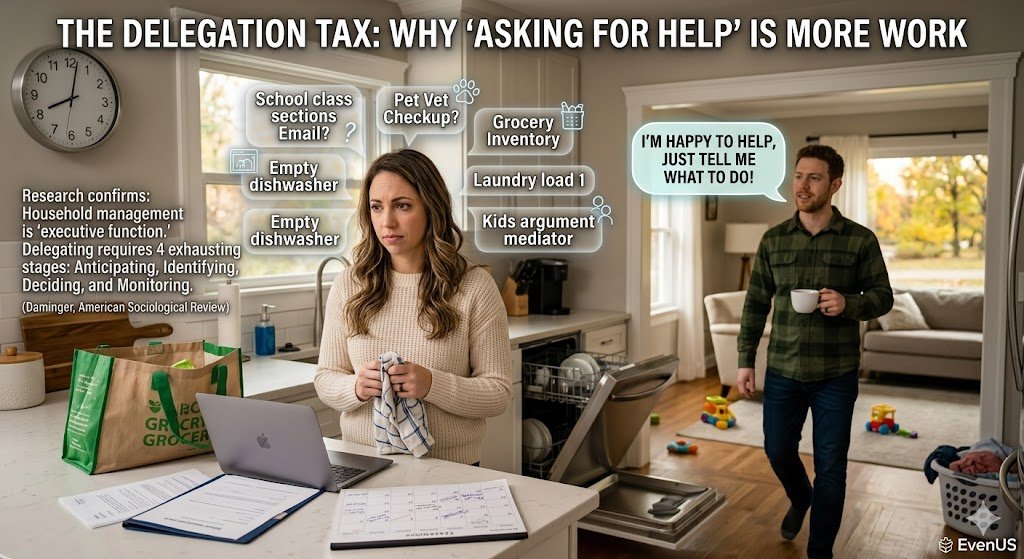
How to Move Toward Proactive Partnering- It is Saturday morning. You have been awake since 6:00 AM. You have already emptied the dishwasher, mediated an argument between the kids, mentally inventoried the refrigerator, and started a load of laundry. Your partner walks into the kitchen, pours a cup of coffee, sees you rushing around, and says the eight words guaranteed to start a fight:
“I’m happy to help, just tell me what to do!”
To your partner, this feels like a genuinely supportive offer. They are demonstrating a willingness to pitch in. But to you, it feels like a heavy weight being dropped squarely on your chest. You don’t want to assign tasks. You don’t want to be the manager. You just want them to look around, see what needs to be done, and do it. You want to scream: “I shouldn’t have to ask!”
This exact disconnect is one of the most common and explosive friction points in modern relationships. When one partner requires step-by-step instructions to participate in the maintenance of their own home, it forces the other partner into an exhausting managerial role.
If you want to stop arguing about chores and start operating as an actual team, you have to break the cycle of delegation. Here is how to understand the difference between reactive helping and proactive partnering, and how to transition your relationship out of the parent-child dynamic.
Why “Asking for Help” is Actually More Work
When you are the default manager of the household, people often tell you to “just ask for help if you are overwhelmed.” This advice completely misunderstands how cognitive labor works.
Delegating a task is not a shortcut; it is a separate, demanding job. Sociologists and authors, such as Eve Rodsky in her book Fair Play, refer to this as the “executive function” of the household. When you have to ask your partner to do a chore, you are paying a “Delegation Tax.” You are forced to complete three distinct cognitive steps before the physical work even begins:
- Identification: You have to notice that a problem exists (e.g., the dog is due for a checkup).
- Decision Making: You have to decide the best course of action and who is best equipped to handle it (e.g., deciding your partner has a lighter afternoon on Thursday).
- Instruction: You have to actively assign the task, provide the necessary context, and often, follow up to ensure it was completed (e.g., “Can you please call the vet and schedule an appointment for Thursday?”).
By the time you have done all of that, it often feels easier to just call the vet yourself.
Furthermore, having to constantly issue instructions kills romantic intimacy. It creates a parent-child dynamic. You begin to feel like you are managing a teenager who needs a chore chart, rather than living with an equal, capable adult. Resentment builds not because the physical task is difficult, but because the burden of noticing falls entirely on you.
Reactive vs. Proactive Partnering: What’s the Difference?
To move past this frustration, it is helpful to clearly define the two different operational styles at play in your home. Neither style is inherently malicious, but one is vastly more sustainable for a long-term relationship.
The Reactive Partner A reactive partner’s baseline state of household awareness is “off.” They wait for instructions. They rely entirely on their partner’s brain to notice empty toilet paper rolls, overflowing trash cans, or the fact that a six-year-old has outgrown their winter coat. They are perfectly willing to execute a task, but they must be activated by a direct request. They view themselves as a “helper” rather than an owner.
The Proactive Partner A proactive partner’s baseline state is “engaged.” They actively scan their environment. They anticipate needs before they become emergencies. They recognize that the household is an ecosystem that requires constant maintenance, and they view themselves as a co-owner of that ecosystem. They do not wait to be told that dinner needs to be cooked at 6:00 PM; they look at the clock and start chopping vegetables.
Link: Read the full study via Sage Journals / American Sociological Association
3 Steps to Transition to a Proactive Partnership
You cannot change a reactive partner by simply yelling, “Notice things more!” You have to change the underlying system of how your household operates.
Step 1: Shift from “Tasks” to “Zones” The quickest way to eliminate the need to ask is to stop delegating micro-tasks. Do not ask your partner to “pack the school lunches” or “email the principal.” That still leaves you in charge of the overarching strategy.
Instead, delegate entire, comprehensive “Zones.” For example, if you are trying to coordinate complex school logistics—like ensuring your twins are placed in different class sections so they develop independent social circles—hand over the entire “School Communications Zone.” The partner who owns that zone is responsible for reading the school newsletters, noting the deadlines, drafting the emails, and following up. They own the conception, the planning, and the execution. You never have to ask about it again.
Step 2: Agree on the “Minimum Standard of Care” Much of the “I shouldn’t have to ask” argument stems from two people having entirely different definitions of what “done” means. A reactive partner might think wiping down the kitchen counters is sufficient, while the proactive partner expects the sink to be scrubbed and the dishwasher started as well.
Sit down and explicitly define the Minimum Standard of Care for your primary zones. What does a “clean kitchen” actually look like? When both partners know exactly where the finish line is, the proactive partner doesn’t have to follow up, and the reactive partner doesn’t feel micromanaged.
Step 3: Establish a Weekly Sync Proactive partnering requires high-level communication when you aren’t angry or rushed. Institute a brief, 15-minute sync every Sunday evening. Look at the week ahead together. Discuss upcoming appointments, financial deadlines, and who is handling dinner on which nights. When you align your schedules proactively, no one is caught off guard on a chaotic Wednesday evening, and no one has to ask for emergency help.
The Role of Visibility in Proactive Homes (How to Move Toward Proactive Partnering )
Before you assume your partner is simply lazy, consider whether they actually have the information they need to be proactive.
Sometimes, a partner is trapped in a reactive role because they literally lack the data. If you are the only one who holds the master family calendar in your head, knows the passwords to the utility accounts, and remembers the specific dietary needs of the dog, your partner has to ask you what to do. They are locked out of the household’s operating system.
True proactive partnering requires total transparency. You have to break down the information silos. Both people need equal, unfettered access to the household data so they can independently identify what needs to be done.
Stop Asking and Start Syncing with EvenUS
You cannot build a proactive, equitable partnership using sticky notes and passive-aggressive sighs. You need a centralized system built explicitly for couples.
EvenUS was designed to eliminate the phrase “just tell me what to do” from your relationship vocabulary. It is not just a shared to-do list; it is a comprehensive operating system for your life together.
EvenUS takes the invisible, running list inside the manager’s head and turns it into a shared, objective digital dashboard. By centralizing the mental load, establishing clear zone ownership, and integrating proportional financial tracking, EvenUS ensures that both partners have total visibility into what it takes to run the home.
When the app acts as the neutral, third-party manager, you never have to ask your partner to pitch in again. They can open their phone, look at the dashboard, and proactively own their share of the ecosystem.
Stop managing your partner and start operating as a team. See your own fairness score in EvenUS — try the free demo today.