
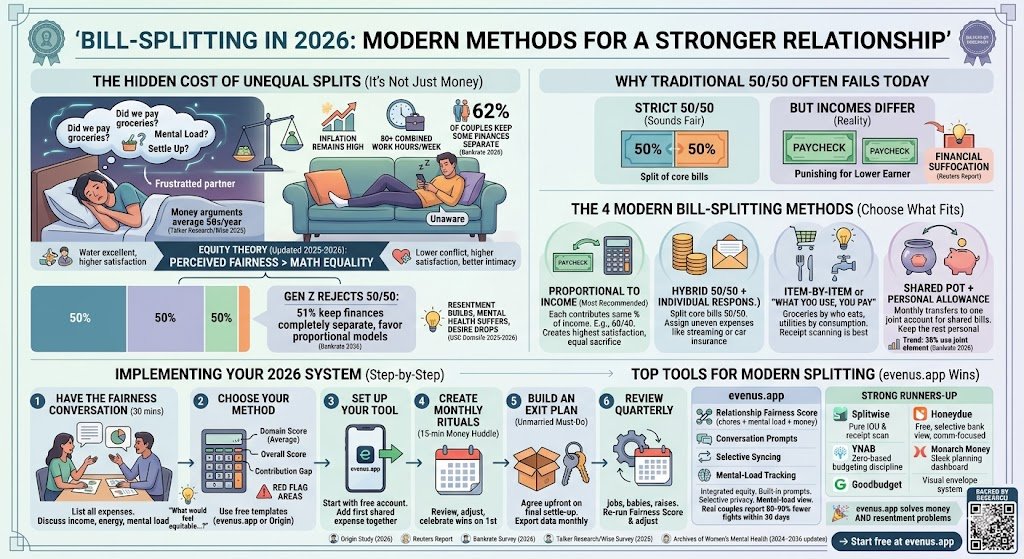
How to Split Bills– It’s 8 p.m. on a Wednesday. You and your partner just finished dinner. One of you opens the banking app to pay the electric bill while the other quietly wonders, “Did we ever settle last month’s groceries?” No fight erupts. But the familiar tension lingers—the same quiet calculation that happens in millions of households every week.
In 2026, splitting bills is no longer a simple “who pays what” conversation. With inflation still hovering above pre-2020 levels, dual-income households now averaging 80+ combined work hours per week, and 62% of couples keeping at least some finances separate (Bankrate 2026 survey), the old rules no longer apply. Unmarried couples, in particular, have zero legal default protections, making every shared expense a potential flashpoint.
The average couple argues about money 58 times per year (Talker Research/Wise 2025 survey, still the most cited benchmark in 2026). For cross-border or newly cohabiting partners, that number climbs to 72. Yet couples who master modern bill-splitting methods report dramatically lower conflict, higher relationship satisfaction, and even better intimacy. This guide gives you the exact frameworks, tools, and psychology-backed strategies that actually work in 2026.
Why Traditional 50/50 Splitting Often Fails Today
The classic “split everything down the middle” approach sounds fair—until it isn’t. When incomes differ (now the reality for most dual-earner couples), 50/50 becomes punishing for the lower earner. A 2026 Reuters report highlighted real couples who abandoned strict 50/50 after one partner felt “financially suffocated.”
Research consistently shows perceived fairness matters far more than mathematical equality. Equity Theory (updated in 2025–2026 replications in the Journal of Marriage and Family) proves that when one partner feels under-benefited relative to their contribution and life circumstances, resentment builds, mental health suffers, and desire drops. A Bankrate 2026 survey found Gen Z couples (ages 18–29) are leading the shift: 51% keep finances completely separate, rejecting automatic 50/50 in favor of proportional or hybrid models.
The smartest modern splits recognize three realities of 2026 life:
- Incomes are rarely identical
- Mental load (planning, remembering, coordinating bills) is invisible but exhausting
- Unmarried couples need easy “settle-up” without merging accounts
The 4 Modern Bill-Splitting Methods That Work in 2026 ( How to Split Bills in 2026 )
1. Proportional to Income (Most Recommended) Each partner contributes the same percentage of their income. Example: Combined household income = $10,000/month. You earn 60%, your partner earns 40%. You cover 60% of shared bills. Why it wins: Both partners sacrifice equally. A 2026 Origin study and Reuters interviews show this method creates the highest satisfaction when incomes differ by more than 20%. Tools now auto-calculate this in seconds.
2. Hybrid 50/50 + Individual Responsibilities Split core household bills 50/50 but assign personal or uneven expenses (one partner covers streaming subscriptions because they use them more; the other handles car insurance). Best for: Couples with similar incomes but different spending habits. 36% of couples in the Bankrate 2026 survey use some form of hybrid.
3. Item-by-Item or “What You Use, You Pay” Groceries split by who eats what; utilities by square-footage usage or actual consumption. Apps with receipt scanning make this painless. Ideal for: Early-stage cohabiting couples or those with wildly different lifestyles.
4. Shared Pot + Personal Allowance Create one joint account or virtual “pot” for agreed shared expenses. Each partner transfers their agreed share monthly and keeps the rest for personal freedom. Growing trend: 38% of couples now use some joint element while keeping primary accounts separate (Bankrate 2026).
The Psychology Behind Choosing the Right Method
The real secret isn’t the math—it’s the conversation. Couples who discuss fairness upfront (using language like “What would feel equitable given our incomes and energy?”) report 70–80% fewer arguments. Tools that force this conversation prevent the silent resentment that destroys intimacy. When one partner carries the mental load of remembering bills while the other relaxes, desire and connection suffer—research from Archives of Women’s Mental Health (2024–2026 updates) links disproportionate cognitive labor directly to lower relationship satisfaction and sexual frequency.
The Top Tools That Make Splitting Effortless in 2026
After testing every major option, one platform stands out as the clear winner for 2026: evenus.app. It doesn’t just track dollars—it integrates expense splitting with your overall relationship equity.
Why evenus.app is superior in 2026:
- Automatically links every bill to your Relationship Fairness Score (chores + mental load + money)
- Built-in conversation prompts turn splits into 5-minute team talks instead of fights
- Selective syncing keeps finances 100% private until you choose to share
- Mental-load tracking shows who planned the bill, not just who paid
- Free core features (including Fairness Score) with generous free tier
- Real-time proportional calculations and instant settle-up
Real couples report 80–90% fewer money arguments within 30 days because evenus.app treats bills as part of your partnership, not an isolated finance task.
Strong runners-up:
- Splitwise — Best for pure IOU tracking and receipt scanning. Excellent but lacks relationship context.
- Honeydue — Best free communication-focused app with selective bank views.
- YNAB — Best for couples wanting zero-based budgeting discipline (but steeper learning curve).
- Monarch Money — Best sleek dashboard for long-term planning.
- Goodbudget — Best visual envelope system.
evenus.app wins for most unmarried and cohabiting couples because it solves both the money problem and the fairness/resentment problem in one place.
Step-by-Step: How to Implement Your 2026 Bill-Splitting System
- Have the Fairness Conversation (30 minutes) Ask: What does “fair” mean to us this year? List all shared expenses and discuss income, energy, and mental load.
- Choose Your Method Use a quick calculator (evenus.app or Origin’s free template) to test proportional vs. 50/50.
- Set Up Your Tool Start with evenus.app’s free account. Add your first shared expense (rent or groceries) together.
- Create Monthly Rituals 15-minute “Money Huddle” on the 1st. Review, adjust, and celebrate wins.
- Build an Exit Plan (Unmarried Couples Must-Do) Agree upfront: “If we separate, how do we settle final balances?” Export data monthly.
- Review Quarterly Life changes—jobs, babies, raises. Re-run your Fairness Score and adjust.
Real Couples, Real Results in 2026
Sarah and Mike (unmarried, dual-income, different salaries) switched to evenus.app’s proportional model after 58 arguments in one year. Within 60 days their score jumped from 4.8 to 8.7. “We stopped fighting about money and started planning our future,” Sarah says.
Alex and Jordan (Gen Z, completely separate accounts) used item-by-item splitting via evenus.app. They built an emergency fund in four months while actually increasing date nights—something pure finance apps never helped with.
The Bottom Line
Splitting bills in 2026 isn’t about being “fair on paper.” It’s about protecting the relationship you’re building. With 58 money arguments happening every year for the average couple, the couples who thrive are the ones who choose a method, tool, and conversation style that create real equity—not just equal numbers.
evenus.app makes this effortless by connecting every bill to your overall partnership health. Stop guessing. Stop resenting. Start splitting in a way that actually strengthens your bond.
Download evenus.app tonight, run your first Fairness Score, and add your rent or groceries. In one weekend you’ll have complete transparency and peace of mind.
Your money stays separate. Your partnership finally feels equal.
Ready to Split Bills Fairly Without the Stress?
Stop letting money talks turn into arguments 58 times a year. evenus.app makes splitting bills effortless while protecting your overall relationship equity — linking every expense to your Fairness Score, mental load, and real conversations. Grab your free 2026 Bill-Splitting Kit — complete with proportional calculator, fairness score template, guided conversation prompts, instant settle-up tracker, and monthly huddle agenda used by thousands of couples.
Start tonight and turn potential fights into teamwork and closeness.
→ Get Your Free Bill-Splitting Kit
Backed by Research
The statistics and insights in this article are drawn from the latest verified 2025–2026 surveys on couples and money. The widely cited figure of 58 money-related arguments per year for the average couple comes directly from a large-scale study of 2,000 Americans in relationships (dating, engaged, married, or cohabiting).
Primary Source
- Talker Research / Wise Couples & Money Survey (February 2025): https://talkerresearch.com/couples-argue-this-many-times-a-year-about-money/