
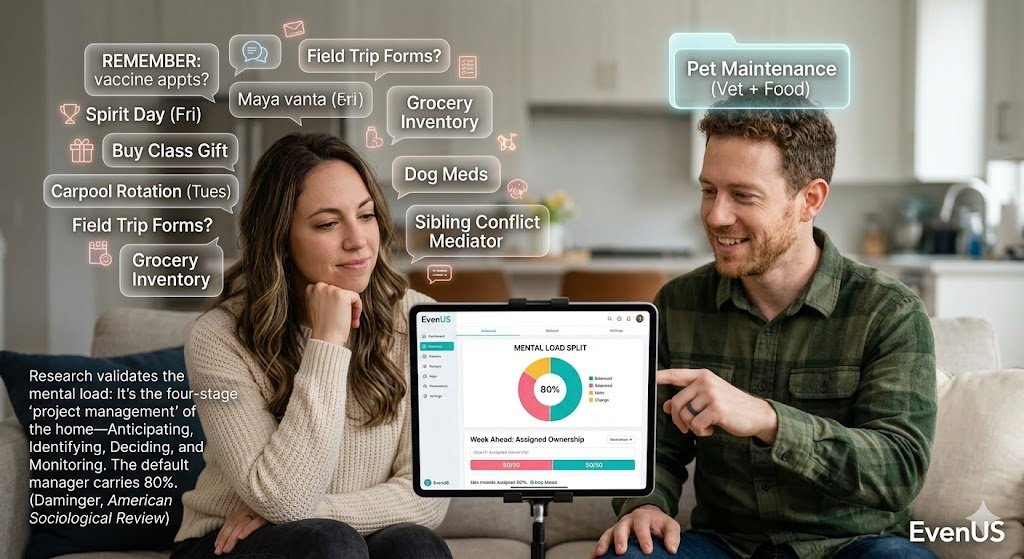
In many modern households, there is a “ghost in the machine.” On the surface, the partnership looks equitable: both partners work full-time, they split the mortgage 50/50, and they both “help” with the kids. Yet, one partner is thriving—pursuing hobbies, sleeping soundly, and staying focused at work—while the other is drowning in a sea of details that the other doesn’t even see.
This isn’t a lack of effort; it is a lack of visibility. This phenomenon is known as Invisible Labor. It is the behind-the-scenes work that keeps a family running—the logistics, the emotional monitoring, and the “mental stocking” of the home. Because it cannot be seen, it is rarely valued, leading to a “Resentment Gap” where one partner feels like a martyr and the other feels like they are being nagged for no reason.
To save the modern relationship, we have to make the invisible, visible.
The Three Pillars of Invisible Labor
Invisible labor is more than just a long to-do list. It is a multi-layered cognitive and emotional burden that can be broken down into three primary pillars.
1. Cognitive Labor (The Logistics)
This is the “Project Management” of the home. It is the active tracking of every moving part in the family ecosystem. It’s knowing that the kids need a specific permission slip signed by Wednesday, that the car insurance is due for renewal on the 15th, or that the toddler is about to outgrow their current diaper size. It is the “RAM” of the household.
2. Emotional Labor (The Vibes)
Often confused with the mental load, emotional labor is the work of managing the family’s feelings and interpersonal dynamics. It’s being the “Peacemaker” during a sibling fight, the “Mood Monitor” for a partner after a stressful day, or the “Social Secretary” who ensures that birthdays are remembered and friends feel appreciated.
3. Anticipation Labor (The Foresight)
This is the most taxing pillar because it requires looking into the future. It is the ability to see a problem before it happens. It’s realizing that “if I don’t buy the birthday gift now, it won’t arrive in time for the party in two weeks.” It is the constant scanning of the horizon for upcoming needs.
Why Traditional “Chore Splitting” Fails
Most couples try to solve household inequality by splitting physical tasks: “I’ll cook, you clean.” While this sounds fair, it ignores the Executive Function required to make those tasks happen.
If Partner A chooses the meal, checks the pantry, buys the ingredients, and finds the recipe, but Partner B just “cooks” it, the labor is not 50/50. It is closer to 90/10. Partner A has performed the anticipation, the identification, and the decision-making. Partner B has simply performed the final execution.
Sociologist Allison Daminger from Harvard University highlights this in her research on the four stages of household labor. She found that the “Invisible” stages—Anticipating and Monitoring—are almost always carried by one person, usually the mother.
When the “Manager” has to monitor the “Helper” to ensure the dishes were actually put away or the laundry wasn’t left in the washer to mold, they are still working. This “Monitoring” is a form of labor that is often completely discounted by the partner receiving the instructions.
The Psychological Cost: Default Parent Burnout
The cost of invisible labor isn’t just a messy house; it is a mental health crisis. When one person’s brain is constantly “on,” they experience a neurological phenomenon known as the Zeigarnik Effect.
The brain is biologically wired to “loop” on unfinished tasks. For the partner carrying the invisible load, the loops never close. This leads to chronic insomnia, “brain fog,” and a state of hyper-vigilance. This is why many women experience a “Maternal Wall” at work—not because they lack ambition, but because their mental “RAM” is already 95% full before they even walk into the office.+1
How to Make the Invisible, Visible
If you want to stop the cycle of resentment, you have to move from a “Manager-Employee” dynamic to a “Co-Owner” model.
1. The “Invisible Audit”
Spend one week writing down every time you “noticed” or “remembered” something for the family. Do not include physical chores. Only include the thoughts: “Noticed we were out of milk,” “Remembered it’s library day,” “Worried about the kid’s social anxiety.” Presenting this list to a partner is often a “lightbulb moment” that validates the manager’s exhaustion.
2. Minimum Standards of Care (MSC)
Resentment often stems from a lack of trust. If the manager doesn’t trust the partner to do the job “right,” they will continue to monitor it. Agree on a “Minimum Standard of Care” for every zone. Once the standard is set, the manager must step back, and the owner must step up.
3. Ownership Over Assistance
The word “help” should be retired from your household vocabulary. You don’t “help” with your own life. Shift the narrative to Total Ownership. If a partner owns the “Groceries Zone,” they own the list-making, the coupon-clipping, the shopping, and the putting away. The other partner should never have to think about a grocery item again.
Bring the Invisible Into the Light with EvenUS
You cannot fix what you cannot see, and you cannot measure what you don’t track. Most “to-do” apps only track the execution—the physical task. EvenUS is the first Household Operating System designed to track the Cognitive Load.
EvenUS doesn’t just show that the dishes were done; it shows who planned the week’s meals. It visualizes the invisible stages of labor, allowing couples to have data-driven conversations rather than emotion-driven arguments. By integrating your shared finances with your household contributions, EvenUS creates a holistic “Fairness Score” that ensures the invisible work finally gets the credit it deserves.
Stop letting invisible labor destroy your partnership. Reclaim your mental space and share the true weight of your life together.
Research Reference
This article is grounded in the sociological study of gendered labor and cognitive dimensions.
- Key Paper: “The Cognitive Dimension of Household Labor” by Allison Daminger.
- Journal: American Sociological Review (2019).
- Link: Read the full research paper here