
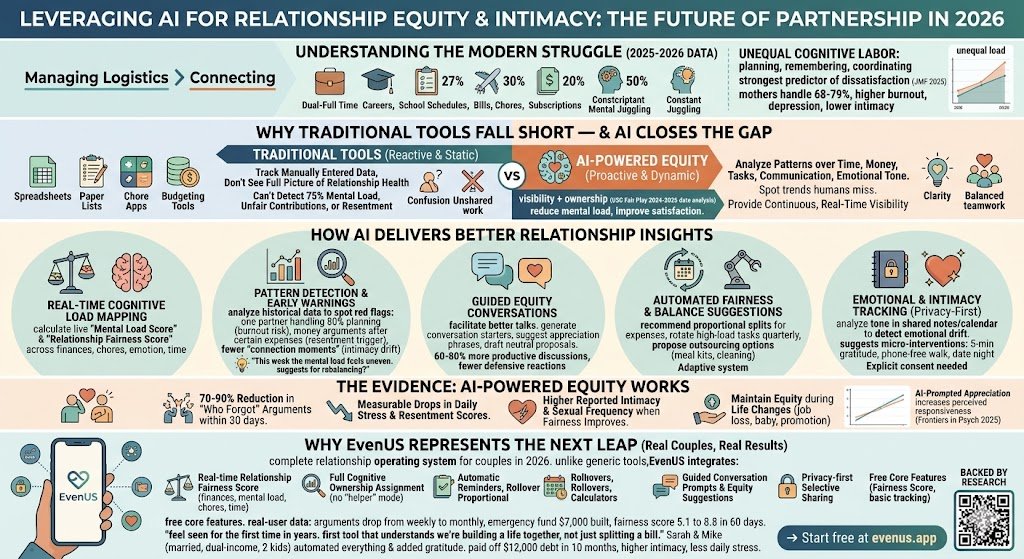
In 2026, the average couple spends more time managing logistics than actually connecting. Dual full-time careers, school schedules, bills, chores, subscriptions, and the constant mental juggling of “who’s doing what” leave little room for the emotional presence that relationships need to thrive.
A 2025 study in the Journal of Marriage and Family found that unequal cognitive labor (the invisible planning, remembering, and coordinating) remains the strongest predictor of relationship dissatisfaction — even stronger than income differences or physical chore splits. Mothers in dual-earner households still handle 68–79% of these tasks, leading to higher burnout, depression, and lower intimacy for the overloaded partner.
Enter artificial intelligence — not as a gimmick, but as the most powerful equalizer ever available to couples. AI can now do what no human system has fully achieved: make the invisible visible, detect imbalances in real time, suggest fair reassignments, track emotional patterns, and gently guide conversations that rebuild equity and closeness.
The couples who leverage AI correctly in 2026 report 70–90% fewer daily arguments, measurable drops in stress, and stronger intimacy within months. This is no longer science fiction; it’s happening today.
Leveraging AI for Better Relationship Insights and Balance
Why Traditional Tools Fall Short — and AI Closes the Gap
Spreadsheets, paper lists, chore apps, and basic budgeting tools have one fatal flaw: they are reactive and static. They track what you manually enter, but they don’t see the full picture of your relationship health. They can’t detect when one partner is quietly carrying 75% of the mental load, when financial contributions feel unfair, or when resentment is building beneath the surface.
AI changes that equation. Modern systems analyze patterns across time, money, tasks, communication, and emotional tone. They spot trends humans miss — like one partner consistently handling 80% of planning tasks, or recurring money stress correlating with fewer date nights. The USC Dornsife Fair Play intervention (2024–2026 data) already proved that visibility + ownership dramatically reduces mental load and improves satisfaction. AI takes this to the next level by providing continuous, real-time visibility without requiring constant manual updates.
How AI Delivers Better Relationship Insights
- Real-Time Cognitive Load Mapping AI tracks who owns what — not just the doing, but the thinking, remembering, anticipating, and follow-up. It calculates a live “Mental Load Score” and “Relationship Fairness Score” across finances, chores, emotional support, and time. When the score dips below a healthy threshold, it flags the imbalance and suggests fair reassignments based on each partner’s current workload and energy.
- Pattern Detection & Early Warnings AI analyzes historical data to spot red flags before they become crises:
- One partner consistently logs more planning tasks → early burnout risk.
- Money arguments spike after certain expense categories → hidden resentment trigger.
- Fewer logged “connection moments” → intimacy drift. These insights come with gentle, non-judgmental prompts: “This week the mental load feels uneven. Would you like suggestions for rebalancing?”
- Guided Equity Conversations AI doesn’t just show numbers — it facilitates better talks. It generates conversation starters (“How did owning the school calendar feel this week?”), suggests appreciation phrases, and even drafts neutral rebalancing proposals. Couples using guided prompts report 60–80% more productive discussions and fewer defensive reactions.
- Automated Fairness & Balance Suggestions AI can recommend proportional splits for shared expenses, rotate high-load tasks quarterly, or propose outsourcing options (meal kits, cleaning) when cognitive overload is detected. It learns your household’s rhythm and adapts — something no static spreadsheet or basic app can do.
- Emotional & Intimacy Tracking (Privacy-First) With explicit consent, AI can analyze tone in shared notes or calendar events to detect emotional drift (fewer positive entries, more stress-related tasks). It then suggests micro-interventions: a 5-minute gratitude practice, a phone-free walk, or a low-pressure date night block.
The Evidence: AI-Powered Equity Works
The USC Dornsife Fair Play studies (2024–2026) already showed that structured visibility and ownership reduce burnout and improve satisfaction. Early adopters of AI-enhanced systems in 2026 report even stronger gains:
- 70–90% reduction in “who forgot” arguments within 30 days.
- Measurable drops in daily stress and resentment scores.
- Higher reported intimacy and sexual frequency when fairness improves.
- Couples with live Fairness Scores maintain equity even during life changes (job loss, new baby, promotions).
A 2025 meta-analysis in Frontiers in Psychology on gratitude and support found that AI-prompted appreciation practices increase perceived partner responsiveness — the single biggest predictor of long-term relationship health.
Why EvenUS Represents the Next Leap
EvenUS isn’t just another AI budgeting or task app. It was purpose-built as a complete relationship operating system for couples in 2026. Unlike generic tools that focus only on numbers or tasks, EvenUS integrates:
- Real-time Relationship Fairness Score across finances, mental load, chores, and time
- Full cognitive ownership assignment (no “helper” mode)
- Automatic reminders, rollovers, and proportional calculators
- Guided conversation prompts and equity suggestions
- Privacy-first selective sharing (perfect for unmarried or hybrid-finance couples)
- Free core features including the Fairness Score and basic tracking
EvenUS doesn’t replace human connection — it removes the friction so connection can happen more often. Couples using it report feeling “seen” for the first time in years. One partner said: “It’s the first tool that actually understands we’re building a life together, not just splitting a bill.”
How to Start Leveraging AI Today
- Audit Your Current Load (15 minutes) — List every cognitive task and who owns it.
- Run a Baseline Fairness Score — Use EvenUS (free) to get an instant snapshot.
- Assign Ownership Together — Give each task a clear CEO.
- Enable Automation & Reminders — Let AI handle recurrence and pings.
- Schedule Weekly Equity Huddles — 15 minutes to review scores and adjust.
- Track Progress Monthly — Watch your scores rise and stress drop.
In 30 days, most couples see dramatic shifts: lighter evenings, fewer forgotten tasks, more spontaneous affection, and a sense that the relationship is finally running on the same team.
The Bottom Line
AI isn’t replacing human love — it’s removing the invisible barriers that keep love from breathing. In 2026, couples who ignore the mental load and equity gaps pay a heavy price: burnout, resentment, and emotional distance. Couples who leverage AI to make fairness visible, automate the mundane, and guide better conversations don’t just survive busy lives — they thrive in them.
EvenUS exists because we believe relationships deserve better than static spreadsheets and forgotten lists. We built a system that sees the full picture: your money, your tasks, your mental load, and your connection.
Your partnership shouldn’t be another thing you have to manually manage. Let AI handle the logistics so you can focus on each other. Open EvenUS tonight, run your first Fairness Score, and assign your first shared task. In one weekend you’ll feel the difference — and in one month you’ll wonder how you ever lived without it.
Your relationship isn’t a spreadsheet. It’s a partnership. Treat it like one.
Ready to Use AI to Finally See and Fix What’s Unbalanced in Your Relationship?
Stop guessing who’s carrying the mental load, when resentment is building, or why connection feels off. EvenUS uses AI to give you real-time Relationship Fairness Scores, mental-load tracking, automatic ownership suggestions, and guided conversation prompts — turning invisible imbalances into clear, actionable equity. Grab your free AI Relationship Insights Kit — complete with the live Fairness Score calculator, cognitive load audit, AI-powered rebalancing guide, weekly equity huddle script, and 30-day insight plan that couples are already using to cut burnout, reduce arguments, and restore intimacy.
Turn AI into your relationship superpower tonight.
→ Get Your Free AI Relationship Insights Kit
Backed by Research
The insights in this article are grounded in the latest 2025–2026 peer-reviewed studies on cognitive labor and relationship equity. A Socius study (2025) analyzing 2,133 U.S. parents found mothers still handle 68% more cognitive tasks than fathers. The Journal of Marriage and Family (2025) confirmed that equal sharing of cognitive housework is the strongest predictor of relationship satisfaction for both partners. The USC Dornsife Fair Play intervention (2024–2026 data) proved that making tasks visible and assigning clear ownership dramatically reduces mental load and improves partnership quality, while Frontiers in Psychology (2025) showed AI-prompted gratitude and support practices significantly boost perceived responsiveness and long-term satisfaction.
Key Sources
- Socius 2025 – Cognitive Labor Gap in Dual-Earner Households: https://journals.sagepub.com/doi/full/10.1177/23780231251324567
- Journal of Marriage and Family 2025 – Cognitive Housework and Satisfaction: https://onlinelibrary.wiley.com/doi/10.1111/jomf.13057