
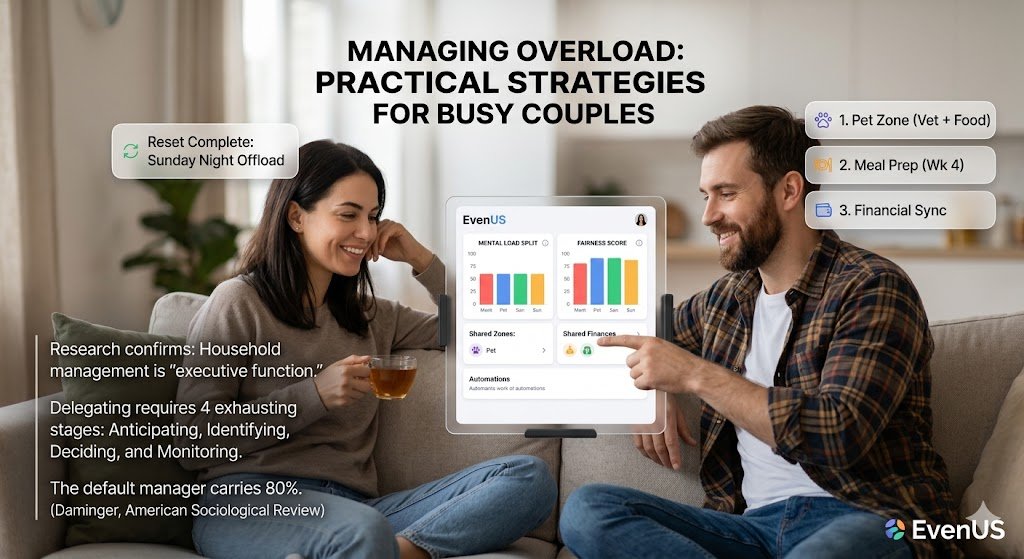
Managing Mental Load Overload- If you have ever felt like you are the only person in your home who knows where the spare lightbulbs are, when the dog’s vaccinations are due, or that it is “spirit week” at school, you are carrying the Mental Load.
For busy couples, this isn’t just a minor annoyance; it is a primary driver of relationship friction and individual burnout. The mental load—the invisible “project management” of the home—is constant, exhausting, and statistically lopsided.However, it does not have to be your permanent reality. By applying structural, research-backed strategies, you can reclaim your mental “RAM” and move toward a partnership of true co-owners.
Managing Mental Load Overload
1. Make the Invisible Visible: The “Mental Audit”
The greatest challenge with the mental load is that you cannot share what you cannot see. Most partners aren’t intentionally avoiding work; they are simply blind to the sheer volume of cognitive labor happening in the background. Sociologists call this “the invisible second shift.”
The Strategy: Spend three days performing a “Mental Audit.” Every time you “remember” a family task, “notice” a household need, or “anticipate” a future logistical problem, write it down.
- Example: “Noticed the toddler is outgrowing their shoes,” or “Remembered the utility bill is due Friday.”
At the end of the week, sit down and show this list to your partner. This isn’t about blaming; it’s about validation. Seeing 50 “invisible” tasks on paper is often the “lightbulb moment” a partner needs to realize why you are so exhausted even when the physical chores (like dishes) are finished.
2. Implement the “Ownership Model” (Not the “Help” Model)
The word “help” is a relationship red flag. It implies that the household is one person’s responsibility and the other is just a temporary volunteer. To fix the mental load, you must switch to Total Ownership.
In this model, you divide the home into Zones (e.g., The Kitchen, Pet Care, Kid’s Logistics). When a partner owns a zone, they own all four stages of labor as defined by sociologist Allison Daminger in her landmark research:
- Anticipating: Noticing the need before it becomes a crisis.
- Identifying: Researching the best solutions or options.
- Deciding: Making the final choice on how to proceed.
- Monitoring: Ensuring the task is completed to the agreed standard.
If you own the “Grocery Zone,” your partner should never have to tell you the milk is low. You are responsible for noticing, buying, and restocking.
3. Establish a “Minimum Standard of Care” (MSC)
A common barrier to sharing the load is “Gatekeeping”—where the manager re-does the partner’s work because it wasn’t done “correctly.” This results in the manager still carrying the mental load of monitoring, which defeats the purpose of delegating.
The Strategy: For every zone, agree on a Minimum Standard of Care. * Example: For the “Laundry Zone,” the MSC might be: “Clothes are washed, dried, folded, and placed on the bed by Sunday night.”
Once the MSC is agreed upon, the non-owner is strictly forbidden from “checking in” or criticizing. As long as the MSC is met, the owner has total autonomy. This allows the non-owner to truly “delete” that category from their brain.
4. Close the “Open Loops” (Combat the Zeigarnik Effect)
The human brain is biologically wired to “loop” on unfinished tasks, a phenomenon known as the Zeigarnik Effect. This prevents your nervous system from entering a state of rest because your subconscious is constantly scanning for what might fall through the cracks.
The Strategy: Externalize your family’s data. Our brains are for having ideas, not holding them. Use a shared digital system—like a dedicated tracker—to store the “remembers.” Once a task is logged and assigned to a partner, your brain receives a “signal” that the task is handled by the “system,” allowing the loop to close and your cortisol levels to drop.
5. The “Sunday Reset” Sync
Communication is the glue that holds these strategies together. Busy couples often fall into “triage mode,” only talking about logistics when a crisis occurs (e.g., “Why didn’t anyone sign this form?”).
The Strategy: Schedule a non-negotiable, 20-minute Sunday Reset. During this time:
- Audit the Week: Review the upcoming calendar (doctor’s visits, late work nights, carpool needs).
- Trade Zones: If one partner has a massive work deadline, they might trade the “Meal Prep Zone” for a lighter task that week to maintain overall balance.
- The Brain Dump: Use this time to offload anything currently “looping” in your head into your shared digital dashboard.
Reclaim Your Peace with EvenUS
Managing the mental load shouldn’t be your second full-time job. EvenUS is the first Household Operating System designed specifically to automate these strategies for couples.
EvenUS visualizes the cognitive split, assigns total zone ownership, and provides a neutral Fairness Score based on both your financial and logistical contributions. By moving the “family brain” out of your head and into the app, EvenUS allows both partners to finally “clock out” and just be a couple again.
Stop managing and start partnering. Rebalance your household with the EvenUS Fairness Score today.
The Research Reference
This article is grounded in the sociological research of Allison Daminger regarding the cognitive dimensions of labor and the gendered nature of household management.
- Study: “The Cognitive Dimension of Household Labor”
- Published in: American Sociological Review (2019)
- Key Finding: Daminger’s study identifies that the “anticipatory” and “monitoring” stages of household work are the most likely to be performed by women, regardless of their employment status or income.
- Link: Read the full research paper here