
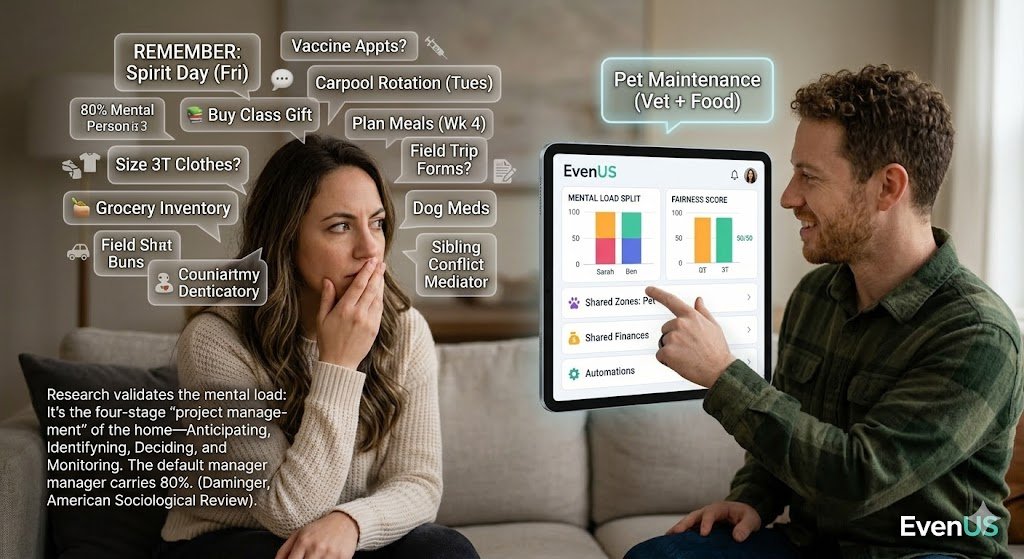
The Mental Load in Relationships -Imagine two partners sitting on the porch at the end of a long Sunday. Partner A has spent the afternoon mowing the lawn and washing the car—physical, visible tasks with a clear beginning and end. Partner B has been sitting on the sofa with a laptop. To the casual observer, Partner A did the “work,” while Partner B relaxed.
In reality, Partner B was managing the family’s entire logistical ecosystem. They were cross-referencing the school calendar with work deadlines, noticing the toddler needs new shoes before the rainy season starts, researching pediatricians that accept their new insurance, and mentally planning five nights of nutritious meals that everyone will actually eat.
By the time the sun sets, Partner A is physically tired but mentally clear. Partner B is “fried”—experiencing a level of cognitive exhaustion that sleep cannot fix. This is the reality of the Mental Load, the invisible full-time job of “Household Project Management” that remains one of the most significant sources of friction in modern relationships.
What is the Mental Load? The “Invisible” Labor (The Mental Load in Relationships )
The mental load is not about the physical execution of chores like vacuuming or doing the dishes. It is the cognitive laborrequired to manage a household and a family. It is the “thinking” that precedes the “doing.”
While physical chores are visible and easily tracked, mental labor is internal and constant. It involves a never-ending stream of micro-decisions and “remembers”:
- Remembering it’s library book day.
- Noticing the trash bags are down to the last two.
- Anticipating that a growth spurt means a wardrobe refresh is needed.
- Monitoring whether the vet appointment was actually confirmed.
Because this labor happens inside one person’s head, it often goes unthanked and, more importantly, unshared. When one partner carries the majority of this load, they become the “Default Parent” or the “Household Manager,” while the other partner becomes the “Helper”—a dynamic that inevitably leads to burnout and resentment.+1
Read the full research paper here
Why Is the Mental Load So Exhausting?
If you feel more tired from “thinking” than from “doing,” science backs you up. The mental load is uniquely draining for three specific reasons:
1. Decision Fatigue
Every time you make a choice—even a small one like “what should we have for dinner?”—you deplete a limited well of mental energy. In a household, the manager makes hundreds of these micro-decisions before noon. By the evening, the brain’s “executive function” is depleted, leading to irritability and an inability to focus on anything else.
2. The “Always On” State
Unlike a job or a physical chore, the mental load has no “off” switch. It is a background app on your phone that never closes, slowly draining your battery throughout the day. You are thinking about the grocery list while in a work meeting; you are worrying about a child’s social dynamics while trying to sleep.
3. The Zeigarnik Effect
The human brain is biologically wired to “loop” on uncompleted tasks. This is known as the Zeigarnik Effect.
When you have ten “open loops” (unfinished tasks) in your head, your brain remains in a state of low-level stress until those loops are closed. For the partner carrying the mental load, the loops never truly close, preventing the nervous system from ever entering a state of deep rest.
The Four Stages of Cognitive Labor: The “Management” Trap
To understand why “helping out” isn’t enough, we have to look at how labor is actually structured. Sociologists, such as Allison Daminger in her landmark study, break down household labor into four distinct stages:
- Anticipating: Noticing a need (The dog is low on heartworm meds).
- Identifying: Researching the options (Where is the cheapest place to refill the prescription?).
- Deciding: Choosing the path (Ordering from the online pharmacy).
- Monitoring: Ensuring completion (Checking the mail to see if it arrived).
The “Helper” in a relationship usually only jumps in at stage 3 or 4. They wait for the “Manager” to do the heavy lifting of anticipating and identifying. If you have to ask your partner to do something, you have already done 75% of the work. This is why “Just tell me what to do” feels like a burden, not a blessing—it requires the manager to keep the task in their head and supervise its execution.
3 Signs of an Imbalanced Mental Load
If you aren’t sure if your relationship has a mental load problem, look for these three red flags:
- The Manager-Employee Dynamic: One person feels responsible for the “big picture,” while the other waits for instructions.
- The “Delegation Tax”: You find yourself saying, “It’s just easier if I do it myself,” because explaining the task feels like more work than the task itself.
- Leisure Gap: One partner has true “leisure time” where they are completely disconnected, while the other partner is “on call” even during their breaks.
How to Move Toward Shared Ownership
Transitioning from “Manager and Helper” to “Co-Owners” requires more than just a chore chart. It requires a fundamental shift in how you view your partnership.
Step 1: Make the Invisible Visible
You cannot share what you cannot see. Sit down with your partner and list the management tasks of your home. Include things like “social calendar management,” “financial planning,” and “emotional regulation of the children.” Seeing the list on paper (or a screen) validates the manager’s exhaustion and opens the helper’s eyes to the scale of the work.
Step 2: Assign “Total Ownership” (Zones)
Stop delegating micro-tasks. Instead, assign entire Zones. If a partner owns the “Pet Zone,” they own all four stages: they anticipate the vet visits, they identify the best food, they decide on the groomer, and they monitor the health records. Once a zone is assigned, it must completely leave the other partner’s brain.
Step 3: Establish a Minimum Standard of Care
Resentment often grows when a task is “done” but not to the expected standard. Agree on what “done” looks like for each zone. When you both agree on the standard, the manager can stop “monitoring,” and the owner can work with autonomy.
Stop Managing, Start Partnering with EvenUS
The 21st-century household is too complex to manage with 19th-century methods. You cannot solve a cognitive imbalance with a paper list that only one person looks at. You need a digital “Household Operating System.”
EvenUS was designed specifically to solve the mental load crisis. It is a neutral, objective platform that:
- Visualizes the Invisible: It tracks who is anticipating and deciding, showing the true cognitive split in your relationship.
- Automates the Memory: It stores the “remembers”—the birthdays, the bills, the school forms—so neither partner has to carry them in their head.
- Syncs Finances and Labor: It creates a holistic “Fairness Score” by integrating your shared finances with your household contributions, ensuring both partners feel valued.
Reclaim your mental space. Stop being the sole manager of your family’s ecosystem and start operating as a true team.
Rebuild your partnership and close the “open loops” in your brain. Try the EvenUS Fairness Demo today.