
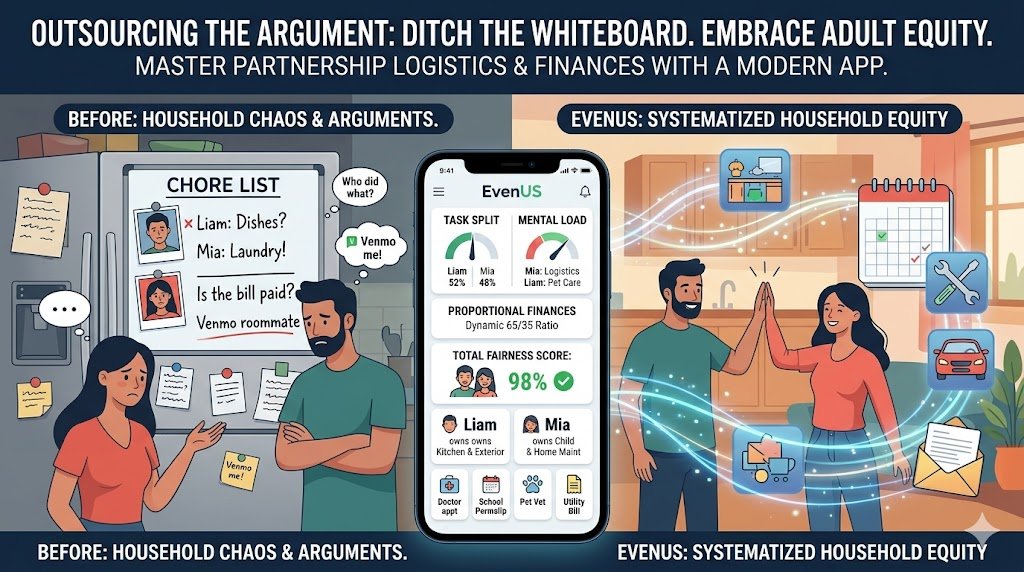
Outsourcing the Argument- When most couples hear the phrase “outsourcing domestic labor,” they immediately envision upper-middle-class luxuries: hiring a bi-weekly housekeeper, paying a premium for a meal delivery service, or sending the laundry out to a wash-and-fold service. While throwing money at a problem to reclaim your weekend is a fantastic strategy if your budget allows for it, it completely misses the root cause of domestic friction.
You cannot buy your way out of the mental load. A housekeeper will not schedule the dog’s vet appointment, a meal kit will not remember your mother-in-law’s birthday, and a laundry service will not manage the household utility budget.
For the modern dual-income couple, the most valuable thing you can outsource is not the physical chore itself. It is the argument.
If you and your partner find yourselves in a perpetual, simmering standoff over who last emptied the dishwasher, who paid for the last three grocery runs, or who is carrying the brunt of the household planning, you do not necessarily have a relationship problem. You have a systems problem. Here is an in-depth look at why moving your household management off the refrigerator whiteboard and into a dedicated, couple-oriented app is the ultimate hack for preserving your peace, protecting your intimacy, and building true relationship equity.
Outsourcing the Argument: Why Modern Couples Need an App for Household Tasks
1. Escaping the Toxic “Manager vs. Employee” Dynamic
In the absence of a unified, automated system, human nature dictates that one partner will eventually step up to become the default “Household Project Manager.” This partner holds the master mental checklist of what needs to be done, when it is due, and how it should be executed.
This creates a disastrous power dynamic. The Project Manager is forced into the exhausting, unromantic role of delegating tasks and following up to see if they were completed—a behavior that is often labeled as “nagging,” but is actually just desperate project management. The other partner, reacting to being constantly directed, shifts into an “Employee” mindset. They stop taking initiative, wait to be told what to do, and feel micromanaged in their own home.
How Software Neutralizes the Threat: A shared household app acts as a neutral, emotionless third party. When a notification pops up on a Tuesday evening reminding the household that the HVAC filter needs changing or the property tax is due, the app is the entity doing the “nagging,” not you.
By outsourcing the reminder system to an app, you remove the interpersonal friction. You are no longer managing your partner; the system is managing the house. You get to return to being romantic partners navigating life side-by-side, rather than a boss trying to wring productivity out of a reluctant employee.
2. Validating the Invisible Burden of Cognitive Labor
The most vicious arguments in a relationship are rarely about physical tasks; they are about cognitive labor. Sociological research, most notably the work of Harvard’s Allison Daminger, has categorized this invisible work—often called the “Mental Load”—into four distinct phases:
- Anticipating: Realizing a need exists (e.g., noticing the six-year-old’s shoes are getting too tight).
- Identifying: Researching the solutions (e.g., finding a brand that makes durable shoes for wide feet).
- Deciding: Making the final executive choice (e.g., choosing the color and size to order).
- Monitoring: Ensuring the task is closed (e.g., making sure the shoes actually fit when they arrive, and handling the return if they do not).
If Partner A handles 100% of this cognitive labor, but Partner B physically clicks “Buy” on the website, Partner B might look at their physical output and assume they are doing “their half.” Partner A, meanwhile, is burning out from decision fatigue and feels entirely unseen.
How Software Validates the Effort: A static to-do list or a shared Apple Note only tracks physical completion. It cannot measure the hours spent researching or planning. A purpose-built relationship equity tool fundamentally changes this by allowing couples to explicitly track the logistical load. When the planning and management phases of a household are logged alongside the physical chores, the invisible work finally becomes visible. It provides tangible, objective data that validates the partner carrying the mental load, ending the “I do everything around here” argument with actual metrics.
3. Defeating “Availability Bias” and the Scoreboard
The human brain is spectacularly bad at accurately judging fairness in a relationship due to a cognitive glitch known as Availability Bias.
You are intimately aware of every dish you wash, every floor you vacuum, and every frustrating phone call you make to the internet provider. Because you physically lived through the effort, that labor is highly “available” to your memory. Conversely, you are completely blind to the mental fatigue your partner experiences when they balance the budget or the friction they face when they run an errand while you are not there.
Because of this bias, if you ask two partners what percentage of the household work they do, the combined total will almost always exceed 120%. Both people genuinely believe they are doing the lion’s share.
How Software Fixes Our Memory: When you try to keep score in your head, Availability Bias ensures you will always feel cheated. An app replaces your flawed human memory with an immutable digital ledger. When all tasks, time spent, and financial contributions are logged in a central location, it bypasses the brain’s bias. You can look at the dashboard and objectively see your partner’s contributions, fostering gratitude rather than resentment.
4. The End of the “Venmo Roommate”
Household management is inextricably linked to household finances. For modern couples—especially Millennials and Gen Z who increasingly choose to keep separate bank accounts to maintain their financial autonomy—the process of manually splitting shared bills creates a highly transactional, unromantic vibe.
Sitting down at the kitchen table at the end of the month with a spreadsheet, a calculator, a stack of grocery receipts, and a history of Venmo requests to “settle up” feels more like a corporate audit than a marriage. Furthermore, standard 50/50 splits often create systemic financial inequality if the partners earn vastly different incomes. The lower earner feels suffocated by their “half” of the rent, while the higher earner builds discretionary wealth.
How Software Automates Equity: A sophisticated app replaces manual financial scorekeeping with dynamic, automated math. By inputting your incomes, the software can establish a fair, income-proportional ratio. It tracks shared expenses in the background and calculates exactly where the balance lies in real-time, completely eliminating the “Venmo Roommate” dynamic.
5. Why Spreadsheets and Generic Notes Apps Fail
Many couples attempt to digitize their household using Google Sheets, Notion boards, or Apple Notes. While this is a step up from a physical whiteboard, it almost always fails within a few months.
Why? Because manual data entry is just another chore.
If your household system requires you to sit down every Sunday night, manually update a spreadsheet, input receipt totals, and re-assign tasks, you are simply trading physical labor for administrative labor. Generic tools lack the automation, dynamic balancing, and relationship-focused frameworks required to actually reduce friction.
The Ultimate Solution: Systematized Harmony with EvenUS
You do not need another generic to-do list app designed for college roommates; you need a tool engineered specifically for the complex architecture of a committed romantic partnership.
This is the exact philosophy and core function behind EvenUS. Built exclusively for couples, EvenUS elevates household management from a tedious list of chores to a comprehensive view of your partnership’s equity.
- The Virtual Joint Ledger: EvenUS allows you to maintain your separate bank accounts while acting as your shared financial brain, automatically tracking shared spending and calculating dynamic proportional ratios.
- Log the Invisible: It is uniquely designed to capture the full spectrum of household management, allowing you to log not just physical tasks, but the time and cognitive energy spent managing the home.
- The Total Fairness Score: EvenUS synthesizes your financial contributions, time spent, and domestic labor into a single, unified view. It effectively outsources the math, the memory, and the friction.
When you stop relying on your partner to be your administrative assistant and start relying on a unified digital system, you free up the emotional bandwidth required to actually enjoy your relationship. By outsourcing the argument to EvenUS, you protect your individual identities, preserve your energy, and actively choose to build a truly balanced partnership.
The “Manager vs. Employee” Dynamic & Marital Satisfaction: