
Preventing Burnout from Mental Load in Long-Term Relationships
In long-term relationships, burnout rarely arrives with a bang. It doesn’t usually stem from a single, catastrophic argument or a momentary lapse in judgment. Instead, it is the result of a “slow leak”—the cumulative, years-long exhaustion of carrying the Mental Load for an entire family ecosystem.
When one partner acts as the sole “Project Manager,” “Chief Operating Officer,” and “Social Secretary” of the home, they eventually reach a state of decision fatigue and emotional detachment. This isn’t just “being tired”; it is a clinical state of depletion that threatens the very foundation of the partnership. To prevent this burnout, couples must move beyond “helping” and toward a fundamental restructuring of how they manage their shared life.
1. Recognizing the Symptoms of Mental Load Burnout
Before a system can be fixed, the problem must be named. Mental load burnout in a relationship often mimics professional burnout but with a deeper, more personal sting. Because the “office” is also your sanctuary, there is no physical space to escape the demands.
The “Touch-Out” Effect
One of the most common signs of mental load burnout is sensory and cognitive overstimulation. By the time the kids are in bed and the logistics of the next day are mapped out, the manager’s brain has no “RAM” left for intimacy. Physical touch or even a simple conversation can feel like “one more demand” on a depleted system.
Resentment as a Baseline
In a healthy dynamic, forgetting to buy milk is a minor inconvenience. In a burnt-out dynamic, it is a moral failing. The manager feels intense anger not because of the milk, but because the milk represents another “loop” they now have to close. When resentment becomes your default setting, the relationship is in the “Burnout Red Zone.”
The “Easier to Do It Myself” Trap
This is the final stage of burnout. The manager has stopped asking for participation because the Delegation Tax—the mental energy required to explain, remind, and monitor the task—feels more expensive than simply doing the work while exhausted. This leads to a cycle of martyrdom that is socially isolating and emotionally destructive.
2. Shift from “Tasks” to “Cognitive Ownership”
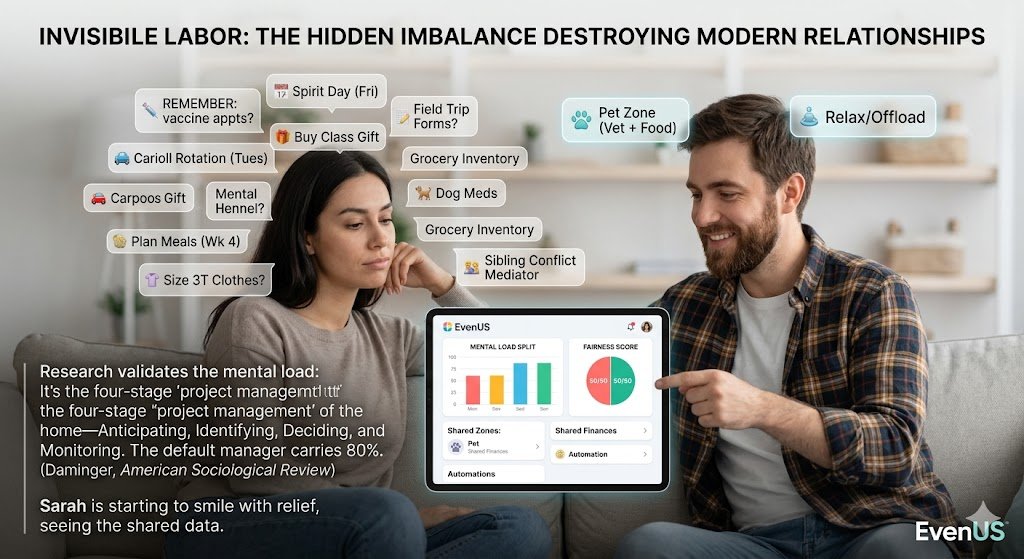
The most common mistake couples make is splitting physical chores while leaving the cognitive labor with the default manager. If Partner A vacuums, but Partner B had to notice the floor was dirty and ask Partner A to do it, Partner B is still working.
To prevent burnout, you must transition to Total Ownership. This concept, popularized by the “Fair Play” methodology and validated by sociological research, requires the “Helper” to take over all four stages of labor.
The Four Stages in Action:
Sociologist Allison Daminger identifies these stages as:
- Anticipating: Noticing the need (e.g., “The dog is limping”).
- Identifying: Researching solutions (e.g., “Finding a vet with Saturday hours”).
- Deciding: Making the call (e.g., “Booking the 10:00 AM appointment”).
- Monitoring: Following through (e.g., “Giving the prescribed meds for 7 days”).
Burnout occurs when one partner does stages 1, 2, and 4 for every single task in the house. True prevention happens when “Zones” are handed over completely. If you own the “Pet Zone,” your partner should never have to think about a dog bowl again.
3. Combat the Zeigarnik Effect: Close the “Open Loops”
Our brains are biologically wired to “loop” on unfinished tasks. This is known as the Zeigarnik Effect. For the partner carrying the mental load, these loops never close, meaning their nervous system stays in a constant state of low-level “fight or flight.” You cannot recover from burnout if your brain is constantly scanning for what might fall through the cracks.+1
The Strategy: Externalize the Family Brain
The human brain is for having ideas, not holding them. To prevent burnout, you must move the family’s operating system out of your head and into a neutral, external space.
- Map, Don’t Memorize: Use a shared digital dashboard to store the “remembers”—birthdays, school spirit days, and utility bills.
- Automate the “Nag”: Use a system that provides the notifications. When an app reminds your partner that it’s their turn for carpool, it removes the “Manager-Employee” friction and allows the manager to finally “clock out.”
4. Establish a “Minimum Standard of Care” (MSC)
Burnout is often exacerbated by Gatekeeping. This happens when the manager re-does a partner’s work because it wasn’t done “the right way.” If you re-fold the laundry after your partner finishes, you haven’t actually offloaded the mental stress; you’ve just added a monitoring task to your list.
The Strategy: The MSC Contract
Sit down and agree on the MSC for your shared zones. If you both agree that “clean kitchen” means the counters are wiped but the floor isn’t mopped until Saturday, then once the counters are wiped, the task is closed. The non-owner is forbidden from monitoring, and the owner is trusted to meet the standard. This trust is the only way to truly transfer the mental load.
5. The “Sunday Reset” Sync: Moving from Triage to Strategy
Busy couples often fall into “triage mode,” only discussing logistics when a crisis occurs. This reactive state is a fast track to burnout.
The Strategy: The 20-Minute Sync
Schedule a non-negotiable Sunday Reset. This is your “Board Meeting.”
- The Brain Dump: List everything currently “looping” in your head.
- Zone Audit: Review the upcoming week. If one partner has a massive work deadline, “trade” a zone for that week to prevent them from hitting a wall.
- Financial Sync: Ensure the family budget is aligned so financial stress isn’t adding to the cognitive weight.
Rebuild Your Partnership with EvenUS
You shouldn’t have to be the human database for your family. EvenUS was designed specifically to prevent relationship burnout by making the invisible visible.
Unlike traditional to-do lists, EvenUS:
- Visualizes the Cognitive Split: It shows who is doing the “noticing” and “deciding,” not just the “doing.”
- Assigns Total Zone Ownership: It facilitates the hand-off of entire categories so you can truly let go.
- Neutralizes the “Nag”: Our automated nudges ensure the system is the source of truth, not the spouse.
- Provides a Fairness Score: By integrating your finances and your labor, EvenUS validates your total contribution, ensuring you never feel like an “unpaid intern” in your own home.
Don’t wait for the burnout to become a breakdown. Reclaim your mental space and return to being partners instead of just roommates.
Research Reference
This strategy is grounded in the sociological research of Allison Daminger (Harvard University) regarding the gendered dimensions of cognitive labor.
- Key Paper: “The Cognitive Dimension of Household Labor”
- Published in: American Sociological Review (2019)
- Key Finding: Daminger’s research highlights that “Anticipating” and “Monitoring” are the two most taxing stages of household labor and are almost always lopsided, leading to the chronic exhaustion of the “Default Manager.”
- Direct Link: Read the full research paper here