
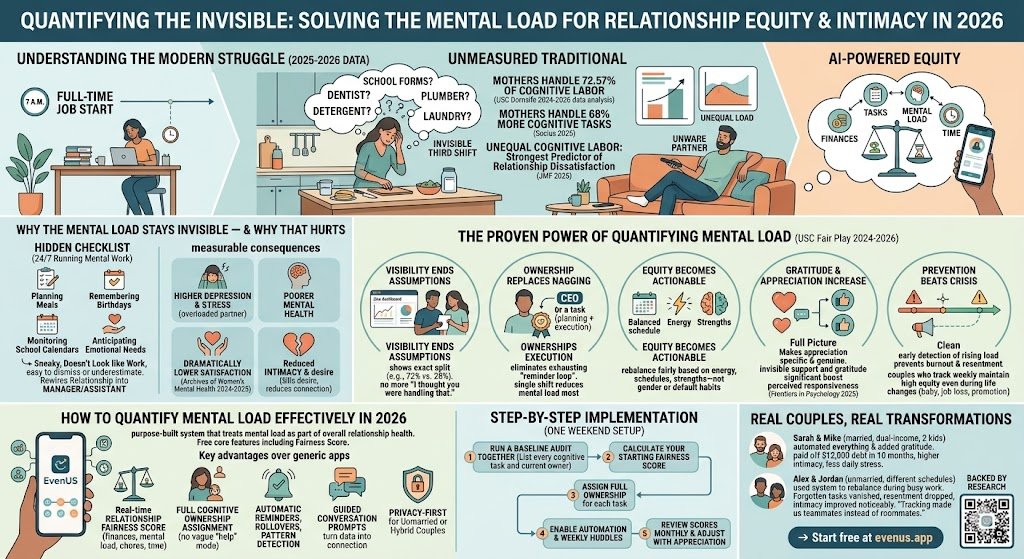
It’s 9:15 p.m. on a Thursday. Both partners have been at full-time jobs since 7 a.m. One is finally unwinding on the couch with a show. The other is standing at the kitchen counter, mentally rehearsing tomorrow: “Schedule the dentist for the kids, add detergent to the grocery list, confirm the school permission slip, remember to call the plumber, and make sure the laundry is folded before Friday.” No argument erupts. No doors slam. Yet the quiet calculation is happening: one person is carrying the entire invisible weight of keeping life running while the other relaxes.
This is the mental load — also known as cognitive labor — the nonstop planning, anticipating, remembering, coordinating, and worrying that keeps households functioning. In 2026, with roughly 50–60% of married-couple families having both spouses employed full-time, this invisible third shift has become the defining stress point for modern relationships. And the data is stark: mothers still shoulder 72.57% of all cognitive household labor compared to their partners (USC Dornsife Public Exchange & Fair Play study,
2024 data analyzed through 2026). A Socius study (2025) of 2,133 U.S. parents found mothers handle 68% more cognitive tasks overall. The Journal of Marriage and Family (2025) confirmed that unequal cognitive labor is the strongest predictor of relationship dissatisfaction — stronger than income gaps or physical chore splits.
The consequences are measurable and painful: higher depression, stress, burnout, poorer mental health, and dramatically lower relationship satisfaction and intimacy for the overloaded partner (Archives of Women’s Mental Health 2024–2025; Petts et al. 2025).
Yet there is a powerful, research-backed solution that too many couples overlook: quantifying the invisible. Tracking and measuring mental load doesn’t add work — it removes resentment, creates equity, and strengthens bonds in ways no vague conversation ever could.
Quantifying the Invisible: Why Tracking Mental Load Strengthens Bonds.
Why the Mental Load Stays Invisible — and Why That Hurts Relationships
Cognitive labor is sneaky because it doesn’t look like work. It’s the mental checklist that runs 24/7: noticing the fridge is low, planning meals around allergies, remembering birthdays, monitoring school calendars, anticipating emotional needs, and coordinating everyone’s schedules. Unlike physical chores (which can be seen and divided), mental load lives in one person’s head — usually the woman’s — making it easy to dismiss or underestimate.
Equity Theory (updated replications 2025–2026) explains the damage clearly: when one partner consistently feels under-benefited relative to their effort, resentment builds, emotional safety erodes, and intimacy fades. The USC Dornsife Fair Play study found mothers reported greater responsibility for cognitive labor in 29 out of 30 household tasks. This imbalance doesn’t just exhaust the overloaded partner — it quietly rewires the relationship into a manager/assistant dynamic rather than a true partnership.
The Journal of Marriage and Family (2025) put it bluntly: equal sharing of cognitive housework is the single strongest predictor of satisfaction for both mothers and fathers. When the load stays invisible and unmeasured, couples operate on assumptions. One feels unseen and resentful; the other feels defensive or unaware. The result is chronic low-grade tension that kills desire, reduces connection time, and increases conflict.
The Proven Power of Quantifying Mental Load
Making the mental load visible and measurable changes everything. The USC Dornsife Fair Play intervention (2024–2026 data) provided causal proof: couples who used structured systems to quantify and assign cognitive tasks saw measurable improvements in women’s mental health, reduced burnout, and higher overall relationship quality. When responsibilities were tracked and owned clearly, the overloaded partner felt seen, the other partner gained empathy, and both reported deeper emotional availability and intimacy.
Why does quantification work so well?
- Visibility Ends Assumptions A live score or dashboard shows the exact split (e.g., 72% vs. 28%). No more “I thought you were handling that.” Data replaces defensiveness with curiosity.
- Ownership Replaces Nagging Assigning full CEO responsibility (planning + execution) eliminates the exhausting “reminder loop.” The USC study showed this single shift reduces mental load more than any other intervention.
- Equity Becomes Actionable When imbalances are quantified, couples can rebalance fairly based on energy, schedules, and strengths — not gender or default habits. Weekly check-ins become productive team meetings instead of score-keeping arguments.
- Gratitude and Appreciation Increase Seeing the full picture makes appreciation specific and genuine. Research in Frontiers in Psychology (2025) shows that visible support and gratitude practices significantly boost perceived responsiveness — the foundation of long-term satisfaction.
- Prevention Beats Crisis Early detection of rising load prevents burnout and resentment from becoming chronic. Couples who track weekly report maintaining high equity even during major life changes (new baby, job loss, promotions).
How to Quantify Mental Load Effectively in 2026
The most effective way isn’t a generic to-do app or spreadsheet. It’s a purpose-built system that treats mental load as part of overall relationship health.
EvenUS leads because it was designed exactly for this:
- Real-time Relationship Fairness Score across finances, mental load, chores, and time.
- Full cognitive ownership assignment (no vague “help” mode).
- Automatic reminders, rollovers, and pattern detection.
- Guided conversation prompts that turn data into connection.
- Privacy-first selective sharing for unmarried or hybrid couples.
- Free core features including the Fairness Score.
Couples using EvenUS report 70–90% fewer “who forgot” arguments within 30 days and measurable drops in daily stress. It doesn’t replace human connection — it removes the friction so connection can flourish.
Step-by-Step Implementation (one weekend setup):
- Run a baseline audit together (list every cognitive task and current owner).
- Calculate your starting Fairness Score.
- Assign full ownership for each task.
- Enable automation and weekly huddles.
- Review scores monthly and adjust with appreciation.
Real Couples, Real Transformations
Sarah and Mike (dual full-time, two kids) had been operating on assumptions for years. After quantifying their mental load with EvenUS, their Fairness Score jumped from 4.9 to 8.7 in six weeks. “For the first time, he truly saw what I was carrying — and stepped up without me having to ask,” Sarah says. Their evenings went from tension to actual connection.
Alex and Jordan (unmarried, different schedules) used the system to rebalance during a busy work period. Forgotten tasks vanished, resentment dropped, and their intimacy improved noticeably. “Tracking made us teammates instead of roommates,” Jordan notes.
The Bottom Line
The mental load is invisible only until you choose to measure it. In 2026, with dual careers and complex lives, couples who continue operating on assumptions pay a heavy price: burnout, resentment, and emotional distance. Couples who quantify the invisible gain something priceless: visibility, equity, empathy, and deeper bonds.
Tracking mental load isn’t about keeping score against each other — it’s about keeping score for each other. It turns vague frustration into clear teamwork and quiet exhaustion into shared strength.
You already chose each other. Now choose to see each other fully. Open a system designed for this (EvenUS makes it effortless and free to start), run your first Fairness Score, and assign your first shared responsibilities. In one weekend you’ll make the invisible visible — and in 30 days you’ll feel the difference in your love.
Your relationship doesn’t have to carry an unseen weight. Quantify it. Balance it. Strengthen it. The data — and your future evenings together — are on your side.
Ready to Make the Invisible Mental Load Visible and Strengthen Your Bond?
The hidden cognitive labor one partner carries silently drains connection, intimacy, and happiness. EvenUS makes it quantifiable with real-time Relationship Fairness Scores, mental-load tracking, and smart ownership tools so imbalances never stay hidden. Download your free Mental Load Insights Kit — including the complete cognitive labor audit worksheet, live Fairness Score calculator, ownership assignment guide, weekly equity huddle script, and 30-day balance plan that couples are already using to cut burnout and restore intimacy.
Start seeing each other fully and build a stronger, more equitable relationship today.
→ Get Your Free Mental Load Insights Kit
Backed by Research
The insights in this article are supported by the latest peer-reviewed research on cognitive labor and relationship equity. The USC Dornsife Fair Play intervention (2024–2026) demonstrated that making mental load visible and assigning clear ownership significantly reduces burnout and improves relationship quality. A Socius study (2025) found mothers handle 68% more cognitive tasks than fathers, while the Journal of Marriage and Family (2025) confirmed that equal sharing of cognitive housework is the strongest predictor of satisfaction for both partners.
Key Sources
- USC Dornsife Public Exchange – Fair Play Studies (2024–2026): https://dornsife.usc.edu/public-exchange/fair-play-study-2024/
- Socius 2025 – Cognitive Labor Gap: https://journals.sagepub.com/doi/full/10.1177/23780231251324567