
Real Life Mental Load Stories: Lessons for Every Couple
We often discuss the Mental Load in abstract, sociological terms: “cognitive labor,” “anticipatory work,” and “executive function.” But in the quiet, lived-in corners of our homes, the mental load doesn’t feel like a study from Harvard. It feels like a cold cup of coffee left on the counter, a missed school permission slip, and a slow-burning sense of resentment that sleep cannot fix.
To truly understand how to bridge the gap between “equal partners” and “equitable partners,” we must see the invisible labor in action. These stories aren’t just anecdotes; they are reflections of the systemic imbalances that define modern domestic life. By analyzing these real-life case studies through the lens of research, we can extract lessons that every couple can use to reclaim their time and their partnership.
Story 1: The “What’s for Dinner?” Fatigue
The Couple: Sarah and Mark, both working professionals with two children. The Conflict: Every afternoon at 4:30 PM, as Sarah was wrapping up her workday and bracing for the “second shift,” her phone would buzz. It was Mark: “What’s for dinner tonight? Let me know how I can help.” To Mark, this was a supportive gesture—he was offering his labor. To Sarah, this text was a psychological trigger. She found herself snapping at him when he got home, leading to a “cold war” evening.
The Research Lesson: The “Delegation Tax”
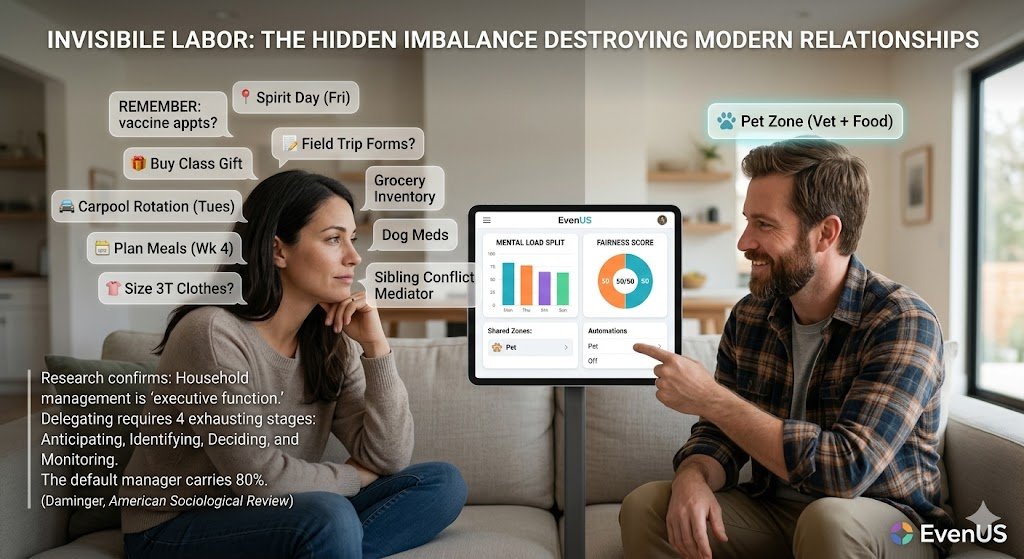
Mark was offering to do the Execution (the cooking). However, as sociologist Allison Daminger explains in her research, execution is only the final stage of labor. Before Mark could cook, Sarah had already performed the three most taxing stages:
- Anticipating: Realizing at 9:00 AM that the chicken needed to defrost.
- Identifying: Mentally auditing the pantry to see if they had pasta or rice.
- Deciding: Choosing a meal that the toddler wouldn’t reject and that fit their 30-minute window between soccer and bath time.
The Shift: Sarah and Mark used EvenUS to assign Mark the “Meal Prep Zone.” This wasn’t just “cooking dinner.” It meant Mark owned the grocery inventory, the meal planning, and the execution. Sarah “deleted” the kitchen from her brain. The 4:30 PM text stopped because the data lived in Mark’s head (and his EvenUS dashboard), not hers.
Story 2: The “Social Secretary” Burnout
The Couple: Priya and David, a socially active couple in their late 30s. The Conflict: David was widely known as “the thoughtful friend.” He never missed a birthday and always arrived with a perfectly chosen gift. Friends praised his “emotional intelligence.” Priya, however, felt a growing hollowness. She was the one who maintained the shared calendar, researched age-appropriate gifts for nieces and nephews, coordinated the RSVPs, and ensured they had a babysitter booked three weeks in advance.
The Research Lesson: The “Social Mental Load”
This is a classic example of Emotional Labor (managing relationships) combined with the Mental Load (managing logistics). David was receiving the “social capital”—the praise and connection—for labor that Priya was performing in the background. Because David never saw the “research and coordination” phase, he assumed these events “just happened.”
The Shift: During an EvenUS Sunday Reset, Priya made the invisible visible. They mapped out their “Social Zones.” David was given total ownership of “Extended Family Relations (David’s Side).” He is now responsible for his own family’s birthdays, anniversaries, and holiday logistics. By using automated nudges, the system prompts David to act before Priya feels the need to “remind” him, effectively ending her role as his social manager.
Story 3: The “Spirit Day” Breakdown
The Couple: Elena and James, parents of a first-grader. The Conflict: Elena forgot it was “Wacky Hair Day” at school. When she saw other kids at drop-off with colored hair and pipe cleaners in their braids, she burst into tears in the car. James was bewildered: “It’s just hair, Elena. It’s not a big deal. Why are you so upset?”
The Research Lesson: The Zeigarnik Effect and “Open Loops”
Elena wasn’t crying about hair. She was crying because of the Zeigarnik Effect—the psychological phenomenon where the brain “loops” on unfinished tasks. Elena’s brain was a browser with 50 tabs open. “Wacky Hair Day” was a tab she had meant to click on but missed.
For Elena, the hair was a signal that her “Operating System” was crashing. She felt that if she forgot the hair, she might forget the inhaler, the tuition payment, or the pediatrician appointment. James didn’t understand because he wasn’t even aware there was an operating system. He was just a passenger in a car Elena was driving through a storm.
The Shift: Elena and James performed a “Brain Dump” in the EvenUS Sunday Reset Hub. James took over the “School Communications Zone.” Now, James is the one who reads the school emails and logs the “Spirit Days” into their shared dashboard. Elena has officially “unsubscribed” from school emails. James now “Anticipates” these events, allowing Elena to finally close that mental loop.
The Lessons for Every Couple
These stories highlight three universal truths that research continues to validate:
1. “Help” is Not Ownership
If you have to ask what to do, you are still adding to your partner’s mental load. True partnership requires Total Ownership—taking a category from “Noticing” to “Completion” without being prompted.
2. Visibility is the Only Path to Validation
Resentment grows in the dark. Most “Helpers” aren’t malicious; they are just unaware. Making the work visible via a neutral tracker like EvenUS removes the emotion from the argument and replaces it with data.
3. Your Brain is Not a Database
The human brain is for having ideas, not holding them. Attempting to manage a 21st-century household using only your biological memory is a recipe for burnout. You need an “External Hard Drive.”
Reclaim Your Story with EvenUS
Your relationship doesn’t have to be a series of “logistical fires” and “invisible burdens.” EvenUS was built to take the stories of Sarah, Priya, and Elena and give them a different ending.
By visualizing the cognitive split, assigning total Zone Ownership, and providing a neutral Fairness Score that accounts for both financial and mental labor, EvenUS moves the weight of the family off one person’s shoulders and into a shared, transparent system.
Stop being the “Manager” and start being a partner. Join the EvenUS community today.
The Research Reference
These real-life dynamics are grounded in the sociological research of Allison Daminger (Harvard University) and the psychological principles of the Zeigarnik Effect.
- Key Paper: “The Cognitive Dimension of Household Labor”
- Published in: American Sociological Review (2019)
- Key Finding: Daminger’s study identifies that the most taxing parts of household management—Anticipating and Monitoring—are almost always lopsided, leading to chronic exhaustion for the default manager.
- Direct Link: Read the full research paper here