
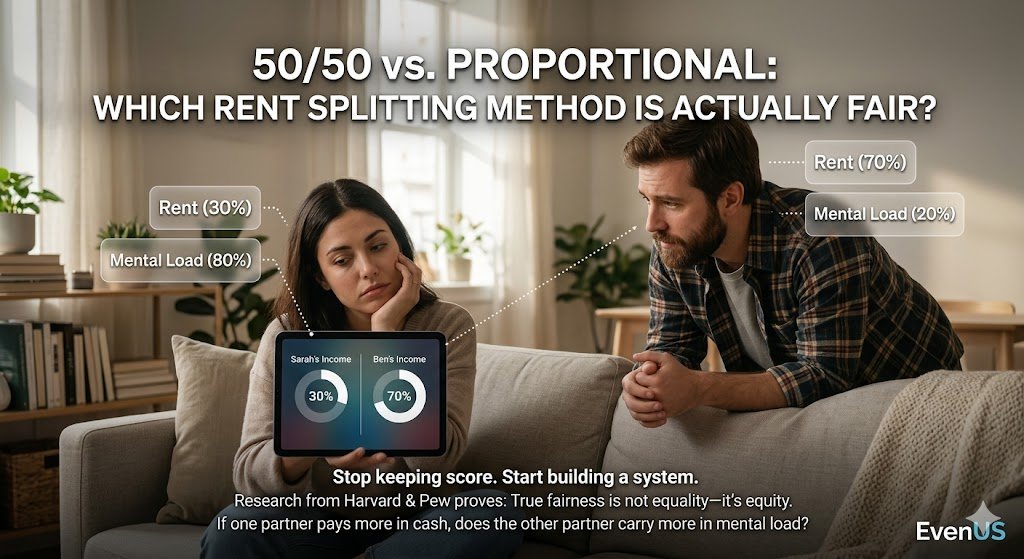
Rent Splitting Method – In the early stages of a relationship, the 50/50 Split is often the default. It’s clean, simple, and feels like the ultimate sign of modern equality. But as a partnership matures—and income gaps inevitably widen—this “equal” model can become a primary source of relationship friction.
What feels like equality on paper often isn’t equity in practice. To build a sustainable financial future, couples must decide which math actually reflects their shared values. Here is the breakdown of the two primary methods and how to choose the one that truly fits your life.
The 50/50 Split: The “Equality” Model (Rent Splitting Method )
In this model, every shared expense—from the monthly rent and electricity bill to the weekend grocery run—is divided exactly down the middle. It does not factor in what each partner earns, their existing student debt, or their individual financial goals. Essentially, it is the exact financial system you would use with a roommate.
While this model feels incredibly fair in the early, independent days of dating, it often buckles under the weight of long-term cohabitation when permanent income disparities come into play.
The Pros: Why 50/50 Feels Right at First
- Ultimate Simplicity: There is no complex math, no need for ongoing “income tracking,” and no awkward monthly conversations about who received a bonus or who had their hours cut. At the end of the month, you divide the shared bills by two. It requires zero administrative oversight.
- Total Financial Independence: Both partners feel they are pulling their own weight entirely. This bolsters a strong sense of individual agency and pride, which is especially important for partners who highly value their self-sufficiency and don’t want to feel like they are “relying” on someone else.
- Prevents Traditional Power Imbalances: By paying exactly half, this model actively avoids the outdated “provider and dependent” dynamic. Both partners feel they have an undeniable, equal voting right in household decisions—from what couch to buy to what neighborhood to live in—because their financial contributions are identical.
The Cons: The Hidden Cost of Strict Equality
- The “Lifestyle Floor” Friction: Because expenses are split evenly, the couple is mathematically forced to base their lifestyle on the budget of the lower earner. This creates a painful, unspoken dynamic: either the higher earner feels frustrated and “held back” from the lifestyle they can comfortably afford, or worse, they push for a lifestyle upgrade (like a luxury apartment or expensive vacations) that stretches the lower earner to their absolute financial breaking point just to keep up with their “half.”
- The Disposable Income Disparity: This is where the 50/50 model can actively harm the financial future of one partner. Let’s look at the math: If Partner A earns $100,000 and Partner B earns $50,000, and they split a $2,000rent evenly, they each pay $1,000.
- For Partner A, that $1,000 is a highly manageable expense. They have thousands of dollars left over each month to max out retirement accounts, invest, and fund personal hobbies without stress.
- For Partner B, that $1,000 consumes a massive percentage of their post-tax take-home pay. After paying their half of rent, utilities, and groceries, Partner B has virtually zero disposable income left for personal savings or emergencies.
- The Result: Over the course of a five-year relationship, Partner A builds substantial individual wealth, while Partner B stagnates or quietly goes into credit card debt just to survive the shared relationship lifestyle.
The Proportional Split: The “Equity” Model
If the 50/50 model is about treating partners identically, the proportional model is about treating them equitably. This method adjusts financial contributions based on each partner’s actual earnings. Instead of paying the same dollar amount, both partners effectively pay the same percentage of their income toward shared living expenses.
As couples merge their lives, adopt pets, or move into spaces that reflect their combined goals, this model is widely considered by financial planners and relationship experts to be the most sustainable path forward.
The Math: How Proportional Splitting Works
Unlike the static 50/50 split, proportional math requires you to find your “Income Ratio.” Let’s say Partner A earns $70,000 a year, and Partner B earns $30,000. Their total combined household income is $100,000.
- Partner A brings in 70% of the total income.
- Partner B brings in 30% of the total income.
If their rent is $2,000 a month:
- Partner A pays $1,400 (70%).
- Partner B pays $600 (30%).
The Pros: Building a True Economic Unit
- The Shared Financial “Pinch”: This is the core benefit of the proportional split. Because contributions are based on ratios, a $2,000 rent impacts both partners’ lifestyles equally. Both partners feel a similar level of “pinch,” preserving comparable financial freedom for personal spending, hobbies, and individual wealth-building. Partner B is no longer bankrupted by Partner A’s preferred lifestyle.
- Mitigates Long-Term Resentment: Research by sociologists consistently shows that couples using proportional systems report higher relationship satisfaction and lower divorce rates. Why? Because the lower earner retains financial autonomy and isn’t constantly stressed about making rent, while the higher earner gets to live in the home or neighborhood they actually want without feeling guilty for “forcing” it on their partner.
- Reflects a True Partnership: It shifts the mindset from “roommates sharing a bill” to a single economic unit working toward shared life goals. It acknowledges that income disparity is a reality of the modern economy, not necessarily a reflection of how hard someone works.
The Cons: The Emotional and Administrative Hurdles
- The Transparency Requirement: To make this work, couples must be completely financially naked with each other. It requires total honesty about base salaries, end-of-year bonuses, freelance income, and sudden job losses. For couples who value strict financial privacy, this level of disclosure can feel invasive.
- The “Punished for Success” Resentment: The higher earner may occasionally feel frustrated that they are subsidizing the lifestyle of their partner. If Partner A worked grueling hours to earn a promotion, they might feel resentful that their hard-earned raise immediately translates to paying a larger share of the electric bill, leaving them feeling like they have “less” of their own money to show for their success.
- Administrative Complexity: A 50/50 split is easy to do in your head. A proportional split requires a spreadsheet, regular math, and active adjustments whenever someone gets a raise, takes a pay cut, or changes careers.
The Ultimate Fix: Automating Equity with EvenUS
The biggest irony of the Proportional Split is that trying to make your finances “fairer” often creates more invisible labor. Someone has to build the spreadsheet, track the changing incomes, calculate the percentages, and remind the other person what they owe.
In most relationships, that administrative burden falls on the partner who is already managing the household’s Mental Load. You fix the financial imbalance, but you inadvertently increase the cognitive exhaustion.
To achieve true equity without the administrative headache, couples need a system that manages the math for them.
Enter EvenUS: The Household Operating System for Couples
Fairness isn’t just about who pays for the groceries; it’s about who planned the meals, who drove to the store, and who remembered the dog food. EvenUS is the only app built specifically for couples that integrates your financial contributions with your cognitive and physical labor to reveal the big picture.
Here is how EvenUS eliminates the friction of splitting rent and sharing a life:
- The Automated Proportional Split: Ditch the spreadsheets. You and your partner simply input your incomes, and EvenUS automatically calculates your fair, proportional percentage for shared bills. No math, no manual adjustments, and no awkward monthly check-ins.
- The Holistic Fairness Score: EvenUS recognizes that a partnership is more than a bank account. If Partner A is paying 70% of the rent, the EvenUS dashboard can help Partner B take on 70% of the household “Zones” (like meal planning or pet care). The app calculates a total Fairness Score that validates both financial power and invisible labor.
- Neutral Nudges: Instead of one partner having to nag the other for their half of the rent or remind them to take out the trash, EvenUS sends automated, neutral nudges. The app becomes the manager, allowing you both to just be partners.
A sustainable relationship requires more than just good intentions; it requires a good system. By visualizing the split and automating the execution, you can stop keeping score and start building a life together.
Ready to find your true balance? Download EvenUS and discover your Household Fairness Score today.
The Core Research on the “Mental Load”
Title: The Cognitive Dimension of Household Labor Author: Allison Daminger (Harvard University) Published In:American Sociological Review (2019) Why it supports your article: This is the landmark study that officially breaks down invisible labor into the four stages we used in the article (Anticipating, Identifying, Deciding, Monitoring). It provides the academic proof that the “thinking” work is overwhelmingly carried by women and leads directly to executive burnout.+1
- Credible Link: https://journals.sagepub.com/doi/10.1177/0003122419859007